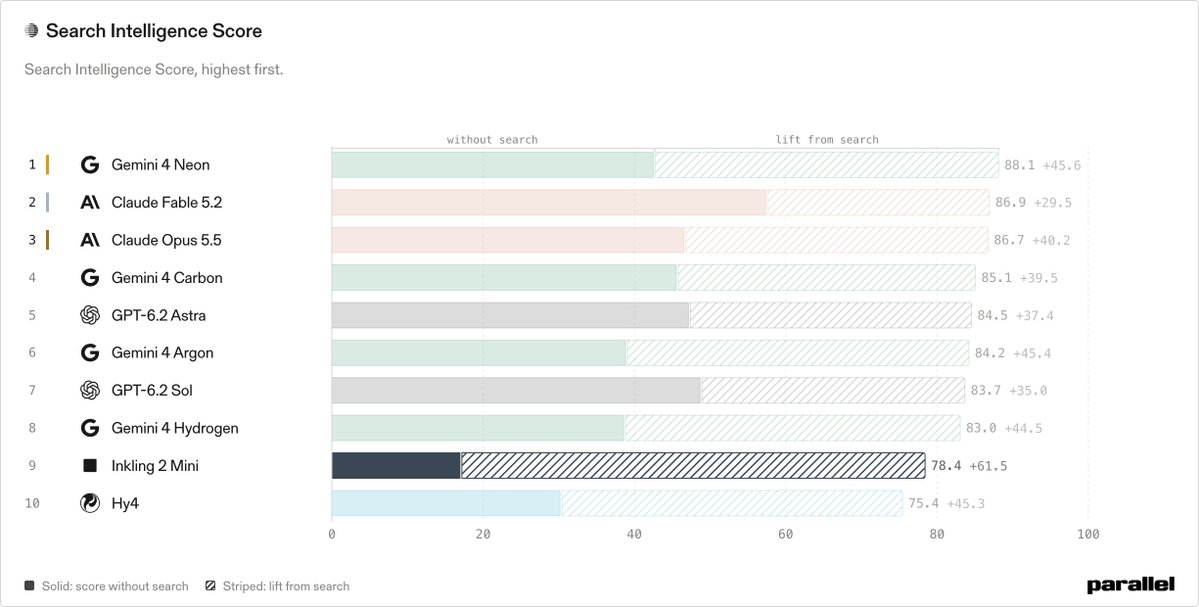
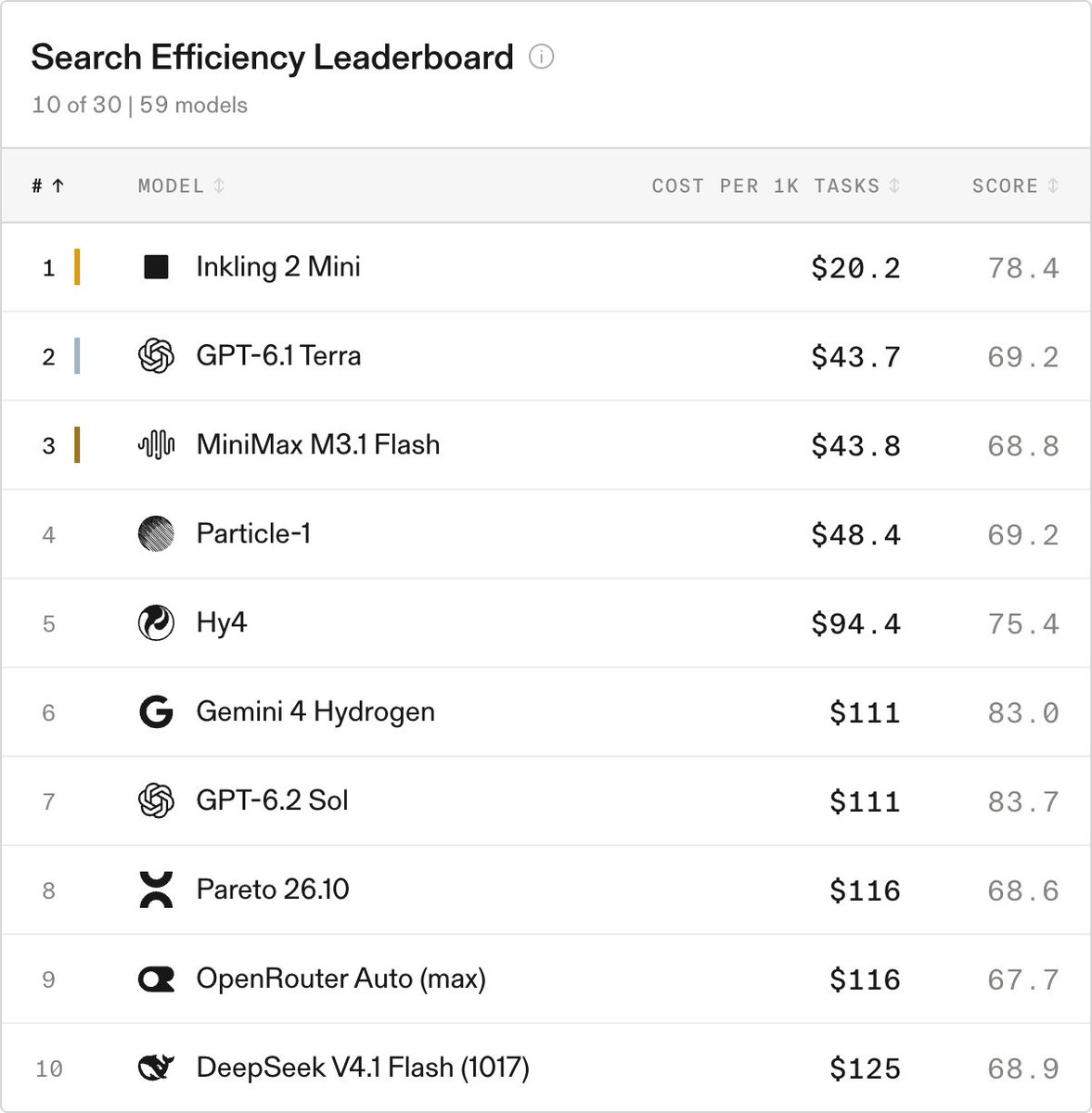
NEW: Inkling 2 Mini is the most efficient model we've tested:
- #1 on efficiency (cost vs. intelligence)
- #9 on intelligence (78.4) overall
- #1 on intelligence among open-weights models
- Lowest cost per correct answer ($25.80)
- Biggest accuracy gain from adding web search
It uses a looped transformer, which runs its middle layers three times for every token. That lets a 26B-parameter model reason more without generating more tokens, which keeps costs low. A model that size can't store as many facts, so it relies on search to fill the gaps, and that's where it gains the most.
last october I wrote this after @karpathy's dwarkesh interview. the core idea: a model can pull from memory in its weights or from retrieval- that choice shapes both cost and quality. facts stored in weights are expensive and lossy - they use capacity that could go to reasoning. so keep the model lean and good at reasoning, and let retrieval infrastructure externalize memory. that intuition is a big part of why we started parallel
pretty cool to see it actually playing out. @thinkymachines machines just released inkling 2 mini: 26B parameters, 3.4B active, small enough to run on a laptop. it loops its middle layers to get more reasoning out of the same weights, without adding room for facts. their own writeup says it makes up the knowledge gap with search and tools
our search benchmark validates this: it scores 16.9 without search and 78.4 with it, the largest lift from search we've measured
that's within 10 points of the top frontier model at about a tenth of the cost: $20 per 1,000 tasks vs $206
Exa claimed to beat Parallel on FinSearchComp T3 by 2 questions out of 84
So we reran it in Exa's own harness
The Parallel Fast got more answers right in all 5 runs, averaging 58.8% vs. 54.0% at 82.5% lower cost per question ($0.0087 vs. $0.0496).
parallel is dominating 3rd party and industry-specific benchmarks:
- #1 on AA search index + pareto optimal
- #1 on @ValsAI web search index
- #1 on range of benchmarks for finance, legal, healthcare/bio
Introducing Parallel Image Search, the first image search engine designed for agents.
Send keyword queries plus a plain-English objective describing the image you want.
Starting at just $1 per 1,000 requests. Available via API and Parallel MCP.
Get 5,000 free monthly searches: https://t.co/SL0DREZGHk