Today, we’re launching Airpost.
I’m 46. That’s not a cool age to found a startup. At least according to Twitter. I still call it Twitter.
I’ve loved advertising all my life. Since I was 19 and my mom told me about a movie called “Nothing in Common” with Tom Hanks where he plays an ad exec whose main job seems to be shooting hoops with his creative partner. That sounded fun.
Since then, traditional advertising has stayed… traditional.
From my 1st job out of college writing TV ads for Snapple and Fox Sports, to leading product marketing at Airbnb, I’ve seen a lot. Now the AI era is here and an entire $1T industry is about to change. Who will change it?
Why not me? Why not us?
Introducing Airpost: a platform and service where world-class creative strategists use custom-built AI to build video ads. Fast.
If you’ve ever sat down to make an ad with AI and realized 20 minutes later you’re still wrestling with that same clip… that’s why we built Airpost.
Growth teams are busy. They’re asked to do too many things as it is. They shouldn’t have to be AI experts as well. Creative strategists shouldn’t have to stare at a white box trying to decide what to prompt. They should have a partner. That’s what we aspire to be. And that’s what we’ve built our tech to do.
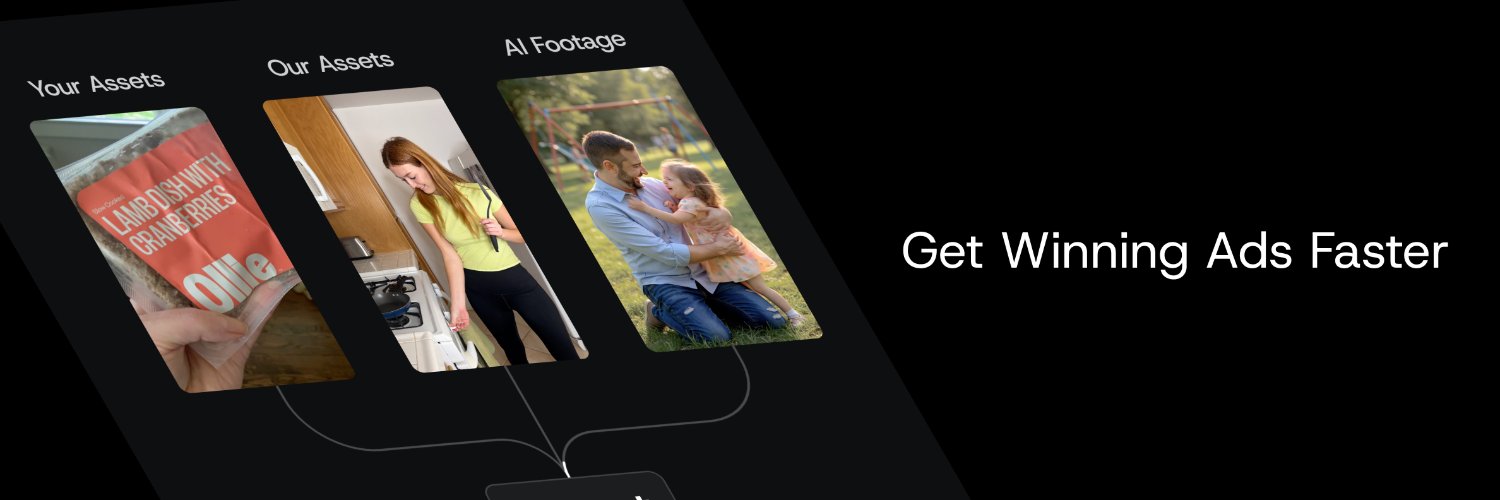
AI ads shouldn’t have to mean only AI footage. We have an exclusive library of over 300,000 video clips we’ve shot ourselves. Our engine uses these, along with client footage and AI footage to make the ads we deliver each week.
We’re funded by the best investors and humans we know. We bootstrapped our performance creative agency, Ready Set, to 200 people. I was always told VCs didn’t add value. If that’s true, it must be other VCs, because ours have been awesome. Thank you Zach Perret, Nate Abbott, Peter Hebert, Max Mullen and all of the firms and folks who’ve believed in us so far.
We’ve gone from 0 to $1M ARR in the six months since we quietly started working with early clients like DoorDash, Dr. Squatch, Calm and more.
So far, every customer has renewed.
To celebrate the launch, we’re giving away a superagent where you:
1) Put in your product URL
2) Get snippets of what your real users are saying on Meta, TikTok, Reddit and X
3) Paste them into ad scripts
Comment “Airpost” and I’ll DM you the private link.
It feels (a little scary but) good to be out there.
Here we go! 🚀
Am I the only one that doesn't get these vibe coding ads? And I spend most of my days vibe coding.
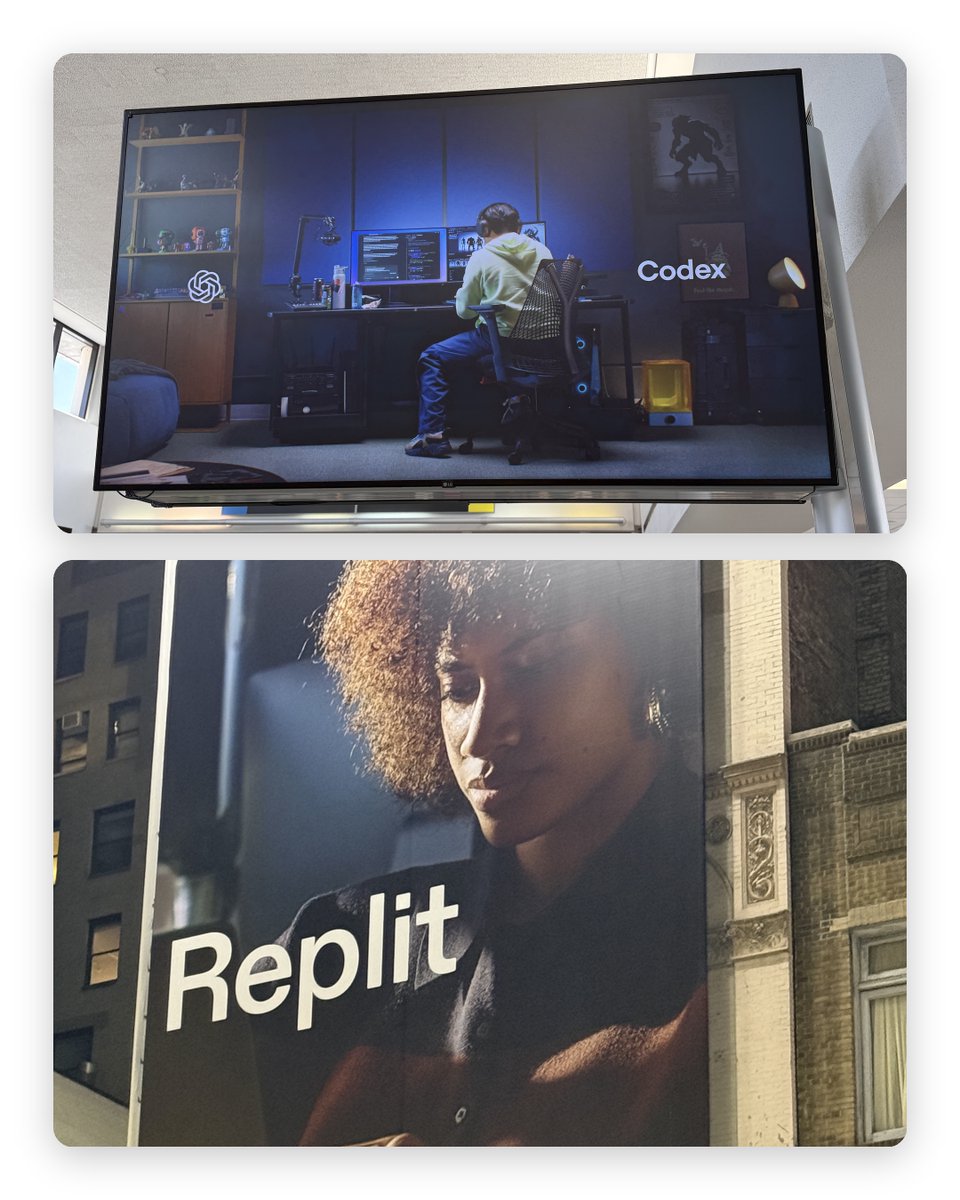
Snapped these in Times Square and at the airport. Both are just people working quietly at their computer. The OpenAI one is video, just the guy typing from far away.
Is there some deep meaning/point here that I'm missing? I know we're not supposed to like ads that tell you something differentiated about the product, but I kind of prefer that.
Codex is not a pair of jeans.
Continuing my coast-to-coast Airpost Full Performance Loop AI-demo-palooza at the Meta Agency Summit in NYC today. That was also my new record for hyphens in a sentence.
We've spent millions and have 18 amazing FT engineers building a first-of-its-kind (more hyphens!) tool and service.
It's like Motion, if Motion could make ads.
If you're an agency at the Meta Summit today I'd love to demo it for you! just dm me.
New @axios:
Exclusive: Hands on with ChatGPT images 2.5. The new editor is faster, better with staying true to faces and adds sketching and other editing tools
Claude Code is taking so much longer to do things.
Which means I'm taking so much longer to do things.
I used to have 10-12 "pots" going all around me (glowing dots in Claude Code.) I would run around and tend to each one/move them forward.
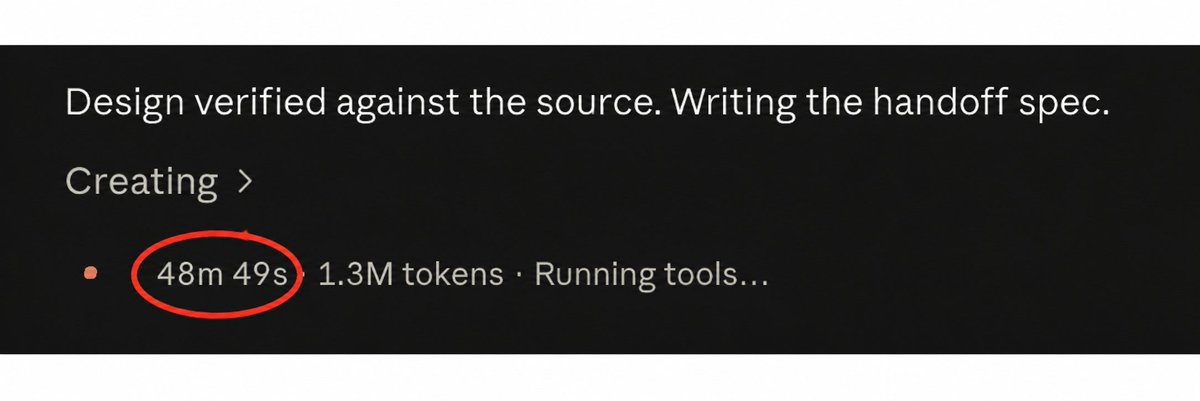
Now they all need 45min (sometimes 2-3hrs!) to think through everything.
I find myself staring at the screen with no pots to check on.
I'm using Codex in addition to my personal and work Claudes but it's still all so slow.
And I'm afraid to use Fast Mode because I think it will be less smart.
Anyone else noticing this trend?
Also it's expensive! I set something up where for every prompt it tells me how much it will likely cost. Highly recommend doing this. Sometimes it's like "This will be $18-45." I imagine I'm going to have to hand someone next to me $40 if I hit go.
Yes my 5-hour window filled in under 25min. It led me to an idea. I built something into my claw code that predicts how much money whatever I’ve just prompted is going to cost me in tokens, and asks me if I want to move ahead or move ahead with a leaner version. So far it's fast and has helped a lot.
30 features of an AI native company:
1) Function-by-function process blueprint of your entire business.
2) Everyone in org using a daily driver harness like Grok Bot, Claude Cowork, ChatGPT at Work.
3) Centralized intelligence layer that aggregates structured and unstructured data, documents, and business logic into a single source of truth that is queryable & agentic work can be done on top of.
4) Model routing via OpenRouter, Ramp, etc that optimizes cost-per-successful-task across the business.
5) Treat context as code, ensuring architecture documents and conventions remain updated while allowing for diligent upfront planning.
6) Willing to throw away everything that you've built every three months and reimagine all your workflows.
7) A “skills distribution system” is used to manage agent behavior and optimize for token efficiency by ensuring developers trigger consistent skills throughout their workflow.
8) Separate technical implementation from high-level specifications, enabling non-technical staff to contribute in a format that agents can utilize to build technical implementation plans.
9) A key software metric is “cost per accepted PR”, with a focus on driving these costs down through better token efficiency.
10) An automated, agent-native development system where fleets of AI coding agents handle planning, writing, testing, reviewing, and shipping code while humans define the intent and acceptance criteria.
11) Heavy planning with higher-effort models and executing with cheaper, faster models.
12) Agent harness that uses CLI tools to parse metadata within markdown files to traverse dependency relationships, allowing agents to be granular in their input token usage.
13) Finance org that runs processes continuously in accounting (record-keeping) to re-define/reset forecasts on a much, much tighter cadence.
14) Financial models embedded in the underlying OS across the org to help drive reasoning.
15) Citizen Developer SDLC where non-technical employees can take a solution from idea to production with governance, access, versioning, and software conventions built in.
16) Closed loop, self-improving non-engineering workflows that learn from previous runs based on external performance metrics or internal evals.
17) AI ROI framework that includes experimental phase, scaling phase, and optimizing phase with bets sitting in 3 buckets: infrastructure, innovation, and efficiency.
18) Paid marketing motion that uses agent swarms to deploy thousands of pieces of creative for testing, before increasing spend on human-generated ads.
19) AEO/SEO engine that audits, rewrites, and (ideally) generates SEO/AEO-optimized blogs on a weekly basis, and then measures if any of it worked.
20) Agentic cyber security solution that fights AI with AI.
21) Combo of RL gym and first-party data to fine-tune open source models on high-volume processes that need SOTA performance at reasonable cost.
22) Human touch and judgement gets reserved for the first and final mile of most processes.
23) Evals are core infrastructure of your business. Anytime new models come out you have an apparatus for testing cost & performance against core processes.
24) Everyone is a builder. Especially C-level execs.
25) Everything gets recorded because what you don’t capture can’t be turned into ai-enabled work.
26) Legal, HR, and IT work in lockstep with owners of AI agenda so that business’ ass is sufficiently covered without slowing down transformation.
27) Bias to disrupting yourself before being disrupted by others.
28) Guardrails before features. Agents inherit the permissions of whoever is asking, enforced in the data layer.
29) Earned autonomy. Feedback feeds the evals that gate each new version, and agents move up a ladder as they clear it: observe, suggest, act with approval, act alone. The endpoint is agents running whole workflows inside a defined boundary, with humans setting the standard instead of checking every answer.
30) Traceability as the training signal. Trace every output to its prompt, model, data, and approver, so human feedback attaches to something specific rather than a vague sense that something is off.
What's missing?
California is adding sales tax to SaaS starting Jan 1
😥Not sure they could have picked a worse time
- 7.25% state + local district taxes, so 8-10% for most customers
- Every CA-based customer you have is getting a price increase you didn't send
- And if you're based here, your entire software and AI budget goes up 8-10% in 2027
Stacks on top of vendor uplifts. A 7% renewal increase becomes 16%.
👉Custom software and AWS-style infrastructure are excluded
🤷Nobody knows yet where usage-based AI spend lands.
@awilkinson@nickgraynews Only if they make it work across every surface and blinking cursor as fast as a button push. Apple has been working on Siri for more than 20 years and still terrible.