We've spent years trying to get healthcare systems to exchange information, which is essential. But two systems sharing perfectly synchronized, outdated information still don't know what's happening to the patient today. Interoperability without real-world feedback is only half the solution.
https://t.co/WvV5LqYmU1
Women aged 48 to 92 with good blood vitamin C levels were stronger than women with low levels, with a firmer grip for their height, faster walking and quicker rises from a chair.
Vitamin C helps build collagen and protects muscle from oxidative damage, and earlier work in the same English population pointed to a link with muscle. In more than 13,000 men and women aged 42 to 82 from the EPIC-Norfolk study, people with enough vitamin C in their blood carried a little more of their body weight as muscle than people with too little, a small edge in men and roughly twice that edge in women.
That study looked at muscle size. The same research group has now looked at how well people actually move. They analysed more than 5,000 adults aged 48 to 92 from EPIC-Norfolk, measured vitamin C in their blood, and grouped them as low, in between or good. They then tested grip strength, walking speed and how long it took to stand up from a chair five times in a row, taking lifestyle, health and diet into account.
1. Women with good vitamin C levels walked noticeably faster than women with low levels, covering about 22 extra feet for every minute of walking, which is roughly the length of a living room.
2. Women with good levels also got up and down from a chair five times about a full second quicker, and had a stronger grip for their height.
3. Men showed a smaller version of the same pattern, covering about 10 extra feet per minute of walking and finishing the five chair stands a little under a second quicker.
Taken together, the evidence points toward low vitamin C as a marker worth avoiding in later life. Blood levels showed a clearer link than food diaries did, especially in men, where diet records alone showed nothing. Fruit and vegetables remain the main way most people keep their levels up.
The study took one snapshot in time, so it cannot show whether low vitamin C came before slower movement or the other way around. People with good vitamin C levels may also have other healthy habits. It measured blood levels, not the effect of taking supplements, and the authors call for longer studies and trials.
References
Scott J et al., Calcified Tissue International, 2026
Lewis LN et al., Journal of Nutrition, 2020
We've spent years trying to get healthcare systems to exchange information, which is essential. But two systems sharing perfectly synchronized, outdated information still don't know what's happening to the patient today. Interoperability without real-world feedback is only half the solution.
https://t.co/WvV5LqYmU1
The most provocative question here is: who actually owns the patient's journey after discharge? The hospital owns the discharge, the home health agency owns the visit, and the physician owns the follow-up. But nobody necessarily owns the gaps between them. #health#healthcare
https://t.co/A6MhlQMUJk
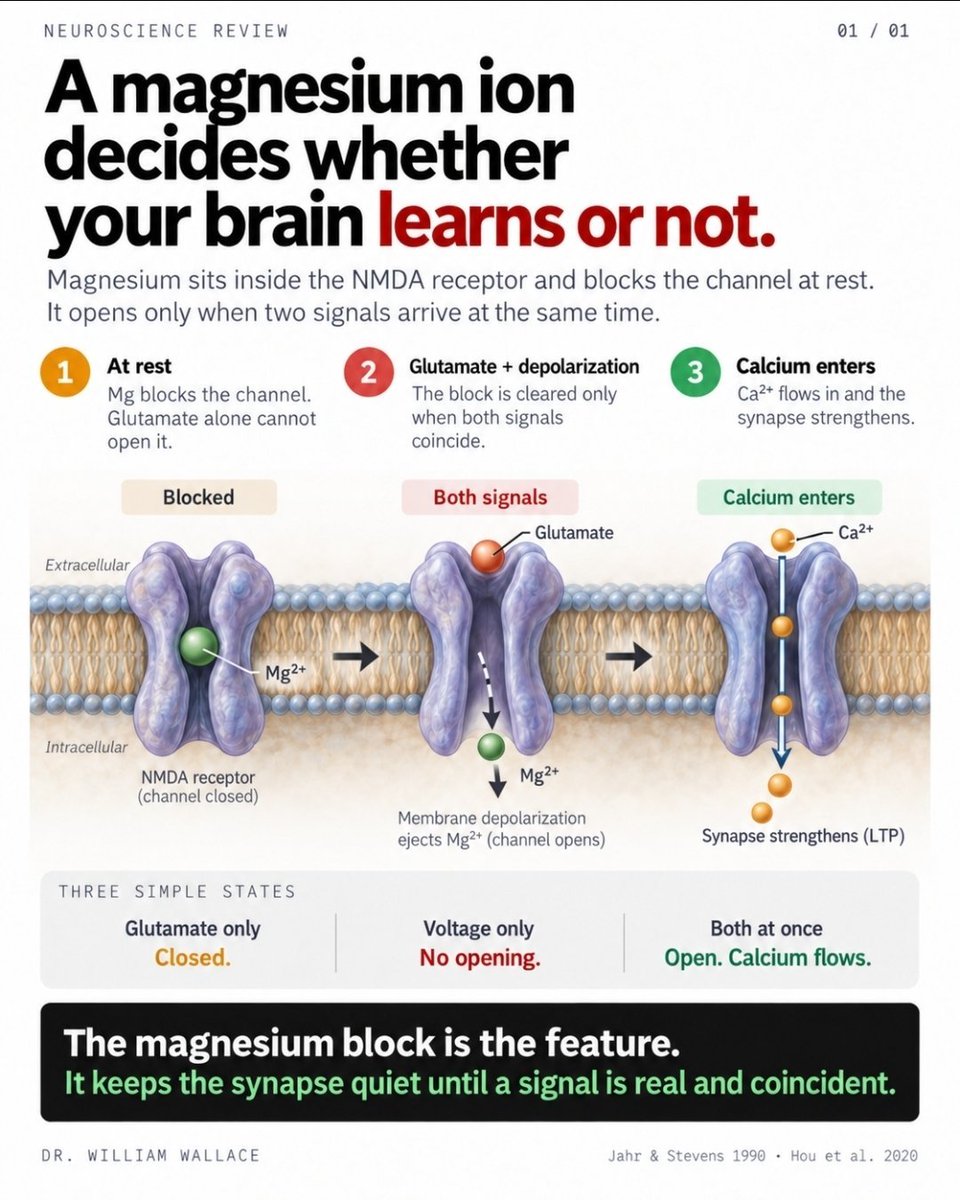
There is a magnesium ion sitting inside one of the most important channels in your brain, and it spends most of its time blocking it. That is not a malfunction. That block is how your brain decides what to learn.
The channel is the NMDA receptor. It is central to learning and memory, and it has an unusual rule for opening. Glutamate, the brain's main excitatory signal, has to bind to it. But binding alone does nothing, because a magnesium ion is physically lodged in the pore, plugging it shut. The only way to clear that plug is for the neuron itself to already be active and electrically depolarized. Glutamate plus voltage, at the same instant, pops the magnesium out.
So the receptor only opens when two things happen together: an incoming signal and a neuron that is already firing. That makes it a coincidence detector. It is the molecular version of "these two things are related," and that is the cellular basis of learning. When it opens, calcium floods in, triggers an enzyme called CaMKII, and the synapse gets stronger. Strengthening that connection is, quite literally, the physical act of learning something.
The magnesium block is the gatekeeper for the whole process. It keeps the channel silent until the signal is real and coincident, so the brain strengthens what matters and ignores random noise.
This is where it gets interesting. That same block also acts as a brake on overexcitation. When magnesium is low, the brake loosens and these channels become easier to open with less provocation. At the mechanism level, that means the threshold for excitation drops. This is a clean, well-established piece of biochemistry. It is also exactly the kind of mechanism that gets oversold, so be careful with the leap from "magnesium gates NMDA receptors" to "magnesium fixes anxiety." The gating is real and rigorous. The clinical claims downstream of it are a separate, much messier question.
What is not in doubt: a single magnesium ion sitting in a channel is one of the most elegant control switches in human biology, and it is running quietly in your head right now.
Jahr & Stevens, J Neurosci, 1990
Hou et al., Mol Neurobiol, 2020
The most provocative question here is: who actually owns the patient's journey after discharge? The hospital owns the discharge, the home health agency owns the visit, and the physician owns the follow-up. But nobody necessarily owns the gaps between them. #health#healthcare
https://t.co/A6MhlQMUJk
Dry skin or oily? 💦🌵Acne-prone or anti-aging? Take our 30-second skin type quiz, have the perfect routine customized for you, and save 10% OFF your next Dr. Bailey Skin Care order.
https://t.co/tXWJysD72o
Many have asked about when the Vitiligo Clinic will start at Mass General Brigham. It's here!
Dr. Rashighi is scheduling vitiligo patients to be seen starting next week, and I will start in just a few months. Call to schedule an appointment.
Announcing:
The Geriatric Dermatology Society
https://t.co/8iUP580sAo
Thanks to leadership from medical student lead Shreya Sreekantaswamy from @UofUMedicine
We hope this serves as a collaborative platform for research, clinical, educational advancement. #dermtwitter
Be careful with what you find on social media. Some of the advice against using #sunscreens can be harmful to your skin. Be #sunsmart and avoid #TikToxic information. @VCHResearch @UBCmedicine @BCCancer https://t.co/f1nagCArTF
Several headlines lately have suggested topical isotretinoin as an alternative to oral isotretinoin (Accutane). In this video, I share a deep dive of the evidence to answer if topical isotretinoin really could be an alternative and if we should use at all
https://t.co/n4BjNPuyOA
We need to convince our youth to stop engaging in risky sun behaviors. A tan represents DNA damage and leads to skin cancer and premature aging. There is nothing healthy about sunburns and tan lines. Thanks for the interview! https://t.co/Fg0NyQlq4R
Excited to invite @RoxanaDaneshjou to @CedarsSinai and hear how she is pushing the boundaries of dermatology with improving image acquisition and reducing bias in datasets and AI models! @james_y_zou@StanfordMed