Kairos Open Beta is here.
Your edge is how quickly you turn information into a trade.
Live market data, satellite data feeds, and ultra-fast sports updates, alongside best-price execution across venues. From spotting the opportunity to trading it, all in one terminal.
Trade on Kairos.
Introducing the Kairos × @Polymarket × @TXODDSOfficial Trading Championship.
$30,000
Top traders.
Top creators.
Four Prize Pools.
Bet on your favorite participants directly on Polymarket, or climb the ranks on Kairos and get featured yourself.
Think you can outperform the market?
Details Below:
Privy CEO @sternhenri sees three big trends in stablecoins and the blockchain growing in the future:
"First, we're going to see a rise of non-dollar stablecoins as more people embrace them."
"Second, I've heard of a few projects that are trying to have an inflation stablecoin. The stable actually grows with inflation, so that you're on purchasing power parity. I think they're really hard to instrument and get quite right, which is why I don't think they've taken off just yet."
"Third, there's a company called Pearl that is finding a way to do fast matrix multiplication and back a blockchain on this, so you can issue tokens based on how much compute you've got ready to do useful inference. So there was a question for me of, what other useful work could you back the currency on?
These numbers are staggering:
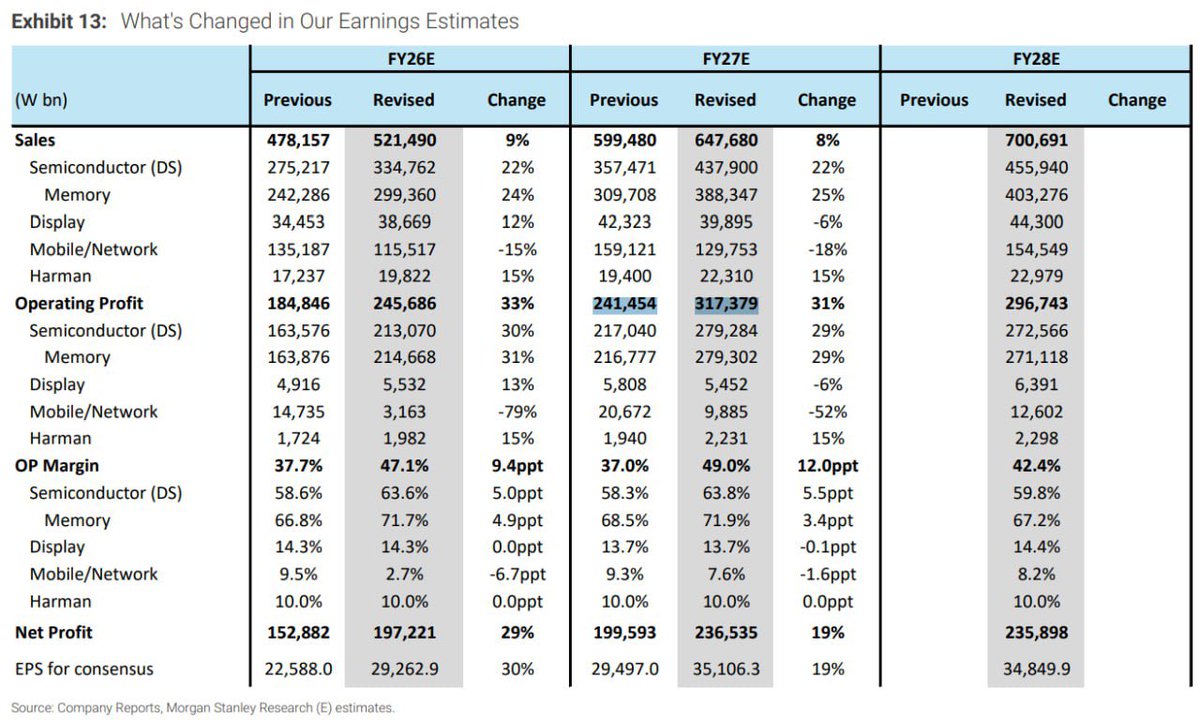
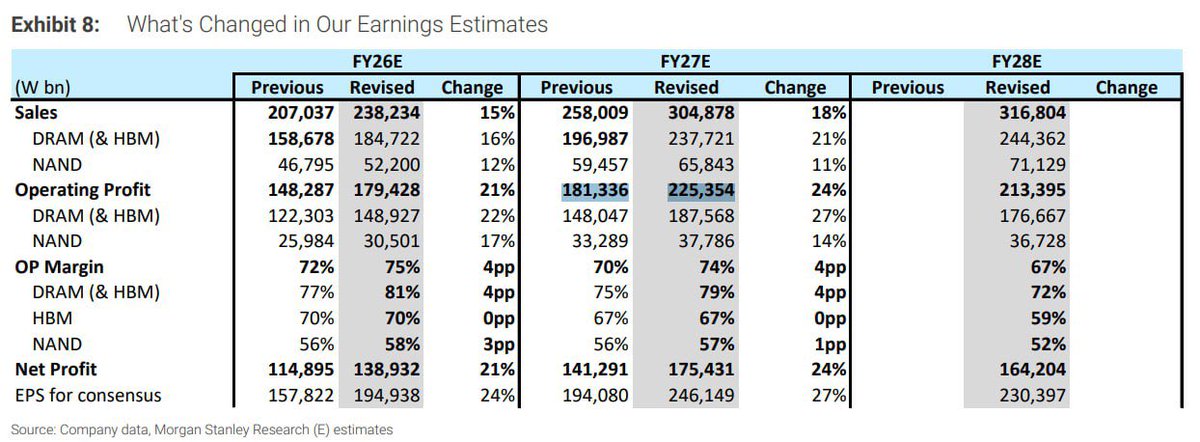
Samsung and SK Hynix are projected to become the most profitable companies in the world by 2027.
Their projections exceed $APPL and $GOOGL, both ~$4T companies in operating profit.
For reference, Samsung is valued at ~$820B and SK Hynix is valued at ~$410B.
That would make a ~$410B company in SK Hynix more profitable than $GOOGL ($3.7T) in 2027.
By Morgan Stanley estimates earlier, SK Hynix and Samsung are est. to bring in:
~$387.7 Billion USD combined operating income.
America’s two most profitable companies $APPL and $GOOGL combined brought in $263 Billion USD for 2025. (Google $129-132B, Apple $133.1B)
2027 est.
Samsung Electronics: ~$226.7 Billion
Sk Hynix: ~$161.0 Billion
2027 est:
Apple: ~$156B-$165B
Google: ~$168B-178B
The statistics of smaller Korean equities exceeding multi trillion dollar US hyperscalers in profitability is staggering.
It’s a genuinely interesting point, that a $410B company exceeds $4T+ hyperscalers in profitability.
But the bigger question markets are pricing in is if the memory shortage is ephemeral, or if they become a necessary “Oil” like GPUs for the AI buildout.
If your answer to that is “likely, might be good to get exposure to Korean, Japanese, or Taiwanese equities.
If I were a16z, yc, or sequoia, I’d be aggressively investing in startups that are building novel ways to collect and annotate real-world data.
> Billions of hours of driving data
> Factory workers interacting with appliances and heavy machinery
> Audio segmentation with deep dialectical and cultural understanding
> Wet-lab experimental data
> Continuous collection and annotation of agent traces at compute scale
When we built LLMs, most of the data already existed on the internet. We just had to scrape, clean, and scale. But as we move toward world foundation models, the bottleneck is high-quality, real-world, well-annotated data.
And annotation quality matters. There’s a massive difference between:
“Apple on a tree”
and
“Ripe apples on a tree. The wind is blowing at 2 miles per hour. The temperature is around 18°C.”
The question is simple. How much of the world can you actually capture?
Today, LLMs know that apples fall because of gravity, not because they understand causality, but because they understand language correlations extremely well. Understanding the causal structure comes next.
If I were building towards that future, I’d anchor data collection in India and other South and Southeast Asian regions. I’d deploy hardware, collect thousands of hours of human activity data, health signals, and vitals, and run annotation pipelines continuously. Day and night.
If I were a16z, I’d fund founders to do this.
I might just have the urge to do it myself.
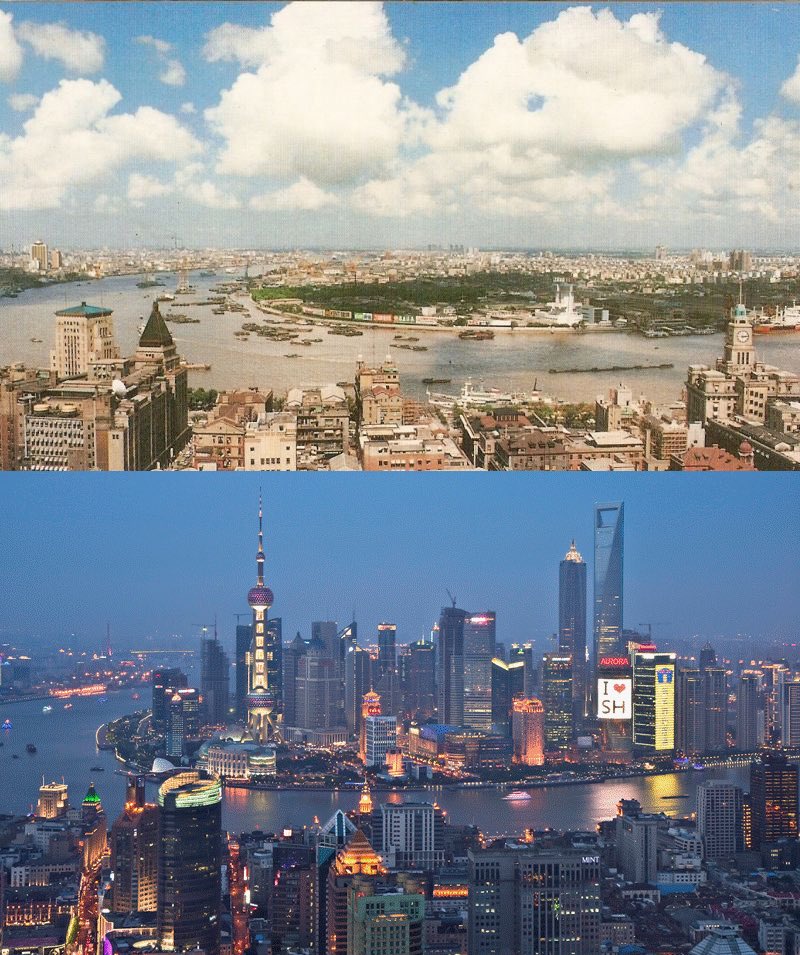
Notably absent: places like Warsaw, Dubai, Riyadh, Shenzhen, Bangalore, Singapore, Ho Chi Minh City, and Shanghai.
That’s why many Americans aren’t calibrated on the world outside the West. They aren’t flying there, and they aren’t seeing it on their TVs.
So the rise is invisible, despite being all too visible.
Larry Page learned about DeepMind because he was on a jet with Elon who was showing a different friend the AlphaGo demo
Zuck tried to buy DeepMind for $800m, Elon offers 5% of Tesla, but Larry beat him by letting Demis stay in London
Like 5 ppl have shaped 30 yrs of tech, nuts