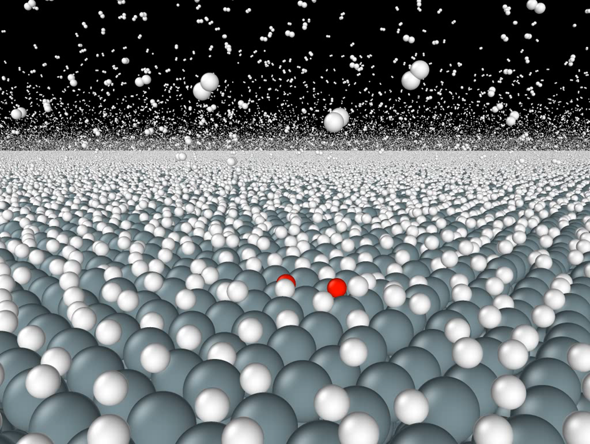
Our work on machine learned reactive force fields is now out in @NatureComms!
We show they can be trained automatically and mapped onto polynomial models that are 2x faster than ReaxFF 🔥
Paper: https://t.co/Ml1ypck8TK
Code: https://t.co/tZnzB6ri6c
@littmath Solution: Let h_{m, N} be the number of outcomes in an N-toss game with m the diff between Bob and Alice's scores, final toss heads. Similar def for t_{m, N}. Easy to show the following recursion relation:
h_{m, N+1} = h_{m+1, N} + t_{m, N}
t_{m, N+1} = h_{m-1, N} + t_{m, N}.
@littmath Here are the probabilities out to N=1000 tosses. At N=100, Bob has a ~48.6% chance of winning, Alice has a ~45.8% chance, and there is a ~5.7% chance of a tie. But Bob's edge diminishes as the number of tosses increases.
FLARE is powering simulation AI on Microsoft Azure Quantum, with AiiDA... Hope we get new materials faster! Thanks to amazing developers at MIR: Jon Vandermause, Yu Xie, Anders Johansson, Steven Torrisi, Lixin Sun, Andrea Cepellotti, Simon Batzner, Cameron Owen, David Lim.
Our work on machine learned reactive force fields is now out in @NatureComms!
We show they can be trained automatically and mapped onto polynomial models that are 2x faster than ReaxFF 🔥
Paper: https://t.co/Ml1ypck8TK
Code: https://t.co/tZnzB6ri6c
Reactive ML molecular dynamics of 0.5 Trillion atoms on 27,336 GPUs with autonomous active learning + uncertainty + record speed + first principles accuracy that matches catalytic activity measurements https://t.co/9lBHTSKv02 @OLCFGOV
We apply FLARE mapped force fields (@Materials_Intel
) to fit fast-and-accurate machine learning potentials, and we adopt unsupervised machine learning to characterize the "phase" of atoms at the surface and in the inner part of Au nanoparticles at different temperatures. 2/4
It's a pleasure to share with you our latest article on Au nanoparticle melting appearing in @NatureComms https://t.co/fGJjwpAR0Q…
A fantastic collaboration with @_RossiKevin, T. Pavloudis, J. Kioseoglou, S. de Gironcoli, R. E. Palmer, & F. Baletto. 1/4
Published now in @ACSChemRev - "Gaussian Process Regression for Materials and Molecules", an introduction to GPR #MachineLearning methods as applied to #compchem & materials science. Openly available at https://t.co/ppKNRwCO6F (1/5)
After a tremendous amount of work - by @vl_deringer and @apbartok in particular - it is a real pleasure to see the @ACSChemRev review on Gaussian process regression for chemistry & materials out in print! Read it #openaccess at
https://t.co/XS8Q4IEnIP
Today with @emblebi, we're launching the #AlphaFold Protein Structure Database, which offers the most complete and accurate picture of the human proteome, doubling humanity’s accumulated knowledge of high-accuracy human protein structures - for free: https://t.co/vtBGmTkKhy 1/
Today we present two studies that demonstrate how a quantum processor can be used to accurately simulate the properties of quantum materials — thin wires and interacting electron sheets — allowing accurate computation of their physical properties. https://t.co/gBDfUjndrc
I was asked by Tony Hey to contribute a chapter for a new edition of the Feynman Lectures on Computation. All I had to do (in about 40 pages) is explain what’s happened in quantum computing since Feynman first talked about it 40 years ago.
https://t.co/8LS4Voc0hK
Thrilled to share our tutorial on the flare code! The notebook demos some nifty tools we've implemented recently, including sparse GP force fields with uncertainties and fast multi-element descriptors (+gradients) derived from the atomic cluster expansion #OpenSource#OpenScience
Want to learn a many-body force field on the fly? Check out our tutorial on FLARE given by @jonpvandermause, now on YouTube! You can run the tutorial in Google Colab here: https://t.co/YmF7FdkCSK #ActiveLearning#BayesianForceFields
https://t.co/21Exe9D5Xe
Excited to be a part of this very nice work by my colleague and collaborator @YuuuXie! Here Yu shows how you can accelerate GP-based ML force fields to perform uncertainty-aware molecular dynamics simulations at scale, going all the way up to millions of atoms.