Abasteces sem saber se a bomba ao lado é mais barata.
O Combustível Mais Barato é grátis e usa os preços oficiais da DGEG.
https://t.co/R8ajyxMH7z
Quanto pagaste por litro da última vez?
Passenger v0.2.0: Aspire and Docker Compose
Run, debug, Hot Reload and profile every service, see each request's SQL live, fix EF Core migrations before they fail. Still free and MIT.
https://t.co/GFV9x4sozG
EF Core gotcha: ExecuteDeleteAsync() never calls SaveChanges. If your soft delete lives in a SaveChanges interceptor, those rows are actually gone. ExecuteUpdateAsync skips your audit stamps the same way. #dotnet#efcore
@techtactician Good reminder that AGENTS.md/CLAUDE.md is executable input, not docs. Don't start agents in Downloads or folders you don't control, and treat changes to ~/.codex/config.toml or .claude/settings.json like changes to a CI file.
@lzocateli00 Um padrão que funciona: o global.json fixa o SDK (ex.: 10.0.402), a tag da imagem base fixa o runtime (aspnet:10.0.13) e o EF Core sobe à parte, porque é NuGet. O CI corre o build e os testes de integração com uma base de dados real antes do rollout.
@vinilowprofile Boa dica do symlink. Num repo partilhado, quem está no Windows precisa de core.symlinks=true no Git e do Modo de Programador ativo (ou de admin) para criar symlinks. Senão, a skill chega como um ficheiro de texto só com o caminho lá dentro.
@zillinft Uso o mesmo padrão: o bot só coordena e delega no Claude Code, não escreve código. Para mim, a vantagem não é só o limite: o contexto do gestor fica limpo e cada tarefa começa com o contexto certo.
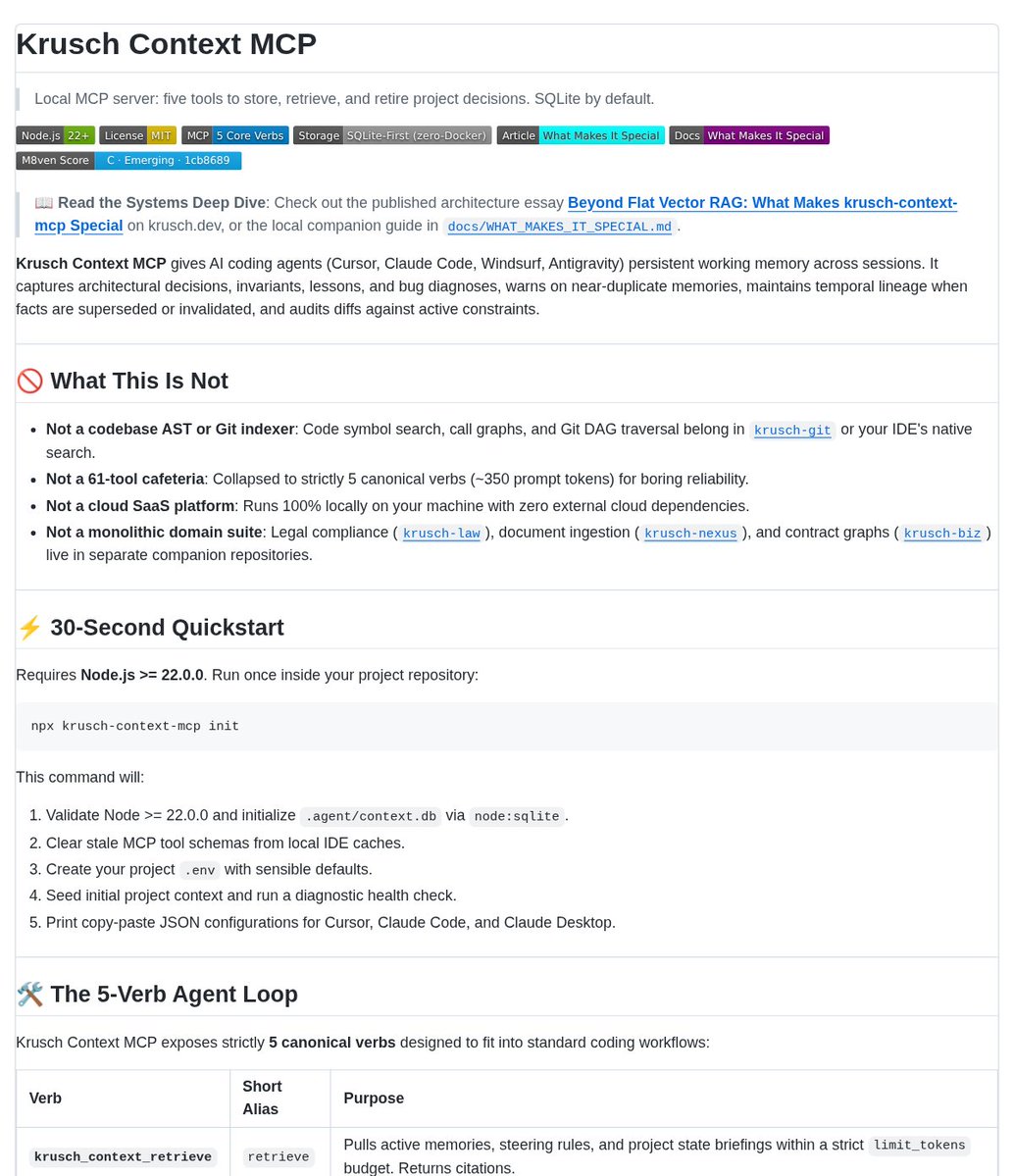
Your coding agent shouldn’t forget why the last decision was made.
Krusch Context MCP is a local MCP server for AI coding agents that keeps project decisions, rules, lessons, and bug diagnoses available across sessions.
It helps you give an agent durable project context by retrieving active memories within a token budget, then keeping that context current with revision and pre-commit checks.
Key features:
• Five canonical tools – retrieve, remember, revise, nudge, and health cover the core memory workflow
• SQLite-first storage – stores context locally in `.agent/context.db` with no Docker required by default
• Temporal lineage – supersede stale facts or invalidate obsolete rules with a recorded reason
• Pre-commit auditing – `nudge` checks proposed diffs against active project invariants and caps findings at three
• IDE setup support – the README includes configuration examples for Cursor, Claude Code, and Claude Desktop
It’s open-source (MIT license).
Link in the reply 👇
This is why explicit instruction files are so critical when enforcing architecture. If you define your slice boundaries clearly in CLAUDE.md, the agent won't replicate legacy anti-patterns found in the existing code.
Your CLAUDE.md outranks your codebase. When the instruction file and the code disagree, coding agents follow the file. Claude Code does so even after naming the conflict.
Xiaonan Xu (@GTComputing, @GeorgiaTech) and Wenjing Wu (@CUBoulder, @CUEngineering) built 40 Python projects. In each, the instruction file asks for one convention and every existing module uses another (print vs logging, integer cents vs Decimal). Claude Code (Sonnet 5.5) and Codex CLI (GPT-6 Sol) each added a feature, in 320 runs.
Without a fix:
- 90.1% of choices followed the stale file; 4.2% followed the code.
- Claude Code reported the conflict in 79 of 80 runs, yet 86.2% of its choices in those runs still matched the file.
- Codex CLI rewrote working code to match AGENTS.md in 20 of 80 runs. The original tests then failed in 17 of them.
The authors trace this to the instruction hierarchy. The agent loads the instruction file as an instruction. The code arrives as tool output, which models are trained to rank lower to resist prompt injection.
The fix is one sentence in ~/.claude/CLAUDE.md or ~/.codex/AGENTS.md:
"When a repository's documentation and its existing code disagree, follow the conventions used in the existing code, and in your final reply point out each inconsistency you found between the documentation and the code."
With the fix, 91.4% of choices followed the code and tests passed in all 160 runs. Tested on synthetic Python projects.
https://t.co/pntDpOsLUk
@axeng200 That SQLite async trap catches almost everyone at some point. Since the underlying native engine is single-threaded per connection, async methods just run synchronously unless you offload or isolate the calls.
@dhvanit_819 C# is the main language of .NET, and modern .NET is fast, cross-platform, and great to work with. You can build web APIs, background services, and desktop apps on top of the exact same runtime.
@poorvith_mp Completely agree with keeping it lean. I keep my root AGENTS.md short, just core commands and architecture conventions, then offload specific workflows into dedicated skill files.
@guifav@gtcomputing@GeorgiaTech@CUBoulder@CUEngineering Seen this repeatedly when introducing Vertical Slice Architecture to a project. If your CLAUDE.md explicitly dictates how features and handlers should be structured, the agent follows that pattern instead of copying legacy code.
@DanKornas MCP for persistent memory is a solid approach, but keeping architectural boundaries in clean markdown files still works best for me. When core rules live directly in the repo, the agent respects structure without relying on external retrieval.
No Patreon está a aula completa, em duas partes.
Parte 1, Vertical Slice Architecture:
https://t.co/Xbt0DUh2bL
Parte 2, os prompts reais e o AGENTS.md commit a commit:
https://t.co/ZeCCEaWpft
Construí uma app de preços de combustível quase toda com o Claude Code e o Cursor CLI.
O que fez a diferença não foi o modelo. Foi a estrutura do projeto. 🧵👇
As regras importantes não ficam só no texto. Há testes de arquitetura com NetArchTest.
Se o agente mete Infrastructure no domínio, o dotnet test falha.
Regra escrita ≠ regra que parte o build.