HPV vaccination trains antibodies to block targeted virus types linked to penile cancer before they enter cells. It doesn't treat an existing penile sore.
Ref: NCI, Human Papillomavirus (HPV) Vaccines; Penile Cancer Symptoms
#PenileCancer#HPV
Great thoughts!
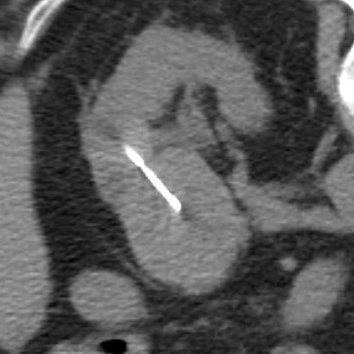
A central scar is NOT pathognomonic of benign oncocytoma, even if associated with segmental enhancement inversion (SEI) so percutaneous renal mass biopsy was performed...
This revealed an "oncocytic renal neoplasm" with morphologic features and immunoprofile consistent with renal oncocytoma.
What would you do next? Do you trust these biopsy results?
@BrighamRad@MGBRadEdu@FOAMrad@SAR_RFS@futureradres@ARRS_Radiology@Abdominal_Rad@CBRadiologia #MedEd
Ever wondered how to invert the prostate adenoma into the bladder during BipoLEP? 👀
Excellent visualization is key to mastering every surgical step. The clarity of @RichardWolfGmbH optics makes 👍 difference! 🔍
This should be common knowledge by now. I’ve already encountered a case where a physician mistook a primary clear cell renal cell carcinoma for metastasis from a coexisting low-grade prostate cancer. PSMA expression is not exclusive to prostate cancer.
Renal tumors can show PSMA PET uptake because some tumor-associated blood vessels express PSMA. Uptake alone doesn't establish that a lesion came from the prostate.
Ref: doi:10.3390/biomedicines11113095; doi:10.3390/diagnostics13193082
#KidneyCancer#PSMAPET
Salvage HoLEP in a 61-year-old patient with persistent bladder outlet obstruction despite two previous BPH procedures (Rezūm and TURP), and a history of two prostate biopsies.
At the beginning of the video, note that only a small channel had been created at the bladder neck, while the entire apical adenoma remained intact.
Marked prostatic congestion, multinodular adenomatous hyperplasia, extensive fibrosis, and dense tissue adhesions made enucleation particularly challenging.
Patience, meticulous identification of the correct anatomical planes, and controlled dissection are essential.
A thorough final inspection under improved visualization is crucial to identify and remove any residual adenomatous nodules.
#HoLEP #BPH #Endourology
Genitourinary Tuberculosis Diagnosis Using Urine GeneXpert: A Single-center Retrospective Study
You can see the free full text of the research by Mohd. Hamid Shafique Ahmed et al.
Link : https://t.co/9zzOl4kCi4
#Genitourinary#tuberculosis#GeneXpert#AFB#culture#extrapulmonary
Don't combine sildenafil for erectile dysfunction with nitrate medicines for chest pain. Both amplify a blood-vessel relaxation signal, so blood pressure can fall dangerously.
Ref: VIAGRA Prescribing Information, Contraindications and Clinical Pharmacology
#ErectileDysfunction #MedicationSafety
1/9 Our latest manuscript from the #CAPTURE platform in advanced #ProstateCancer is published in @EurUrolOncol. The prognostic impact of BRCA2 gene alterations has been well established, but is BRCA1 comparable to BRCA2? Are all non-BRCA HRR alterations equivalent? 🧵
First-in-Human Trial of a Robotic System for Transurethral Bladder Tumor Resection.
Robotic en bloc TURBT in #BladderCancer: @jteoh_hk@CUHKMedicine, joins @UroCancerMD@VUMChealth to discuss the first-in-human VIABLE trial. Across 6 patients, technical success was 100%, and detrusor muscle was obtained in all, with no grade ≥2 complications. #WatchNow > https://t.co/seqtoNcdwQ
Platelet-Rich Therapies for #ErectileDysfunction: A Systematic Review and Meta-Analysis Investigates Efficacy.
Do platelet-rich therapies work for #ErectileDysfunction? @drhelenbernie@IUuro joins Alan Wein, MD, PhD(hon), FACS, to review an updated systematic review and meta-analysis of randomized trials comparing platelet-rich therapies with placebo. #WatchNow on UroToday > https://t.co/RhXNAcPXUM
The 2026 AUA stone guideline now says doctors should offer an alpha-blocker for a stone up to 10 mm in the lower ureter, Grade A evidence. Higher up the same drug is optional. Why the location decides, and what the trials actually showed. https://t.co/cNGorQ3HIJ
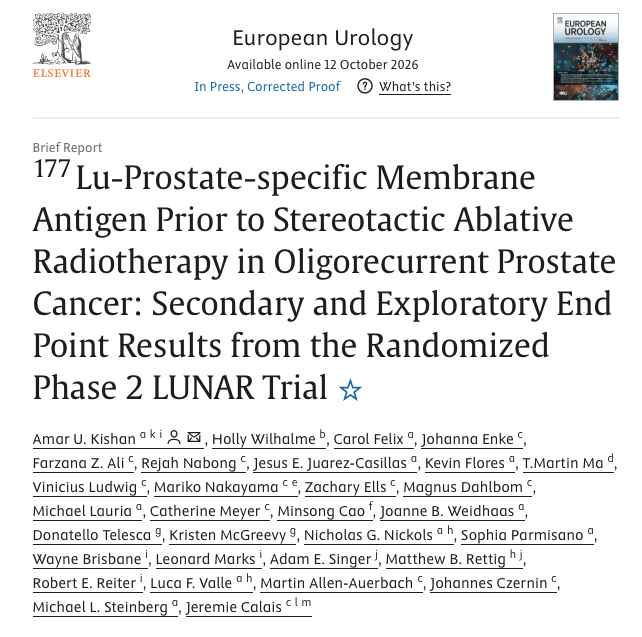
Published in the October 2026 issue of European Urology @EUPlatinum (Impact Factor: 29), this collaborative work was led by Roger Li @UrogerliMD, Can Aydogdu @CanDAydogdu, Laura Bukavina @LauraBukavinaMD A must-read for anyone interested in bladder cancer! Great honor to be part of this work.
@UroDocAsh@AndreaNecchi@apolo_andrea@SpiessPhilippe
This comprehensive review provides an integrated overview of the pathology, molecular characteristics, and clinical management of major bladder cancer subtypes, including squamous, adenocarcinoma/glandular, micropapillary, sarcomatoid, plasmacytoid, nested, and small cell neuroendocrine carcinoma. These tumors are biologically heterogeneous, often clinically aggressive, and frequently understaged on transurethral resection, supporting consideration of early radical cystectomy in selected high-risk patients.
Importantly, treatment response varies substantially by histology. Small cell neuroendocrine carcinoma demonstrates the clearest benefit from platinum/etoposide-based chemotherapy, while other subtypes show variable responses to conventional systemic therapies. Molecular profiling reveals potentially actionable alterations, including ERBB2 in micropapillary carcinoma, CDH1 loss in plasmacytoid carcinoma, FGFR3 alterations in nested carcinoma, and TP53/RB1 alterations in small cell carcinoma. Emerging evidence also supports potential roles for immune checkpoint inhibitors and antibody-drug conjugates.
We emphasizes that variant bladder cancers should not be managed using a uniform approach. Accurate histologic classification, quantification of subtype components, and molecular profiling are increasingly important for personalized treatment and future subtype-specific clinical trials.
Full article available at https://t.co/KLNDkGNVNv
Resultados de VOLGA presentados en #ESMO26@tompowles1
En pacientes cisplatino inelegible, 3 ciclos de EV + durvalumab perioperatorio se asocia con mejora en SLE (HR 0.51), SG (HR 0.58) y respuestas patológicas del 40%.
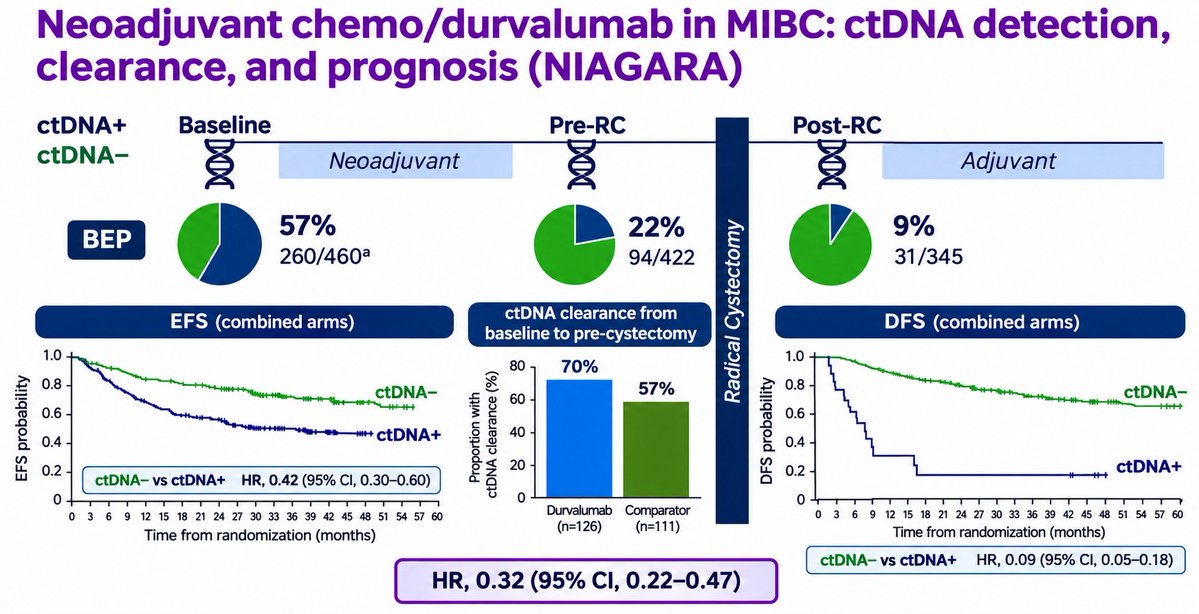
De los pacientes ctDNA+ al inicio del estudio (78%), un 60% habían aclarado ctDNA antes de la cistectomía con tratamiento sistémico. Tasas más altas de positividad en ctDNA comparado con otros estudios perioperatorios, probablemente en relación al uso de una metodología más sensible (Natera Ultransensitive Signatera).
@OncoAlert
🔗Publicado hoy en @NEJM
https://t.co/e8kQvq2nQo