Sold out @HarvardHBS session for the opening keynote with @mamoonha of @kleinerperkins.
What is Mamoon’s life story? How did he make his career choices? Lessons learned from co-leading two VC firms?
Thank you, Mamoon, for taking time from your family!
📸: Evgenia Eliseeva
I asked Perplexity with DeepSeek R1 underneath: “Predict when the Chinese Communist Party will lose power. Give me five scenarios and a very rough forecast on dates for each.” https://t.co/9jG6kiWgoU
New report by leading semiconductor analyst Dylan Patel shows that DeepSeek spent over $1 billion on its compute cluster. The widely reported $6M number is highly misleading, as it excludes capex and R&D, and at best describes the cost of the final training run only.
@honam@altosvc@HarvardHBS Agreed. I actually would like to change the format to feature your journey even more explicitly, if you’re ok with that. Will revert. Thank you!
Amazing interview about resilience: @honam / @altosvc. Such a privilege that Ho makes the time to be a guest each year at @HarvardHBS https://t.co/yujo5QIBXR
How could a company shut down abruptly with no warning? The Answer: Debt Covenants on Venture Debt
While this isn't specifically about Bench (I have no inside knowledge), their "$60M" Series C illustrates an important point - Pitchbook shows it was actually $37M equity and $23M debt. Further evidence that they used debt: Bench lists SVB as an investor on their website, likely venture debt.
A plea to journalists: Always ask companies to break out equity vs debt in fundraising announcements. Only include equity in headlines! You are doing us all a disservice by including debt.
Venture debt is most often used alongside an equity round. On paper, it seems counterintuitive for the lender - you get the risk of an early-stage company with capped upside of debt. Lenders get interest payments, warrants, and equity kickers, and only back companies where they're confident VCs will continue supporting them. Most importantly, they protect themselves with debt covenants.
These covenants are mandatory conditions during the loan term, including financial requirements like:
-Maintaining minimum cash balances
-Meeting revenue/growth targets
-Staying under maximum burn rates
-Maintaining debt service coverage ratios
And non-financial conditions such as:
-Board composition
-Major investor participation in future rounds
Breach these covenants, and the lender can demand immediate full repayment, freeze bank accounts, and seize collateral - effectively forcing an instant shutdown.
While rare (many companies don't fully utilize their venture debt, and lenders often show flexibility if communication remains open), it does happen. When lenders lose confidence in getting repaid, they'll call the capital and seize assets.
Can venture debt be useful for scaling? Yes. But it's often misused to extend runway or inflate perceived fundraising totals - both dangerous moves. When business turns south, those seemingly helpful strings become deadly chains.
As Warren Buffett noted (2018 letter):
"We use debt sparingly. Many managers, it should be noted, will disagree with this policy, arguing that significant debt juices the returns for equity owners. And these more venturesome CEOs will be right most of the time. At rare and unpredictable intervals, however, credit vanishes and debt becomes financially fatal. A Russian roulette equation – usually win, occasionally die – may make financial sense for someone who gets a piece of a company’s upside but does not share in its downside."
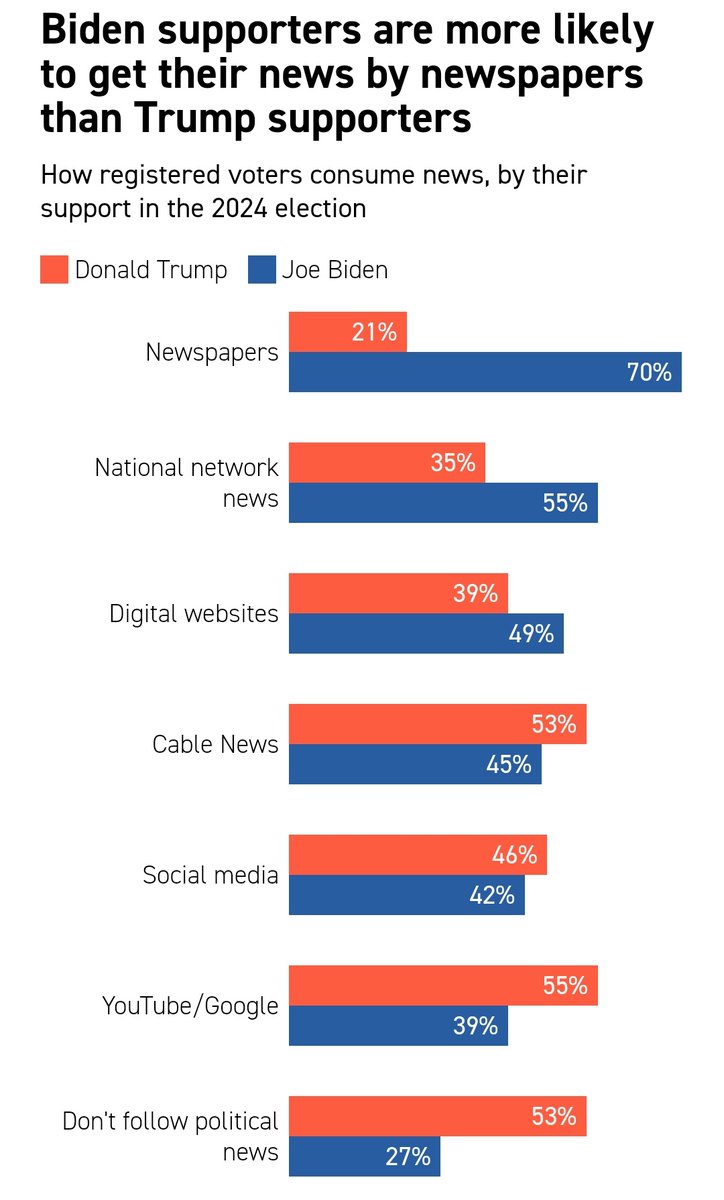
"These studies reveal an interesting fault line. While most women get their news from TikTok, most young men get their news from YouTube, X, and Reddit."
Also, if you read a newspaper, odds are 3-to-1 you voted Harris. If you don't consume news, odds are 2-to-1 you voted Trump.
A century ago, Germany’s democracy was hijacked by a bombastic and charismatic tyrant — and in this five-minute video, you’ll learn how he did it. Why did I produce this? Because I believe that history is speaking to us, and all too often, those who refuse to learn from it are doomed to repeat it.
As you watch, imagine filling out a Bingo card filled with Germany 1933/USA 2024 parallels: big rallies, rage-filled and hateful rhetoric, simple answers promising quick and easy solutions to complicated problems, empty promises of a great-again future, scapegoating outsiders, and political enemies silenced on day one. And notice the caring wisdom and concern from my German friends as they share these lessons from their dark history.
It’s hard to understand how Trump could, on the eve of a tight election, paint a picture of Liz Cheney before a firing squad by actually saying, “Let’s put her with a rifle standing there with nine barrels shooting at her, OK? And let’s see how she feels about it when the guns are trained on her face.” You can’t get into the mind of a dictator with an insatiable appetite for power — but you can recognize the playbook they all seem to follow.
Just watch this clip. It’s excerpted from my hourlong public television special “The Story of Fascism in Europe,” which is streaming free (and ad-free) at https://t.co/YA10kVH0V8. If you care about our democracy and love our country, it’s hard to stop watching.
When I produced this in 2018, I hoped this day would never come in our country. But November 5th is upon us. Please share this with anyone in your life who might need a reminder that the stakes are high...and this is very real.
A most sincere thank you to @KKR_Co Co-CEO Joseph Bae for coming to @HarvardHBS!
What is Joe’s life story, what were his pivotal career decisions, and how does he think about risk? What is the KKR business model?