@rikiyatakehi@a1zhang@lateinteraction It would be an interesting next step to use this capability to identify what each of our neurons are responsible for and potentially using that to treat neurological conditions (and deciding when this is ethical vs not)
1/4 LLMs solve research grade math problems but struggle with basic calculations. We bridge this gap by turning them to computers.
We built a computer INSIDE a transformer that can run programs for millions of steps in seconds solving even the hardest Sudokus with 100% accuracy
@shreyasnsharma I am also working on self-improving code with a project called CodeEvolver. My focus is AI applications, and we're seeing 30% relative gain over prompt optimization on retrieval / research tasks. I'd love to chat @shreyasnsharma !
@shreyasnsharma Very interesting. The candidate picker in GEPA is obviously a big improvement on a greedy approach, but one thing is missing for self-improving code: the coding agent attempts a new branch without the benefit of the learnings from past code changes. Love what you're working on!
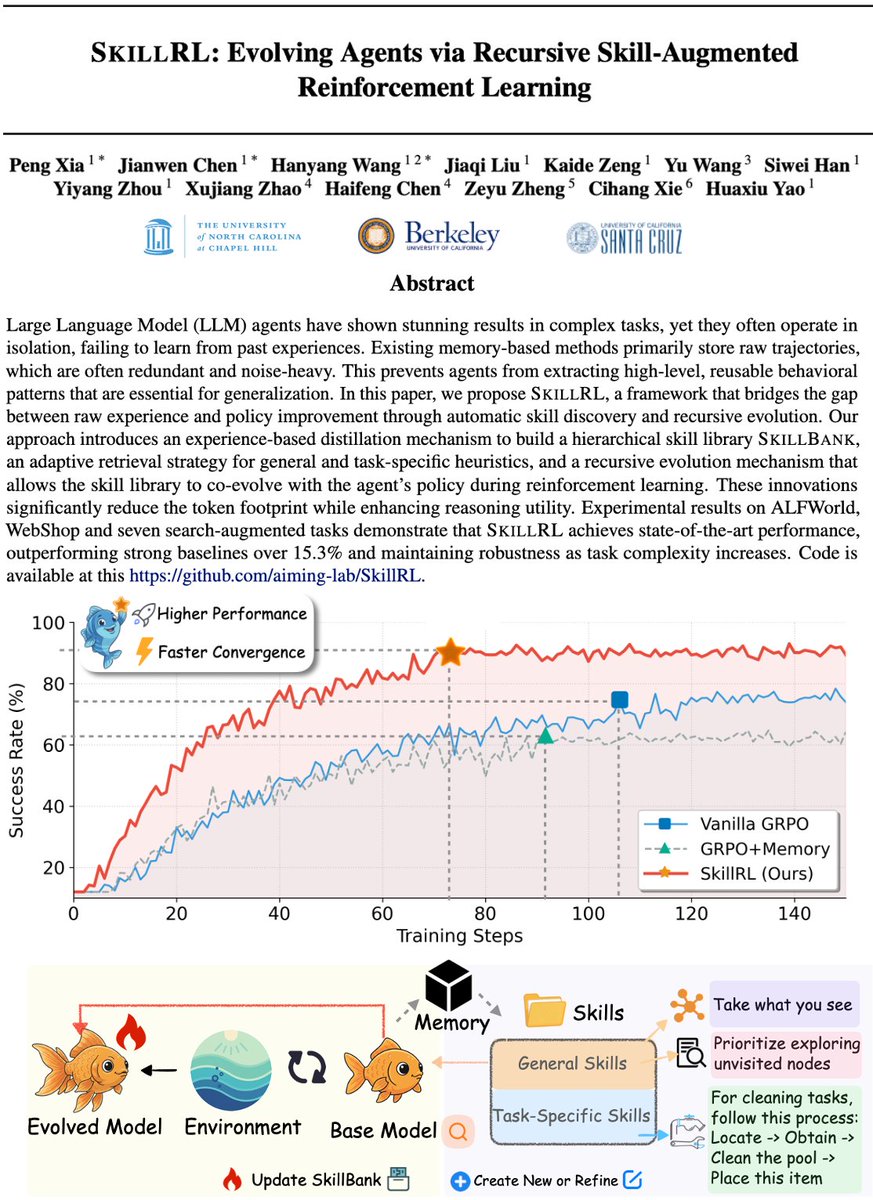
SkillRL attains massive improvement by modifying its own skills library and using its improved skills to help train its underlying model policy via RL. This continues back and forth over many iteration steps. Very interesting!
Why do most LLM agents hit a wall?
They don’t accumulate skills.
Introducing SkillRL📚 — recursive skill-augmented reinforcement learning that lets agents learn skills from failure and evolve over time.
🔥A 7B model:
• +41% over GPT-4o
• ~20% fewer training tokens
• 33% faster convergence
SkillRL bridges raw experience → policy improvement by distilling trajectories into structured, co-evolving skills during RL.
Most agents forget.
SkillRL evolves. 🔄
📄 Paper: https://t.co/6VoxpGoPR6
💻 Code: https://t.co/qVDnIaci2K
Great work @richardxp888, Jianwen Chen, Hanyang Wang, @JiaqiLiu835914, @lillianwei423, @AiYiyangZ, and nice collab. w/ @__YuWang__, @XujiangZhao, Haifeng Chen, Zeyu Zheng, @cihangxie.
@colinmcnamara@AustinLangChain@karpathy I fully concur. Can’t wait to release CodeEvolver beta in the near future.
Give CodeEvolver a dataset and objective, and watch the AI system improve itself.
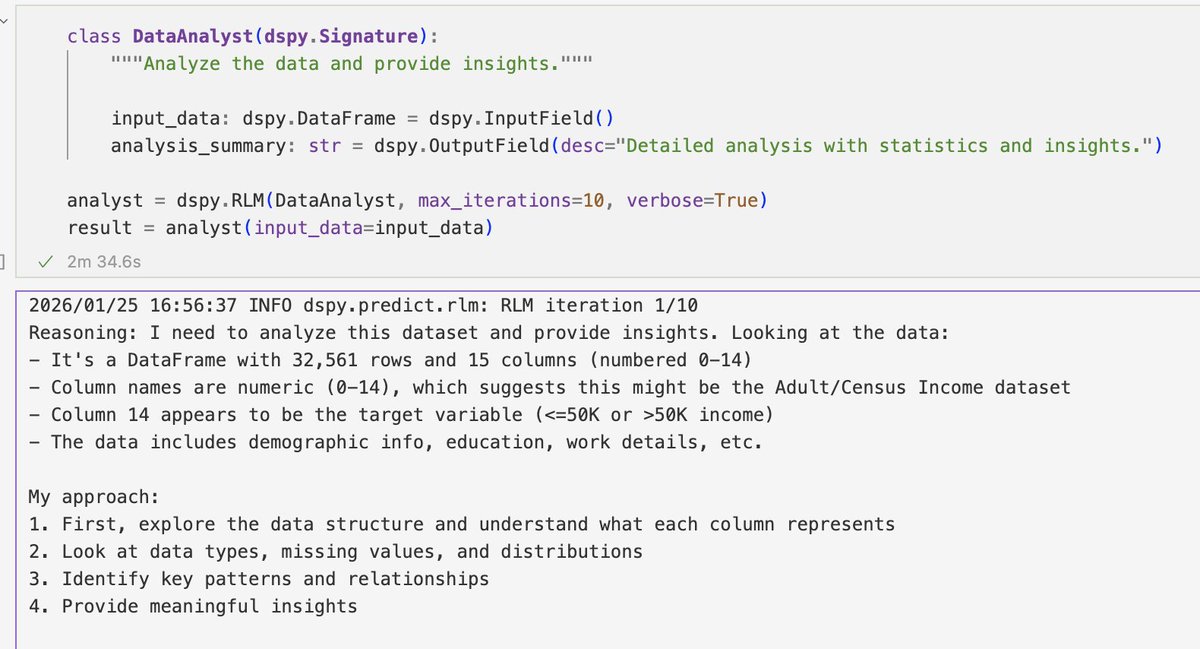
@raw_works@DSPyOSS@a1zhang@lateinteraction The two key aspects of RLM vs Claude Code is having the prompt as an external object, accessed symbolically with python, and recursive spawning that results in much less context per call.
Love your project idea. Curious how these two aspects are implemented. @raw_works
@a1zhang So the key distinctions that result in less context are:
- RLMs spawn recursively (less context per call than hard-coded sub-agents)
- The prompt is an external object, accessed symbolically with python
Love the paper!
RLMs solve context rot!
I like to compare it to “Claude Code on your context window,” but what actually solves context rot is:
- RLMs spawn recursively (less context per call than hard-coded sub-agents)
- the prompt is an external object, accessed symbolically with python
Fundamentally, what really is the difference between an RLM and S={context folding, Codex, Claude Code, Terminus, agents, etc.}?
This is the last and most important RLM post I'll make for a while to finally answer all the "this is trivially obvious" from HackerNews, Reddit, X, etc. I know there's a lot of noise rn, but this is the one thread I'd rly ask you not to skip!
For a while I didn't have a super clear answer to this. and no, it's NOT that:
1. CC sub-agents are user-defined while the LM defines the sub-agent in RLMs. this is a minor difference that I suspect Anthropic will phase out at some point
2. Coding scaffolds use a file system while the original paper uses a Python REPL. In fact, FS is a REPL.
3. RLMs offload context into a variable. CC / Codex implicitly do this by saving to files, and yes, I know that people have been doing this for time
But I think after some long convos with @lateinteraction@zli11010 and @ChenSun92, I can articulate a lot better that all of these things are important but are missing what actually matters.
RLMs enable **symbolic recursion** -- this means the RLM can spawn recursive calls embedded in symbolic logic. In simple terms, the recursive LM call lives inside the REPL. While for CC / Codex, the sub-agent call is spawned directly as a tool by the main model. This is a subtle difference but extremely significant.
Consider the following example. Say I want my agent to ingest 1M files and find a function I'm looking for.
1. The CC model will hopefully sequentially launch 1M JSON-like sub-agent tool calls per file in its main context, get the answer for each (maybe save to a file), and return.
2. The RLM will write a for-loop / parallel map over each sub-agent call to open each file, save to a var / file, and grab the answer.
The problem here is that we rely on Opus 4.5 to perform a programmatic action (launch 1M sub-agent calls) without the guarantee that it'll actually do it. Now maybe it's good enough to do this, but consider a nastier task, where we want to launch sub-calls only for files satisfying some weird property P (this is quite common for say looking at databases or complicated monorepos). In fact, all tool calls are launched this way, which is fundamentally limiting (we already write code to programmatically perform operations (e.g. search if XYZ)!
The tldr; here is that the REPL and sub-calling tool being *separate* is not a good thing. It's such a subtle / simple point but it lends itself extremely well to more robust / programmatic model reasoning through training. Beyond the fact that CC / Codex are trained specifically for coding tasks, this minor difference leads to a whole class of new solutions that RLMs can solve.
(Thanks to @zli11010 for this point) From a PL perspective, the way Codex / CC handle sub-agents is almost *silly*. If we think of the REPL that the RLM uses as a "language" or sorts, sub-calling should be a feature of this language. It shouldn't be separate, and is strictly less expressive than the RLM design.
Hope this clears things up, happy to answer more questions but I plan on updating the paper to articulate this better and make things clearer :)
Four AI founder friends told me they do not have a structured pipeline for improving their LLMs.
A good AI workflow requires high quality testing data and structured pipelines to evaluate and iterate.
We went from 65% to 95% accuracy on our use case: https://t.co/1leFvw9My6
One of the companies I’ve been working on is called The Product LLM (https://t.co/V6bsYVrOjx)
We build AI bots that search for exact product matches on any website at low cost, for e-commerce software providers.
In anticipation of our launch, we're giving away $2,000 to a member of the Nook community!!
Enter in three simple steps →
1. Retweet this post
2. Follow us on X
3. Sign up to our waitlist: https://t.co/gSDrzKVhcA
Don’t just gamble with crypto - earn a stable 9.3% APY
*Winner announced April 30th