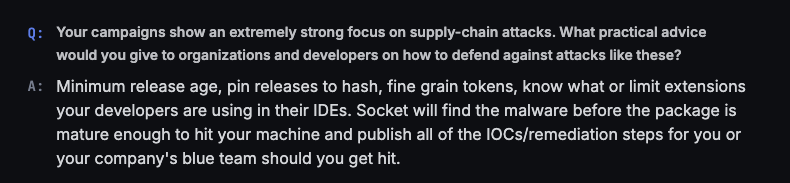
Today is my last day at Block, closing out almost 11 of the last more than 12 years helping build security into products that serve tens of millions of people and safeguard billions of USD in monetary value.
I'm exceptionally proud of what we accomplished during my time there: growing Square to EMV payments and international markets, building security into Cash App's cloud platform from the very beginning, establishing pervasive application-layer encryption across Cash App services, growing client authenticity signals into a platform that now protects tap-to-pay, making bitcoin custody significantly safer and secure, creating data classification frameworks that became company-wide standards, safely migrating critical encryption infrastructure to the cloud, meeting PCI certifications for mobile payments acceptance, and shipping exciting new secure-by-design hardware products.
I'm grateful to the incredibly talented people I worked alongside. It's rare to find a place where you can do interesting work that matters with such great people at that scale for that long.
As for what I'm doing next, stay tuned. I'm excited to start again somewhere new (to me)!
Today, our very own Executive Director Justine Bone (@justinembone) is speaking at Financial Services Explained Day in Washington, DC.
Crypto ISAC is looking forward to joining a panel discussion on cryptocurrency, cybersecurity, and what meaningful protection for the digital asset ecosystem requires in practice.
We’re glad to be part of the conversation with public-sector and technical cybersecurity stakeholders working to better understand emerging threats and strengthen collaboration across the ecosystem.
#CryptoISAC #Cybersecurity #DigitalAssets #ThreatIntelligence #PublicPrivate
Great to wrap “Securing, Not Assuming Trust” with Justine Bone @justinembone at #Hederacon2026.
Appreciate the thoughtful discussion and perspectives shared by moderator, Joe Blanchard of @hashgraph, alongside Marc Baumann of @dfnsHQ, Steven Walbroehl of @HalbornSecurity, and Nick Percoco of @krakenfx.
Resilience at scale requires coordination. Collaboration across the ecosystem is becoming essential to building the infrastructure needed for the next generation of digital finance.
If you were there, would love to hear your takeaways.
#HederaCon #CryptoSecurity #Cybersecurity #DigitalAssets #CryptoISAC
"The gap between the threat level and the defensive infrastructure has been stark. That gap is why @Crypto_ISAC exists."
Our ED @justinembone on what last week's @USTreasury announcement really means and what the industry needs to do next.
➡️ https://t.co/2fhZs3ty6C
Since our founding, @CryptoISAC has prioritized public-private collaboration — because securing the digital asset ecosystem is a shared mission.
Today's @USTreasury announcement reflects exactly that. Big step for the industry.
🔗 https://t.co/2KBnDFbEmg
🤝 Ready to join the collaborative defense community? https://t.co/kAIWHiKQfm
Some dinners are just dinner. This was not that.
Two nights ago, The Security Table came back for seconds at Reserve Cut, and the room delivered. Founders, executives, and operators from across crypto, TradFi, regulation, and the infrastructure connecting them, all in one place, off the record, saying exactly what they think.
We had leaders from @Microsoft, @Mastercard, @SPGlobal, @chainlink, @withAUSD, @CircuitSecurity, Cap Labs, @MerkleScience, @Corkprotocol, @glacient_tech, @Crypto_ISAC, and more around the table.
The kind of room where you look left and right and think: how is everyone this interesting.
We close every Security Table dinner the same way we close every episode of the podcast: a round of hot takes as the final course. But unlike the podcast, these are off the record, which means the takes are unfiltered, provocative, and make for some of the best conversation of the night.
A few from last night:
🔺 Empathy doesn't scale. Ethics needs to be economically incentivized.
🔺 AI is the third Industrial Revolution.
🔺 Every company will become an AI company.
🔺 The insurance industry is about to be disrupted by blockchain. The oracle problem is the only thing standing in the way.
🔺 RWAs are the wrong entry point for institutional adoption.
🔺 Bitcoin is dead
The conversations that shape this industry don't happen on panels. They happen at tables like this one.
If you weren't there, you missed something. We'll do it again.
This is one of the reasons why financial services are moving to blockchain solutions. Increased resiliency as well as efficiencies. @Crypto_ISAC is monitoring this AND is available for comment.
(Reuters) - The U.S. financial services industry is on heightened alert for potential cyberattacks amid the unfolding U.S. war in Iran, with firms stepping up monitoring for threats that often rise during periods of geopolitical conflict, said executives and analysts.
The killing of Iranian Supreme Leader Ali Khamenei last weekend in an air strike has sparked a conflagration in the Middle East that has roiled markets globally and stoked concerns over the potential for Iran-linked cyberattacks on U.S. financial services operations.
Cybersecurity has long been a top priority for the financial services industry, which operates critical U.S. infrastructure, including payments, clearing and settlement systems, as well as trading platforms and Treasury markets, making it a top target of cyberattacks, according to industry data.
"The industry remains vigilant and ready to respond to cyber threats at all times, and especially when global cybersecurity risks are heightened," said Todd Klessman, managing director for financial services cyber and technology at industry group SIFMA which runs an annual exercise to ensure financial firms can operate through significant cyber emergencies.
"We continue to monitor the current situation with a focus on operational resilience, which is foundational to the integrity and stability of the U.S. capital markets," Klessman said.
Another top banking industry official said lenders are very concerned about the risk of cyberattacks, which they see as likely.
U.S. INTELLIGENCE SEES LOW-LEVEL CYBERATTACKS AS POSSIBLE
According to a U.S. intelligence assessment that Reuters reported on Monday, Iran-aligned "hacktivists" could conduct low-level cyberattacks against U.S. networks, such as distributed denial-of-service attacks (DDoS), whereby hostile actors overwhelm a targeted server with a flood of internet traffic.
Credit rating agency Morningstar DBRS said on Tuesday the most significant risks to global banks and asset managers were likely to be indirect, including sustained higher oil prices and shocks to borrowers, but warned that cyber risks could also rise.
"Iran could increase its cyberattacks against Western entities, including banks," the credit rating agency said.
U.S. investment bank Lazard's geopolitical advisory team also this week flagged cyber risks, noting that Iran has demonstrated a willingness to deploy cyber capabilities against commercial targets, including financial systems.
According to a 2025 report by the Financial Services Information Sharing and Analysis Center (FS-ISAC), an industry consortium, the financial services sector was the top target of DDoS attacks in 2024, with the Hamas-Israel and Russia-Ukraine wars fueling a surge in hacktivism.
While the industry has not in recent memory suffered a major disruption due to a hostile attack, smaller-scale DDOS attacks as well as ransomware attacks have disrupted pockets of the market.
A 2023 ransomware attack on the U.S. broker‑dealer unit of Industrial and Commercial Bank of China disrupted settlement of some U.S. Treasury trades.
A spokesperson for FS-ISAC did not immediately provide a comment.
Remembering memories with my friend Felix ‘FX’ Lindner @41414141, hacker extraordinaire with a huge heart, who passed away last week. Whether in Berlin, San Francisco, or Sao Paulo, hanging out with FX was never dull. FX was prophiled in @phrack #68 https://t.co/CshcZBcJlL
Crypto ISAC goes to the Hill!
Today, Executive Director Justine Bone @justinembone participated in briefings with the Cybersecurity and Infrastructure Security Agency @CISAgov, the Office of the National Cyber Director for Policy @ONCD, and the House Subcommittee on Cyber and Infrastructure Protection, as well as meetings with key lawmakers to elevate real-world threat insights and strengthen public-private coordination.
My wife @debkav and I are heartbroken to share the sad news that our old friend @jasonsnitker AKA Parmaster has passed away.
Par was one of the sharpest and most elusive minds of the early underground hacking scene. As chronicled in “Underground”, he spent years navigating the emerging digital frontier, connecting with hackers internationally and repeatedly staying ahead of the United States Secret Service during a prolonged investigation in the early 1990s.
His story in “Underground” includes the Citibank investigation that helped trigger the pursuit, as well as his time in custody at Rikers Island, where he found himself playing Dungeons & Dragons.
Par’s life reflected both the intensity of the early hacking world and the very real consequences that came with it. He was part of a generation that explored the edges of a new technological landscape before most of the world even understood it existed.
There will be an online memorial gathering on Feb 28. More details to follow.
The old-school hacking community has lost a true original. Rest in peace, Par. If anyone has stories or memories, please share them here.
Crypto threats move fast. We move faster.
@Crypto_ISAC is a “modern ISAC” (shoutout @ITBrew) — now expanding our integration with @Coinbase and connecting crypto + traditional finance intel.
👉https://t.co/wjkWdyLUoL
Brought to you by @Crypto_ISAC: A subtle bug in Balancer turned into a cross-chain exploit in seconds.
This Thursday, @BitFinding’s founders will walk through how their on-chain Exploit Interception Agent detected the attack, backran the exploiter, and helped recover funds at block speed.
📅 Dec 18, 12–12:45 PM ET
🔗 Save your spot: https://t.co/Wnhjp97V3O
Privacy is having a moment on crypto twitter.
Reminder: If your zkSNARK requires sending data to someone else's provers, it's neither zero-knowledge, non-interactive, nor yours.
This is true for security as well. Defenders don't win by locally optimizing things that aren't on the critical attack paths. Defenders win by optimizing their efforts along critical attack paths.