No, they didn’t ’dodge the question’
The Navier Stokes problem concerns the solution of a system of differential equations with or without external forces. Openai solved the case with such a force.
Saying that OpenAI dodged the problem by solving it only when an external force is present is like saying that showing electromagnetic waves are solutions of Maxwell’s equations in a vacuum dodges the challenge to solve them, because no charges or currents are present
Everyone is benchmarking Jev against GPT-5.6.
That's the easy comparison. Jev isn't an LLM, of course it's faster.
So I benchmarked it against the boring open-weight encoders found on @huggingface that have done zero-shot classification for years.
Jev wins on accuracy. It loses at the one thing it's named for. 🧵
We’re sharing a solution to the Navier-Stokes Millennium Prize Problem, one of the deepest problems at the frontier of mathematics.
The proof was produced by a group of agents, using an OpenAI next-generation model significantly more capable than GPT-6 Astra.
The problem concerns whether the description of smooth three-dimensional fluid motion modeled by the Navier-Stokes equations can break down. It has remained unresolved for roughly 90 years.
I had early access to this model and I'll post more Thursday, but I think the most impressive part is this model NEVER GIVES UP
If you throw it in Max reasoning, it will just keep working until it's done.
GPT 5.6 Sol is my favorite model BY FAR.
SpaceX has almost finished writing V1.0 of an in-house AI training stack in C that exact-maps to 220k GB300s with 800G NICs, making heavy use of pipeline parallelism and getting as close to bare metal as possible.
The potential speed improvement vs JAX for large training runs is over an order of magnitude.
Whoa. This breakthrough is going to fundamentally affect the structure of how universities select and retain professors. And more generally the structure of work and creativity. AI has managed to discover a significant result in research mathematics in a one-shot query (!!!), disproving a conjecture that a huge number of people have tried working on (including myself, although I am not anywhere as good as the other experts who have thought about it).
@wtgowers (Fields Medalist who has been thinking a lot about this space of AI and math) wrote: "if a human had written the paper and submitted it to the Annals of Mathematics and I had been asked for a quick opinion, I would have recommended acceptance without any hesitation. No previous AI-generated proof has come close to that." [The Annals of Mathematics is perhaps the most prestigious math journal in the world.]
OpenAI's announcement: https://t.co/faCjJFkY43
Mathematicians' discussion: https://t.co/RF0PzhRonM
In college classes, we already have a major issue where take-home assignments are susceptible to students using AI. Even with in-person exams, we're having issues where students use AI in the bathroom during the exam. Now, how will universities decide which professors to hire and promote? Universities used to judge on the basis of whether you got papers published in highly prestigious journals. Should the person who can use AI to generate massive quantities of publishable results be picked, if it can be done with one-shot prompts?
More generally, everyone (not just universities) needs to rethink their objectives for hiring and promotion. I am also an entrepreneur, and have been refining my hiring process in this age of AI. Before, I used to be particularly impressed by academic competition performance. Today, I search for people who hold 2 certain principles very strongly: they enjoy (1) delighting other people, and (2) achieving understanding through their own thought. I find these people are good at figuring out what makes customers/partners tick (hence able to identify good directions to run without micromanagement), and also curious enough to learn forever. They also tend to already be pretty strong skills-wise, because those two principles inherently drive them to build skills.
I actually think the whole world would be better off with more Thought Full people: https://t.co/cPdqAhQRz3. We'll need people like that to figure out how to help humanity survive. If you'd like to collaborate on ways to make a future, feel free to reach out. That's all I work on nowadays.
I've been driving GPT5.5 on low reasoning for the last week+ and it's very good, very efficient. Haven't been tempted to reach for Opus at all. And it's more succinct than Kimi too. Huge leap forward for @OpenAI 👌
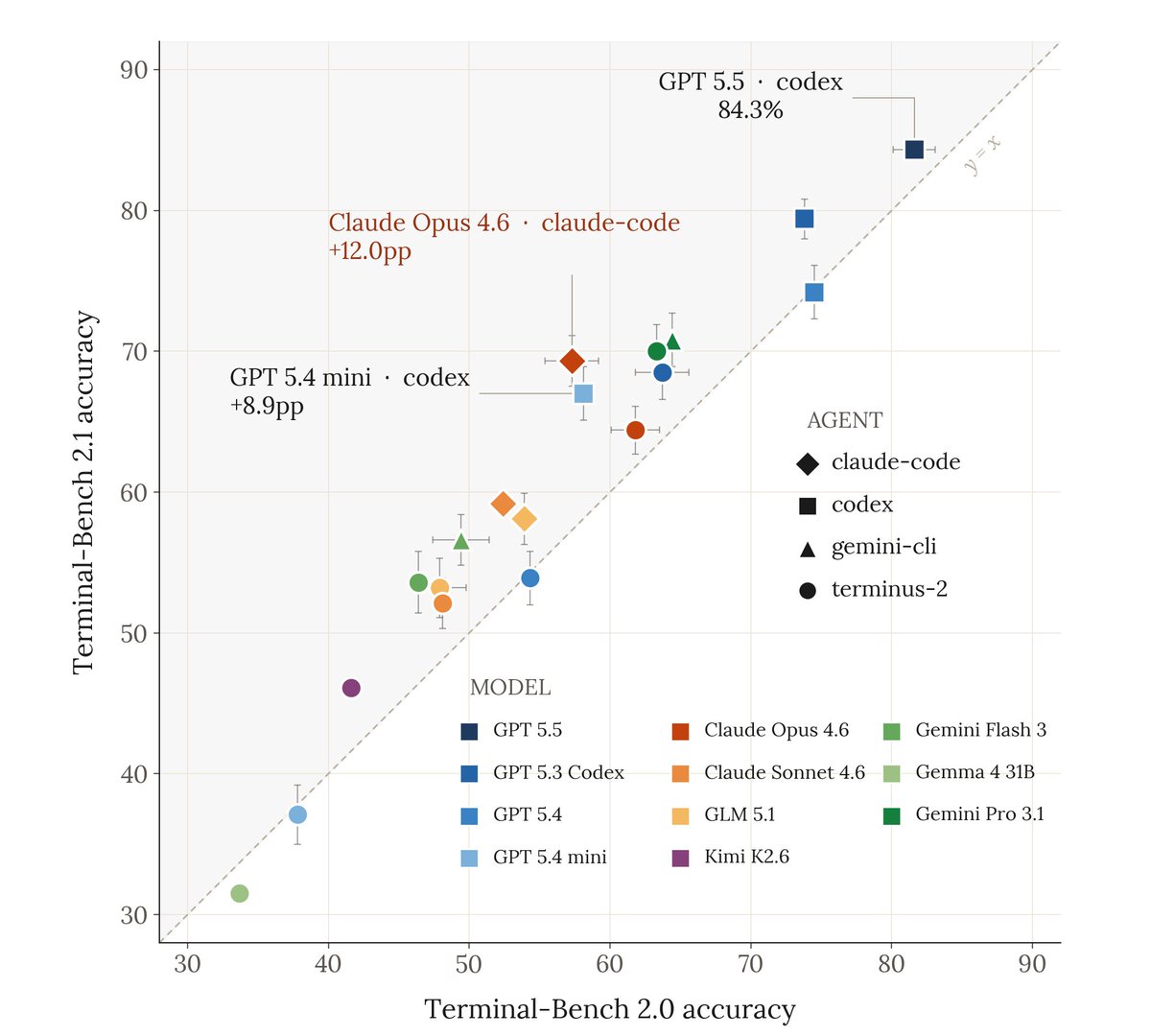
Very excited to release Terminal-Bench 2.1!
Coding agents are among the most economically consequential deployments of LLMs to date. As agents improve, benchmark reliability matters more.
We audited TB2.0 and found and corrected issues in 28/89 tasks. 30% of the benchmark!
But the rankings survived, absolute scores moved up to 12pp!
Moonshot’s Kimi K2.6 is the new leading open weights model. Kimi K2.6 lands at #4 on the Artificial Analysis Intelligence Index (54) behind only Anthropic, Google, and OpenAI (all 57)
Key takeaways:
➤ Increase in performance on agentic tasks: @Kimi_Moonshot's Kimi K2.6 achieves an Elo of 1520 on our GDPval-AA evaluation, which is a marked improvement over Kimi K2.5’s Elo of 1309. GDPval-AA is our leading metric for general agentic performance, measuring the performance on knowledge work tasks such as preparing presentations and analysis. Models are given code execution and web browsing tools in an agentic loop via our open source reference agentic harness called Stirrup. This continues Kimi K2.6’s strength in tool use, maintaining a 96% score on τ²-Bench Telecom, placing it among other frontier models in this category.
➤ Low hallucination rate: Kimi K2.5 scores 6 on the AA-Omniscience Index, our knowledge evaluation measuring both accuracy and hallucination rate. This score is primarily driven by a comparatively low hallucination rate of 39% (reduced from Kimi K2.5’s 65%), indicating a greater capability to abstain rather than fabricate knowledge when the model is uncertain. Kimi K2.6’s low hallucination rate places it similarly to other models such as Claude Opus 4.7 (36%) and MiniMax-M2.7 (34%)
➤ High token usage: Kimi K2.6 demonstrates high token usage, but is in line with other frontier models in the same intelligence tier. To run the full Artificial Analysis Intelligence Index, Kimi K2.6 used ~160M reasoning tokens. This is slightly lower than Claude Sonnet 4.6 (~190M reasoning tokens) but much higher than GPT 5.4 (~110M reasoning tokens).
➤ Open weights: Kimi K2.6 is a Mixture-of-Experts (MoE) model with 1T total parameters and 32B active, same as the previous two generations of models Kimi K2 Thinking and Kimi K2.5. Kimi K2.6 again pushes the open weights frontier in intelligence.
➤ Third Party Access: Kimi K2.6 is accessible through Moonshot’s First Party API as well as third party API providers Novita, Baseten, Fireworks, and Parasail
➤ Multimodality: Kimi K2.6 supports Image and Video input and text output natively. The model’s max context length remains 256k.
Further analysis in the threads below.
Meet Kimi K2.6: Advancing Open-Source Coding
🔹Open-source SOTA on HLE w/ tools (54.0), SWE-Bench Pro (58.6), SWE-bench Multilingual (76.7), BrowseComp (83.2), Toolathlon (50.0), Charxiv w/ python(86.7), Math Vision w/ python (93.2)
What's new:
🔹Long-horizon coding - 4,000+ tool calls, over 12 hours of continuous execution, with generalization across languages (Rust, Go, Python) and tasks (frontend, devops, perf optimization).
🔹Motion-rich frontend - Videos in hero sections, WebGL shaders, GSAP + Framer Motion, Three.js 3D.
🔹Agent Swarms, elevated - 300 parallel sub-agents × 4,000 steps per run (up from K2.5's 100 / 1,500). One prompt, 100+ files.
🔹Proactive Agents - K2.6 model powers OpenClaw, Hermes Agent, etc for 24/7 autonomous ops.
🔹Claw Groups (research preview) - bring your own agents, command your friends', bots & humans in the loop.
-
K2.6 is now live on https://t.co/YutVbwktG0 in chat mode and agent mode.
For production-grade coding, pair K2.6 with Kimi Code: https://t.co/uvoSJKyGCY
-
🔗 API: https://t.co/EOZkbOwCN4
🔗 Tech blog: https://t.co/9wWvgIQSS3
🔗 Weights & code: https://t.co/Be0hjs2RTP
In my doctorate, I proved the Erdős Primitive Set Conjecture, showing that the primes themselves are maximal among all primitive sets.
This problem will always be in my heart: I worked on it for 4 years (even when my mentors recommended against it!) and loved every minute of it.
[Primitive sets are a vast generalization of the prime numbers: A set S is called primitive if no number in S divides another.]
Now Erdős#1196 is an asymptotic version of Erdős' conjecture, for primitive sets of "large" numbers.
It was posed in 1966 by the Hungarian legends Paul Erdős, András Sárközy, and Endre Szemerédi.
I'd been working on it for many years, and consulted/badgered many experts about it, including my mentors Carl Pomerance and James Maynard.
The the proof produced by GPT5.4 Pro was quite surprising, since it rejected the "gambit" that was implicit in all works on the subject since Erdős' original 1935 paper. The idea to pass from analysis to probability was so natural & tempting from a human-conceptual point of view, that it obscured a technical possibility to retain (efficient, yet counter-intuitve) analytic terminology throughout, by use of the von Mangoldt function \Lambda(n).
The closest analogy I would give would be that the main openings in chess were well-studied, but AI discovers a new opening line that had been overlooked based on human aesthetics and convention.
In fact, the von Mangoldt function itself is celebrated for it's connection to primes and the Riemann zeta function--but its piecewise definition appears to be odd and unmotivated to students seeing it for the first time. By the same token, in Erdős#1196, the von Mangoldt weights seem odd and unmotivated but turn out to cleverly encode a fundamental identity \sum_{q|n}\Lambda(q) = \log n, which is equivalent to unique factorization of n into primes. This is the exact trick that breaks the analytic issues arising in the "usual opening".
Moreover, Terry Tao has long suspected that the applications of probability to number theory are unnecessarily complicated and this "trick" might actually clarify the general theory, which would have a broader impact than solving a single conjecture.