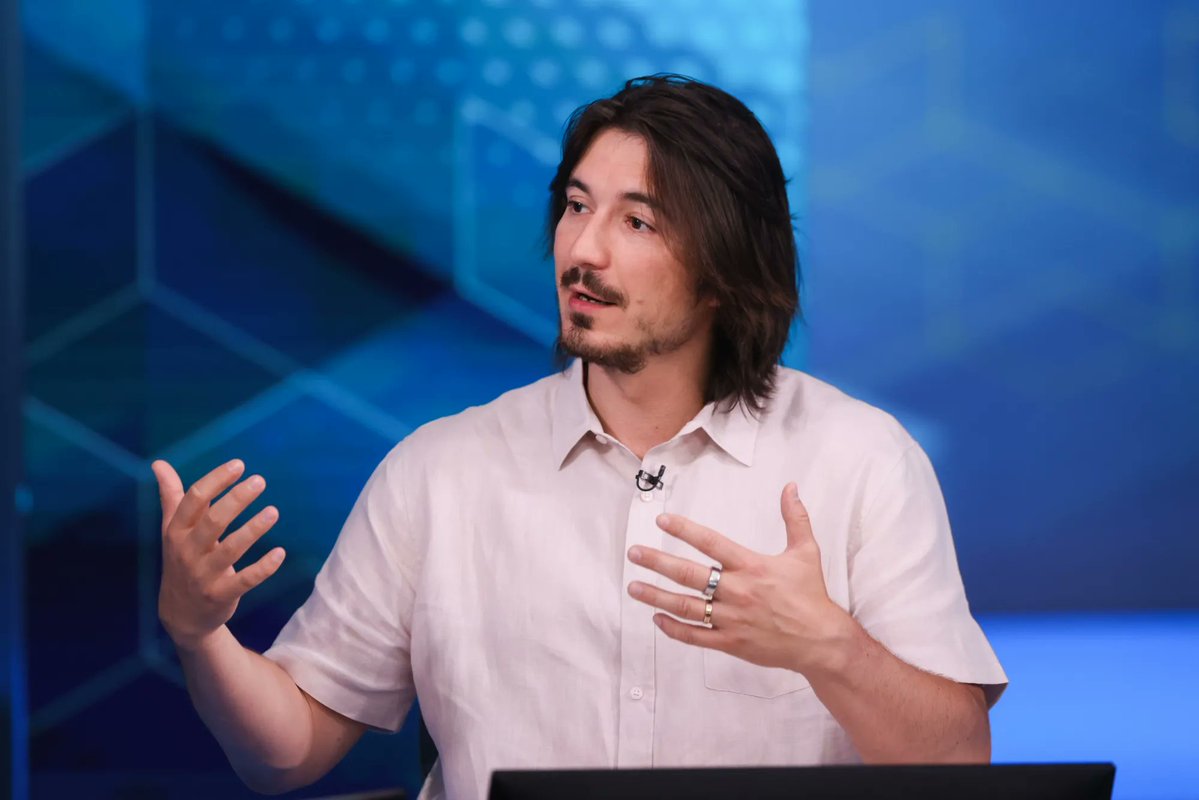
$HOOD
I have covered Robinhood for the past 3 years, and it is fair to say that something really different has happened in the past 2 weeks since their Crypto event in the UK.
Why? Well...
Just over one week after launch of the Robinhood Chain:
- 17M+ transactions
- Nearly 350K total addresses
- Nearly $250M in protocol TVL
- More than $1B in DEX trading volume
And three days ago, Robinhood Chain flipped Hyperliquid in 24-hour DEX volume, according to DefiLlama:
Robinhood Chain: $433.19M
Hyperliquid: $296.23M
The implications for $HOOD are significant and really cannot be ignored by the market.
Robinhood is evolving from a brokerage that earns from customer trading activity into a vertically integrated financial ecosystem with its own blockchain, exchange infrastructure, tokenized assets and on-chain liquidity.
This along with the Trump accounts is why I think the stock has finally decoupled from $BTC and is now trading at 80% above its lows in May. Bitcoin could go up or down, the market has moved on with pegging HOOD's stock to random BTC fluctuations, because HOOD is so, so much more important than what happens with any individual coin.
If Robinhood Chain continues gaining adoption, Robinhood could capture economics from:
- Blockchain transaction fees
- DEX trading and liquidity activity
- Tokenized stocks and real-world assets (something Vlad really wants to push heavily as he sees the entire world is moving on chain)
- Stablecoin payments and settlement
- Third-party applications built on its network
- Increased customer deposits and engagement
The bigger opportunity is that Robinhood may no longer need to simply route transactions through financial infrastructure owned by other companies.
It could increasingly own the infrastructure itself...which has always been the bull case for them in crypto. It's not just about making fees off people trading coins, but owning the entire stack when it comes to the broader crypto ecosystem.
That gives Robinhood more control over the customer experience, potentially stronger margins and several new recurring revenue streams.
It is still early, and some of the initial volume may be driven by launch incentives, but Robinhood Chain is already showing that the company could become far more than a retail brokerage. The main assets being traded on it right now are meme coins, which some people may think are a joke, but to me this is showing the willingness of so many native crypto investors to accept Robinhood Chain as a legitimate platform to be able to trade on and eventually, millions of other assets with real world utility will come on chain.
$HOOD is building toward becoming a global, crypto-native financial platform and that level of innovation and speed is what has helped the stock recover this year but is also getting the street excited for the future, diversified streams of revenue which will continue to compound earnings over the coming years.
LFG.
I think robotics is the next 10x asymmetric trade.
I spent the last week writing a deep-dive research report on my thesis and breaking down exactly how I'm building exposure to this sector.
This is the most important financial research I've published all year:
IF YOU DIED TOMORROW, YOUR FAMILY WOULDN'T BE ABLE TO ACCESS A SINGLE THING YOU OWN DIGITALLY.
BANK ACCOUNTS. PASSWORDS. CLOUD STORAGE. ALL OF IT PERMANENTLY LOCKED AWAY.
HERE'S HOW TO FIX IT IN 30 MINUTES:
Google, BlackRock, and 140+ of the world's largest companies just launched a digital dollar to reset the financial system.
This is the government's secret plan to keep inflation higher.
And it’s putting your hard-earned savings at serious risk.
Here's what's happening:🧵
.@DavidSacks says Palantir CEO Alex Karp is brilliant and completely correct: companies must own their means of production if they don't want to transfer their alpha to OpenAI and Anthropic.
"Enterprises are at risk of transferring their knowledge, their know-how, their trade secrets and their customer data to model providers who might eventually decide to compete with them."
"Enterprises are waking up to this threat, and they're not happy about it. I think Karp is exactly right about that."
"What safety means for an enterprise is—they get to control their own data, their model weights and their compute, so a frontier lab can't hoover up their proprietary knowledge, their alpha, and turn it into their next product."
"Look at what happened to Figma. Anthropic 'blindsided' its then business partner with the launch of Claude Design."
" Anthropic's chief product officer even served on Figma's board and didn't resign until three days before the launch of Claude Design."
"This is not an isolated example."
"Anthropic has also launched Claude Science, Claude Security, Claude Legal, Claude Financial, and of course, Claude Code."
"Every single one of these vertical apps expanded into categories that was previously served by companies building on top of Anthropic's own models."
" They're watching where the value is being created on top of their models, then they're moving in directly."
"The pattern is clear. They are going to use their dominant position in the model to then grab more and more territory in any interesting and lucrative vertical."
" Back to Alex Karp's point: if you're an enterprise customer or a developer, why in the world would you ever want to share any proprietary data with them?"
"You are mortgaging your future. You're sealing your fate. You are going to lead to disaster for your company."
Via @theallinpod@jason@chamath@friedberg
10 WAYS TO PLAY ROBOTICS IN 2026
1. $TER tests AI chips & owns the cobots through Universal Robots
2. $NOVT precision photonics & motion inside surgical & industrial robots
3. $OUST eyes & perception for physical AI machines that need to see & map physical world
4. $HIMX provides vision & display chips that help robots process images, depth & sensor inputs at edge
5. $AMBQ low power edge AI layer for robots & devices that need intelligence without burning massive amounts of energy
6. $ON becomes physical AI edge stack after acquiring $SYNA combining power, sensing, connectivity & edge AI for robotics
7. $SYM warehouse automation pure play using robotics & software to redesign how goods move through fulfillment centers
8. $VPG sits in force sensing & precision measurement layer that helps robots understand pressure, weight & real world movement
9. $TSLA humanoid platform bet with Optimus combining custom hardware, AI inference, autonomy software & real world manufacturing scale
10. $CCXI gives public market exposure to Agility Robotics which is one of clearest pure play humanoid robotics companies through its Digit warehouse robot
Sergey Brin rarely speaks publicly. He sat down for an unscripted Q&A on Frontier AI.
He admits even the people building these models do not fully understand what they have created:
1. All the specialized AI models are converging into one. Google used to need separate models for different scientific problems. Now the main Gemini models are becoming state-of-the-art for math and other scientific questions at the same time. Brin says he would not have predicted this convergence at the outset, and watching it happen has been incredible.
2. Training an AI on one skill mysteriously improves unrelated skills. This is the concept of transfer. Train a model on coding, and its math reasoning gets better, and vice versa. Teaching it to process images can improve its ability to think through geometric word problems. The capabilities bleed into each other in ways nobody fully engineered.
3. Even Sergey Brin does not know how to prompt these models. He says he is genuinely confused about what level to prompt at. Do you tell it to debug a specific chunk of code, or ask it to write a better neural net training algorithm, or just say, " What should I do today. He admits that even at Google, they do not know exactly where the edges of Gemini's capabilities are.
4. One of the biggest leaps in AI came from the dumbest sounding trick. Chain-of-thought prompting is just telling the model to think step by step before giving your problem. Brin says it seemed like the dumbest thing ever, and there was no obvious reason it should work. But it did, and it spurred a significant increase in AI capability. Some of the most straightforward requests turn out to unlock the most.
5. Brin would not modify his own biology for today's AI. Asked how humans can keep up with the accelerating bandwidth of models, he acknowledged neural links and direct brain connections are being pursued. But he said he would personally wait for the technology to mature a lot before doing anything to change his biology. Today's models do not justify it.
6. Super intelligence does not mean solving the impossible. An audience member argued that true super intelligence would mean solving NP complete problems like the travelling salesman. Brin pushed back. Most computer scientists believe P is not equal to NP, which means no algorithm can reliably solve those problems optimally, and it does not matter how smart the AI is. Impossible stays impossible. Super intelligence just means being smarter than humans.
7. Computers mastering a skill has never stopped humans from pursuing it. Deep Blue beat Kasparov at chess in the 1990s, and people kept playing chess. After AlphaGo, the human game of Go advanced dramatically, and the players who lost to it became vastly better. Brin's point: AI does not retire human ambition in an area; it often pushes the state of the art and pulls people up with it.
8. Brin thinks something close to transformers could get us to AGI. Asked directly if transformers are sufficient, he said his guess is yes, largely because they have proven weirdly flexible, working for image and video far beyond their original text purpose. But he was careful to note they have quietly changed a lot along the way and are not the same architecture as the original transformer paper.
9. AGI means two different things, and one requires understanding the physical world. Brin personally thinks of AGI as AI that can improve itself. But he concedes others define it as AI that can do anything a person can, and he thinks they are probably more correct. To do everything a person can, the AI must understand and interact with the physical world, which is why world models, and robotics, become essential.
10. Inside Google, they now use the AI to build the AI. Brin says the team has shifted a lot of energy toward having the AI do things like monitor training runs and generate its own training data. You start to use the tool to build the tool. That is most of what he spends his time on now, what he calls the self-improvement game.
11. Brin is unusually candid about where Google trails its competitors. He admits Google was a little late to focus deeply on coding. He says Gemini 3.0 and 3.1 were on top across the board six months ago, but other labs have since made strides, particularly in coding. He gives a competitor's model the edge now on deep coding and overnight tasks, while pitching Gemini's flash model as far faster for rapid interactive iteration. hindsight, he says, is that they should have focused on code earlier.
12. He sees his own role as a rabble-rouser, not a manager. Brin is honest that delivering Gemini is Corey and Demis's responsibility, not his. he describes his job as poking and prodding the team, asking, are you really doing that, reminding them of priorities they might be missing and ideas they are not paying enough attention to. He admits this is sometimes a little disruptive.
13. Confidence comes from ignoring the monthly temperature. Brin says if he judged Google's position every month by which competitor just shipped a model, he would lose his confidence very quickly. Instead, he watches the longer arc. Things shift around constantly; one lab leads on one thing, another pulls ahead somewhere else, and he feels good about where Gemini actually is despite the day-to-day noise.
Circle just lost a fifth of its value in a single day, and the blow came from its own inner circle. Its stock fell 17 percent after a new stablecoin launched, which is normal.
What is not normal is who built it…. the asset manager that runs roughly 80 percent of Circle's reserves, the exchange that co-founded USDC and is paid nearly a billion a year to distribute it, and the bank that holds the money. BlackRock, Coinbase, and BNY Mellon all backed a rival to the coin they help operate. The story is not really about a competitor.
Circle makes money one way, and it explains the whole reaction. $USDC is a digital dollar.
For every one in circulation, Circle holds a real dollar in cash and short-term Treasuries, roughly 74 billion dollars of reserves, and the interest those reserves earn is almost the entire business. About 80 percent of that pile sits in one fund, the Circle Reserve Fund, managed by BlackRock and custodied by BNY Mellon.
To get USDC into the world, Circle pays distributors. In one recent year it paid Coinbase alone 908 million dollars.
On June 30th more than 140 companies launched a competitor called Open USD, and it inverts the one thing Circle relied on. Instead of the issuer keeping the reserve interest, Open USD shares almost all of it with the businesses that use and distribute the coin. Free to mint, free to redeem, no caps. For any firm that had been helping Circle earn that interest for a fee, the math flips: stop collecting a fee to build someone else's yield, and collect the yield yourself.
The names that signed on are the core of Circle's own machine. The exchange that co-created USDC and earns close to a billion a year distributing it is not only backing Open USD, it is launching it on Base, the blockchain that exchange itself owns. The manager of roughly 80 percent of USDC's reserves is backing it too, and so is the custodian bank. The firms paid to run the reserves, sell the coin, and hold the assets are helping stand up an alternative.
This was clearly written into the incentives from the start. Coinbase earning 908 million to distribute Circle's product is Coinbase working for Circle. Coinbase owning a share of a rival that runs on its own chain is Coinbase working for itself. Once a distributor can own the economics instead of renting them, loyalty to the issuer means leaving money on the table. And the Coinbase deal is up for renewal in August, so Circle now renegotiates with a partner that just helped launch the alternative. That does not make the outcome certain. It changes who holds the leverage.
The deeper pattern reaches far past Circle if you look carefully. It is the risk in any business whose profit comes from sitting in the middle of other people's money.
Circle's role was to be the middleman on the digital dollar, holding the reserves and keeping the interest while everyone else moved the coin. That works until the parties on both sides decide they can route around you and split what you kept. The reserve manager, the distributor, and the custodian do not structurally need the issuer to capture that yield, and Open USD is the first serious attempt to prove it.
None of this means Circle is doomed, and the fair reading matters. This is also just rational diversification. BlackRock earns fees across every rail it can touch, backing a new one does not require abandoning the old one, and Open USD does not launch until later this year.
USDC is still trusted, deeply liquid, and regulated, and Circle's CEO argues the market is big enough for many winners, which may well be true.
But the message in the stock is hard to miss.
A company whose whole moat was owning the middle just watched the firms on either side of it agree to build a road around it. The most dangerous rival is rarely the stranger. It is the partner who already knows exactly how you get paid.
so Trump's annual financials came out today
he made $635M off his memecoin
then he bought a minimum of $1M of stock in companies like $AMZN $PLTR $MSFT $NVDA and $AAPL
JD Vance's report came out and he only owns the S&P, Nasdaq and Dow Jones 💀
i don't think we are ever going to have a President this intimately tied to the stock market and individual names within that stock market
Crypto sentiment is at its worst level since the FTX collapse; the RSI is at an all-time low, Google searches are down, and the fear and greed index is screaming danger, so I sat down with my friend Tom Lee (@fundstrat), Fundstrat's (@FundstratCap) chief strategist and Bitmain's CEO, to get his honest take on where Bitcoin, Ethereum, and the entire crypto market go from here. If you're sitting on unrealized losses right now and wondering whether to hold or fold, this is the conversation you need to hear.
Watch/Listen on X, YouTube, and Spotify.
Timestamps
0:00 Tom Lee Introduction
1:12 Is capital being sucked out of crypto into AI?
3:05 Is Bitcoin in a 4-year cycle?
6:58 Tom Lee on Ethereum: "Price is lagging fundamentals."
8:55 Tom Lee: "AI agents might become wealthier than us."
9:46 Is Tom Lee worried about Quantum resistance in Bitcoin?
11:22 Anthony: "Michael Saylor has become the Bitcoin narrative."
14:35 Anthony's Bitmine bull vs bear case
18:21 Post-FTX conviction: Bitcoin went from $15K to $126K, what does that teach you?
21:47 Tom Lee: These are dark days, but July is a new month
AI spent the last three years learning to think. The next three years it learns to move.
Here are 10 stocks to play the robotics trade in 2026:
1. $VPG - Vishay Precision Group
Q1 revenue up 17.6% YoY to $84.4M with $1M in orders specifically for humanoid robotics applications. Management outlined a 3-year plan targeting 8-10% organic growth driven by sensors for semiconductor equipment, AI data centers, and humanoid robotics. The picks and shovels of physical AI.
I survived the day with just 3 hours of sleep.
So here's a bit of stream of consciousness here.
The overall market is showing resilience, with small cap and NASDAQ outperformance forming a bullish trend that is most likely to continue climbing on a wall of worry.
ISM PMI crossed 50. Copper/gold ratio continues to improve and has bottomed 4 months ago. These are real signals of broadening economic activity and improving liquidity conditions.
The semiconductor sector and Japan are leading this rally, and despite inevitable corrections will come to reset sentiment, trend is still bullish and therefore the market will likely to continue to run up.
Selected sectors are being hit hard: software, China, and crypto. These crashes are happening on relatively low volume and are not happening in a broader market sell off, which to me means that liquidity is still rotating from one sector to another very slowly and is a sign of a healthy market.
It is particularly painful to hold these underperforming sectors while seeing the overall market and selected sectors doing so well. This is worse than having an overall market crash to most people because wealth is not an absolute number and people cannot help but to compare themselves to others even though it's completely meaningless.
Even though liquidity in the crypto sector currently is running dry, there hasn't been a FTX/Celcius/Voyager type bankruptcy because the liquidity conditions in the overall market are still doing well.
It's probably why some crypto-focused influencers are saying that sentiment isn't as bad as the last bottom and why there continues to be people optimistic about #Bitcoin, #Ethereum and the larger cap crypto. Some people still have money and are still interested in speculation.
With that said, I assure you that people on here talking about crypto is now a minority of overall market participants, and most people aren't bearish or bullish on the sector because they simply don't give a damn about it. People have been exiting the crypto space left and right. Miners have left. Most retail have been forced out in the October 2025 crash, and many have learned the lesson to not be in crypto and just stick with stocks. The sample size of sentiment that you get on here aren't a huge segment of the general population and thus probably isn't as good of a sentiment gauge as the last cycle's accumulation phase.
You now have gold, silver, China, crypto, and software stocks selling off all at once.
Gold and silver have had some generational run-up over the past 2 years with a ton of liquidity trapped in them.
China hasn't done anything for 1 year.
Crypto and software stocks haven't done anything for 2-4 years.
The macroeconomic environment is such that it allows selected speculation to thrive, while others wait.
Thus, it is my opinion that this is not yet a bubble, that we are nowhere near the top, and that the best 2 strategies to me is to identify and buy early bull trends on the dip, or be patient and build position on assets that are trying to form a base while nobody cares about them.
Even I don't really feel like talking about the assets that I buy anymore. It doesn't make me feel great buying them or talking about buying them. This means either I'm an idiot and my buys are going to zero, or that they are good buys because it don't make me feel good.
Those who remain diversified and allocate to a basket of 15-20 stocks in 4+ sectors, as well as those heavily allocated to the overall market, are doing well with my macro views and will likely continue to do well moving forward if they can handle the volatility.
Those who listened to my bullish call last year on Silver, I hope my charts helped you to get out over the last few months, as I think liquidity is rotating away from it now.
I still feel comfortable allocating a portion of my portfolio to crypto-related equities not because they've been doing well but to anticipate what I think will probably be coming in 2027-2028.
I remember adding to $PLTR at $6, $SOFI at $4, $AFRM at the teens, $HOOD at $12, $IREN at $5, $CIFR at $3, $SHOP at $25, $TQQQ at $20s, and many more that felt like terrible decisions at the time in 2022-2024.
I remember turning on my laser eyes in Nov 2022 when #Bitcoin was 16K, which was cliche in hindsight.
I need to learn to celebrate my wins better, but I probably won't.
I cannot guarantee anything about $COIN $CONL #Ethereum $DOGE $BMNR $BTCS $RIVN $QUBT $TIGR $BABA moving forward. I've been on #Ethereum 3-4 years ago and $COIN 1.5 years ago. They have been disappointing many, but all I know is that I am patient, open to be wrong, and will be around long enough to see how they play out over time.
President Trump just committed $17,500,000,000 to build 10 new nuclear reactors
Here are the stocks that benefit:
$CCJ: Cameco
*Owns nearly half of the private company building all 10 reactors, and sells the uranium to fuel them
$BAM: Brookfield
*Owns the other half of that same company
$BWXT: BWX Technologies
*Builds the actual reactor parts inside each plant
$CW: Curtiss-Wright
*Makes the pumps and valves that keep reactors running safely
$LEU: Centrus Energy
*The only U.S. company that enriches uranium domestically
$MSFT has respected its multi-year ascending channel since 2022 and right now, it's doing exactly that.
The dotted path says it all — I expect one more retest of support to carve out a higher low before the next leg up, similar to late 2022. Patience is the trade.
For people who are worried about the market today, I get it. This stuff is very stressful.
So I put together a chart of all of the times the VIX (the "fear index" of the market) was up over 30% in a day (like today) in the past ten years.
23 out of 25 instances the market was higher one month later. The only two times it wasn't was Feb 2020 when Covid hit the economy in March 2020.
What is the underlying message? When people are afraid, they make bad decisions. Do the opposite.
Attached is a chart summarizing my results.
🚨 EVERYTHING THAT COULD GO WRONG FOR MARKETS WENT WRONG TODAY.
S&P 500 down -1.65%, wiping out $1.14 trillion.
Nasdaq down -2.60%, wiping out $1.11 trillion.
Gold down -3.38%, wiping out $1 trillion.
Silver down -6.9%, wiping out $280 billion.
Bitcoin down -6.31%, wiping out $80 billion.
In total $2.5 TRILLION wiped out in a single session. These were not isolated moves. Everything started breaking at the same time.
It started with the jobs report this morning.
The US economy added 172,000 jobs in May. Wall Street expected 88,000. That is almost double.
On any normal day, strong jobs is good news. But inflation is already at 3.8% and oil is sitting at $90. A labor market this strong tells the Fed it cannot cut interest rates and may actually need to raise them.
The probability of a rate hike this year went from 40% to 57% in a single day. That spooked every investor holding tech and growth stocks because higher rates mean those stocks are worth less today.
Then the AI trade started cracking.
Yesterday Broadcom reported record earnings: revenue up 48%, AI chip sales up 143% and the stock still crashed 12.6%. The reason was simple.
Broadcom did not raise its AI revenue targets for the year. Investors had expected it to. That single miss made people ask a question they had been avoiding for months: are we paying too much for AI stocks?
That question got louder today when a research firm called SemiAnalysis revealed that Nvidia's next-generation AI chips will need significantly less memory than everyone assumed, roughly half of what the market was pricing in.
Memory chips are what companies like SK Hynix and Samsung make. SK Hynix fell nearly 10% today. Samsung fell over 6%.
South Korea's entire stock market crashed 5.5% in a single session. Japan's semiconductor stocks did the same.
And then Anthropic added fuel to the fire by publishing a report warning that AI is getting close to the point where it can improve itself without human help and calling for a global pause in AI development.
Coming on the same day as the memory demand news and Broadcom's miss, it fed a single growing fear across the market: what if the AI boom is moving faster than the business models can keep up with?
Underneath all of this, there is a liquidity problem nobody is talking about.
SpaceX goes public next week at a $1.75 trillion valuation. Anthropic just filed to go public. OpenAI is next.
These three companies together are worth $4 to $5 trillion. Fund managers need cash to buy into these listings.
But cash levels are already at their lowest since early 2024. The only way to raise cash is to sell what they already own. That selling is happening right now.
The new Fed Chair Kevin Warsh will also hold his very first policy meeting in 11 days. He was appointed by Trump with the expectation of cutting rates.
He is now walking into a situation where inflation is high, oil is high, and the job market is running hot. Investors do not know what he will do.
When nobody knows what the most powerful central banker in the world will decide in less than two weeks, the safest move is to reduce risk today.
Everything that could go wrong, went wrong at the same time. A hot jobs report, a collapsing ceasefire, a crack in the AI trade, a trillion dollar liquidity drain, and a Fed meeting with no clear outcome.
What just happened?
The S&P 500 just erased nearly -$2 TRILLION of market cap just hours after 3rd strongest US jobs report in 18 months.
Meanwhile, Bitcoin is officially down over -50% from its record high in October 2025.
What's happening? Let us explain.
(a thread)