Here is my AI investing guide.
Sitting here August 2026, my current best thoughts are as follows:
1. LPS (Land Power Shell) is still the most obvious and fastest path to cash on cash returns. Lots of value can be assembled and traded quickly at this layer. And as data centers get more pushback, energized land can explode in value. Very bullish here.
I’ve stepped into this layer very aggressively. My partner @anitavlallian and I have acquired almost 6GW coming online in a ramp from today thru 2029 of grid power and behind the meter.
2. Silicon - I helped get @GroqInc off the ground in 2015 and we licensed it to @nvidia for $20B Dec2025. I won’t invest or incubate anything in this layer now. The perf demands of the chips are too high, manufacturing precision is too complex and supply chain influence to get adjacent components like memory isn’t possible for a startup anymore. Lots of capital will be wasted here chasing Groq and Cerebras’ success. Note that both startups made sense a decade ago when these constraints were much more modest.
3. Clouds - Clouds are very very lucrative but very hard to build and very expensive and technically complicated to maintain. And as alignment becomes a more important issue, I expect the clouds will be asked to build robust KYC and attest to it. This makes the risk:reward ratio skewed. I don’t want to be responsible when the USG says a cloud allowed a bad actor to do something bad because of poor KYC.
4. Models are complicated. The big open question is how much of the revenue being generated by them today is because of tokenmaxxing and poor model behavior. If it’s a lot, then the annualized revenues will diminish meaningfully even as token consumption inflects upwards. This is the big economic question at this layer.
5. Harnesses are where the action is and why I started @8090solutions two years ago. In a nutshell, the harness helps enterprises owns their proprietary context (what Alex Karp calls their ‘alpha’). This is an enterprise’s data, workflows, evals, and business rules. A harness that gives this to an enterprise is what creates very low model-agnostic switching costs, which further reinforces my views of #4 above.
6. Applications will be another long term winner along with harnesses. This is where the differentiation between “off the shelf” and “custom time and materials” melts away. Every company, with the right harness, can now imbue their alpha into the software that runs their company. I expect this to mean that “off the shelf” is largely replaced with custom software creating a huge opportunity to write these solutions for companies. Build once and sell repeatedly is a laggard GTM motion for a SaaS world that isn’t needed here. Think custom by design, alpha embedded, proprietary by nature.
Fin.
Good luck to all the players!
As of today, let’s assume 99% of all code written on the internet is still human written and 1% is agentic.
That means 99% of code is sloppy and error ridden. Humans make errors that agents don’t.
As agentic code replaces human code, both the error rates and security incidences will GO DOWN.
There will be new forms of attack vectors by swarms of agents but I would not shut down the internet because of that because companies will have sophisticated swarms of agents to protect them.
If everyone uses commercially available open or closed source models, a stalemate is the most likely terminal outcome.
That said, the immediate priority is obvious. We need to rewrite all the code in all the enterprises. Period. Non negotiable.
So let’s get on with it, close the security holes and flip to a 100% agentic code universe which, still may not make useful or tasteful products, but at least won’t have the errors that humans leave behind as we work.
My interview with @nejatian, CEO of Opendoor.
This is a rare look inside a turnaround, while it's happening. It's raw, real, and violent.
Kaz took over $OPEN when it was months away from bankruptcy. His wife shipped a mattress to the office and told him not to come home until he had a plan to break even.
Some of what he told me:
• "All success is unique, but all failures rhyme."
• The most dangerous people in a company are competent but not mission aligned.
• Meetings are a bug in the system.
• The comfortable lies that sink a company are the same ones that sink careers (and countries).
(Shane and guests may hold positions in assets discussed in this episode. Nothing in this conversation should be considered investment advice, financial guidance, or a recommendation to buy or sell any security.)
You don't need a meeting transcriber. You need a meeting scoped narrowly enough that resulting decisions impact business context that day. The decision and reasoning are the signal, everything else is noise.
Very interested in what the coming era of highly bespoke software might look like.
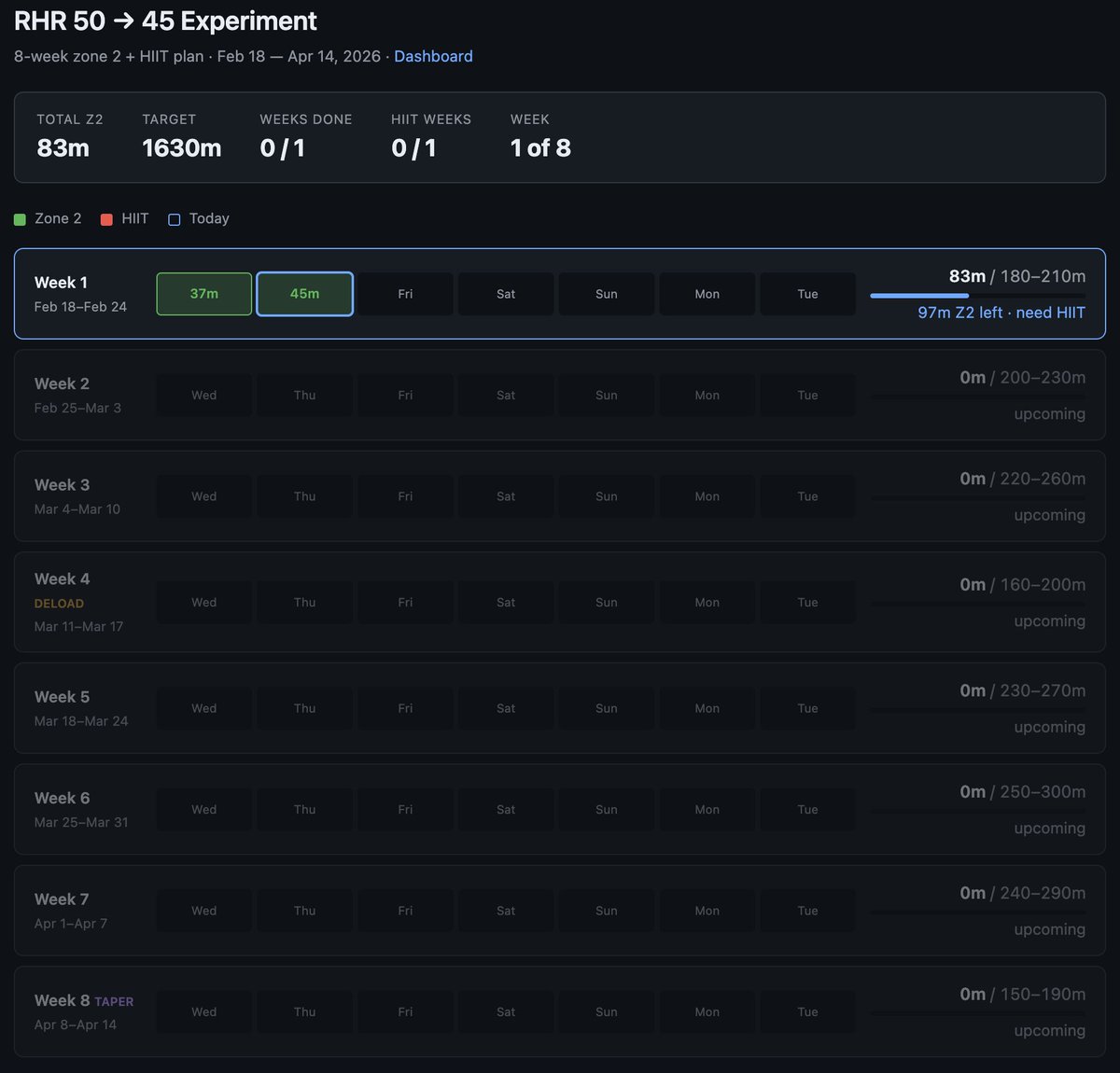
Example from this morning - I've become a bit loosy goosy with my cardio recently so I decided to do a more srs, regimented experiment to try to lower my Resting Heart Rate from 50 -> 45, over experiment duration of 8 weeks. The primary way to do this is to aspire to a certain sum total minute goals in Zone 2 cardio and 1 HIIT/week.
1 hour later I vibe coded this super custom dashboard for this very specific experiment that shows me how I'm tracking. Claude had to reverse engineer the Woodway treadmill cloud API to pull raw data, process, filter, debug it and create a web UI frontend to track the experiment. It wasn't a fully smooth experience and I had to notice and ask to fix bugs e.g. it screwed up metric vs. imperial system units and it screwed up on the calendar matching up days to dates etc.
But I still feel like the overall direction is clear:
1) There will never be (and shouldn't be) a specific app on the app store for this kind of thing. I shouldn't have to look for, download and use some kind of a "Cardio experiment tracker", when this thing is ~300 lines of code that an LLM agent will give you in seconds. The idea of an "app store" of a long tail of discrete set of apps you choose from feels somehow wrong and outdated when LLM agents can improvise the app on the spot and just for you.
2) Second, the industry has to reconfigure into a set of services of sensors and actuators with agent native ergonomics. My Woodway treadmill is a sensor - it turns physical state into digital knowledge. It shouldn't maintain some human-readable frontend and my LLM agent shouldn't have to reverse engineer it, it should be an API/CLI easily usable by my agent. I'm a little bit disappointed (and my timelines are correspondingly slower) with how slowly this progression is happening in the industry overall. 99% of products/services still don't have an AI-native CLI yet. 99% of products/services maintain .html/.css docs like I won't immediately look for how to copy paste the whole thing to my agent to get something done. They give you a list of instructions on a webpage to open this or that url and click here or there to do a thing. In 2026. What am I a computer? You do it. Or have my agent do it.
So anyway today I am impressed that this random thing took 1 hour (it would have been ~10 hours 2 years ago). But what excites me more is thinking through how this really should have been 1 minute tops. What has to be in place so that it would be 1 minute? So that I could simply say "Hi can you help me track my cardio over the next 8 weeks", and after a very brief Q&A the app would be up. The AI would already have a lot personal context, it would gather the extra needed data, it would reference and search related skill libraries, and maintain all my little apps/automations.
TLDR the "app store" of a set of discrete apps that you choose from is an increasingly outdated concept all by itself. The future are services of AI-native sensors & actuators orchestrated via LLM glue into highly custom, ephemeral apps. It's just not here yet.
Americans preparing to get a Covid-19 booster can choose whether to stick with the same vaccine as their initial shots, or choose a different one. Here’s a look at advantages, disadvantages and side effects of mixing and matching. https://t.co/aHtDxY5aeP
A lot of pro-CSAM scanning arguments take the following form: “phones already have lots of opportunities (real and potential) for privacy abuse, so you’re stupid for minding when we try to introduce a new and highly-scalable one.”
@allenholub It's one small part of the system, but WFH had a very significant impact on our cycle-time, reducing it to ⅓ of our pre-lockdown cycle time once we had learnt how to collaborate and work together remotely effectively
People believe they think objectively - but we don’t.
The brain takes in all environmental info, analyzes it against a lifetime of experience, and spits it out in half a second.
The analysis isn’t clean - it’s overlayed with influence. Pause & challenge it often.
My grandpa was one of my heroes.
He influenced my life in more ways than I can count.
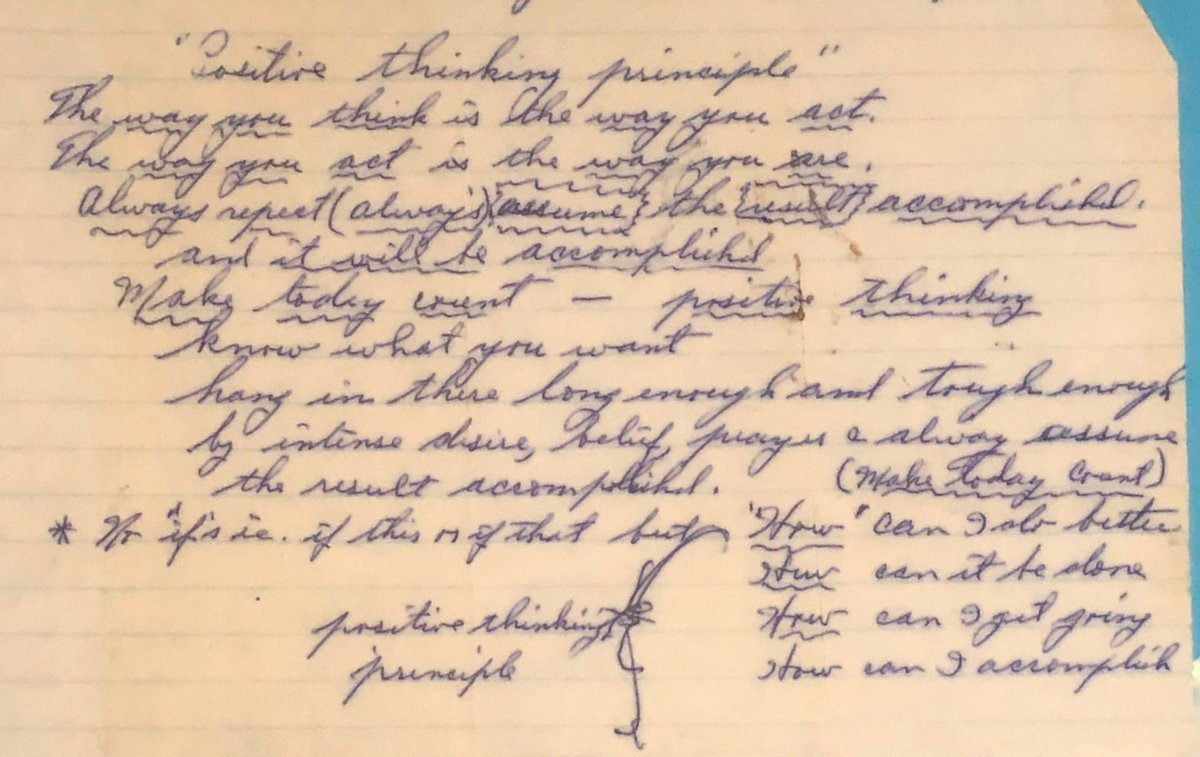
He passed away almost 15 years years ago, but today we found this page in one of his old notebooks.
He titled it the “Positive Thinking Principle”
Transcribed below…
This is, very very slowly, finally getting fixed, largely through banks getting out of the business of writing loan applications (!) and adopting technology partners which have 1+ people who keenly care about UX on staff.
I don’t have any specific opinion to share about Basecamp’s management decisions except that there’s exactly zero chance I send a new client a link to join a basecamp project with all this drama going on.
India is deeply intertwined in the success of Silicon Valley & the future of the US. 🇺🇸🇮🇳
We should do whatever we can to help them & more importantly, we should let them know we will always be there for them. 💉
This is almost a Marshall Plan moment.
https://t.co/MRpZ6aRLDE
1/ The first 18 months of a startup:
After starting my 2nd company in 2019, I decided I would write down useful lessons I learned or re-learned along the way. Some were hard-earned & others required steady focus. A thread that I hope may help other founders starting out 👇
After seeing strange analytics on a project, ran a controlled test and confirmed that customers of Microsoft email services can expect attachments sent to them to be cached, parsed, and any links in those attachments are being loaded, complete with images, and cached. #creepy