The older you get, the more you realize that people actually get what they want from life; it's just that most people also don't know what they want, and they default to want what other people want, and that's a weak motivation, and they end up drifting away from one superficial goal to another, without ever being truly committed to anything, without ever sticking any real meaningful direction.
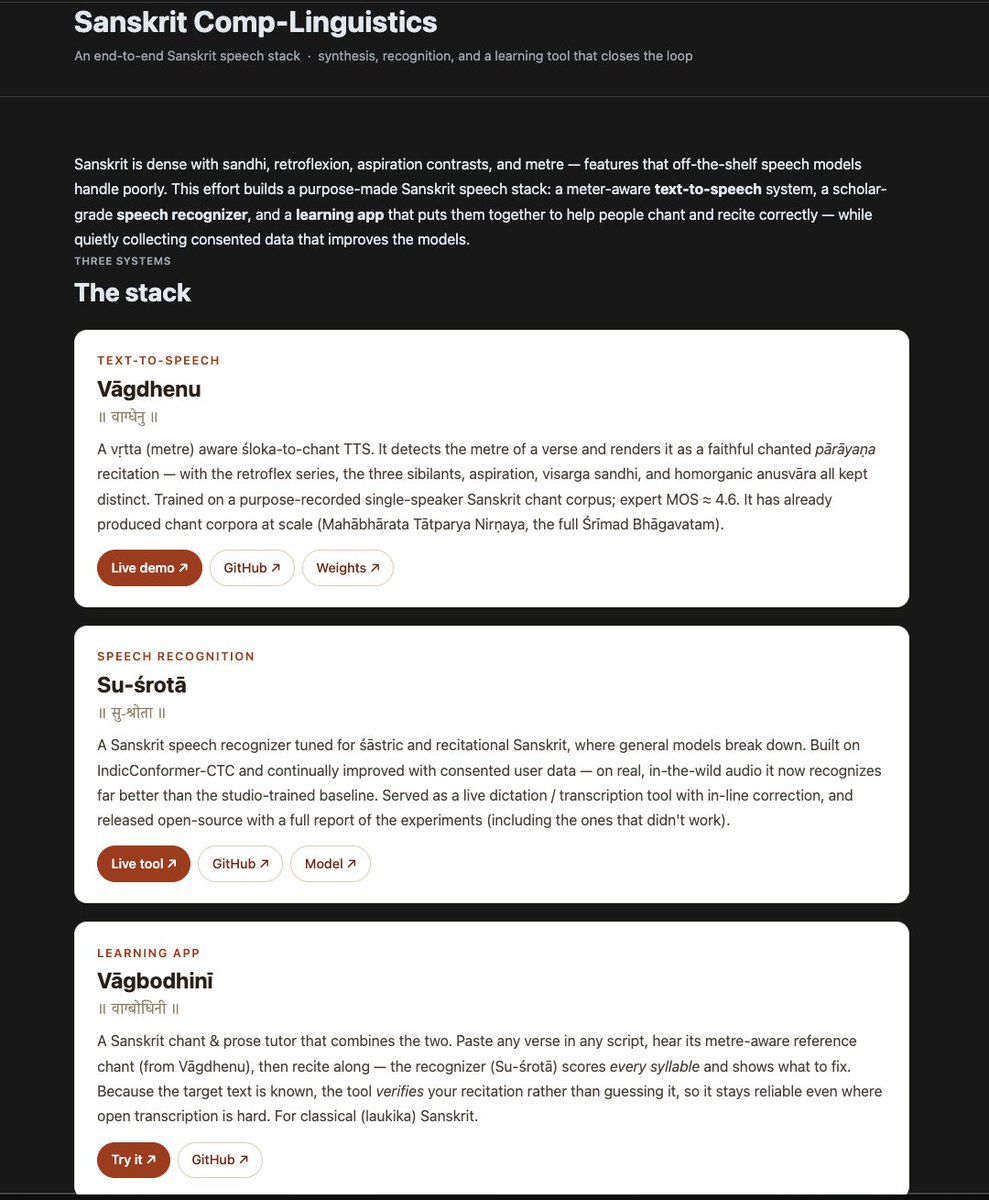
This summer, I worked on a few interesting use cases of AI for Sanskrit - a chant TTS, ASR, chant-learning feedback tool, and several apps, including Bhagavatam and Sarvamula. I just collated all of them in one place: https://t.co/H23qjXPapu. May be of interest to a few here.
What is the purpose of higher education in the age of AI?
I had a very candid conversation with my students about pedagogy, universities, and what needs to change.
Sharing it here to hear what others think. The link for the full talk is in the first reply.
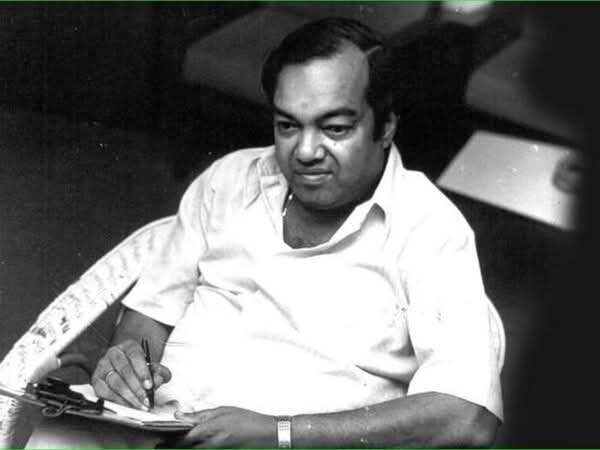
“பாரதியோடு பலர் என்னை ஒப்பிடும்போது எனக்கே மிகவும் வெட்கமாக இருக்கும். என் பாடல்களில் அவசரத்திற்காக எழுதப்பட்ட செயற்கைப் பாடல்களும் உண்டு. கவிதைக்குரிய பொய்கள் உண்டு, நான்விற்ற பொருளில் நல்லபொருள் அதிகமில்லை என்பது நானே எழுதிய வரி
ஆனால் பாரதியோ பாரதி முழுக்க முழுக்கத் தன்னுணர்வுக் கவிஞன்
நான் எழுதிய பாடலும் சரி எழுத்தும் சரி, என்னை போன்றே பாடல்கள் எழுதுபவர்களும் இன்னும் பல எழுத்தாளர்கள் எழுத்தும் சரி அவற்றை பாரதியோடு ஒப்பிடும்போது ஒன்றுமே இல்லை, அவன் எழுதியதாக கிடைத்தது சிறிய புத்தகம் என்றாலும் அதைவிட மிஞ்சி யாரால் எழுதமுடியும்?
சுருக்கமாக சொல்லி பெரிய காரியத்தை செய்துவிட்டு சென்றவன் பாரதி, பல்லாயிரமாண்டு இலக்கிய பரம்பரைக்கு தலைகீழ் திருப்பத்தை அவனே கொடுத்தான்
இன்று என் பாடல்களை நான்கு கோடி மக்கள் இரசிக்கிறார்கள்; பாடுகிறார்கள். அதைக் கண்ணால் பார்க்கும்போதும், காதால் கேட்கும்போதும் எனக்கு உற்சாகம் பெருக்கெடுத்து ஓடுகிறது. அதனால் மேலும் மேலும் நான் எழுதுகிறேன்.
அந்த வாய்ப்பே இல்லாமற் போனவன் பாரதி. தன் கவிதையை யார் இரசிக்கிறார்கள் என்று தெரியாமலேயே அவன் பாடினான்…
காலம் எப்படி வரவேற்கும்? யார் எப்படி இரசிப்பார்கள?” என்பது தெரியாமலேயே தனக்குத் தோன்றியதை எல்லாம் பாடினான். அதனால் எந்தக் கவிதையைப் பாடினாலும் தேன் வந்து பாய்கிறது காதுகளில்.
பாரதி ஒரு ஜாதிக்கு, ஒரு மதத்துக்கு உரியவனல்ல; அவன் சர்வ சமரசவாதி. அவன் வங்காளத்தில் பிறந்திருந்தால் நோபல் பரிசு தாகூருக்குப் போயிருக்காது.
துர்பாக்கியம் பிடித்த தமிழகமே!
பாரதியைக் கொண்டாடு!
அதன் மூலம் பாரதத்தை நீ கொண்டாடுகிறாய்,
தேச பக்தியைக் கொண்டாடுகிறாய்,
தெய்வ பக்தியைக் கொண்டாடுகிறாய்,
தமிழ் மொழியைக் கொண்டாடுகிறாய்,
பாரதியைக் கொண்டாடாதவனுக்குத் தமிழன் என்று சொல்லிக் கொள்ள அருகதை இல்லை.”
கவியரசர் கண்ணதாசன்
ஆஸ்திகர்கள் மற்றும் சனாதனிகளுக்கு ஒரு அன்பான வேண்டுகோள்.
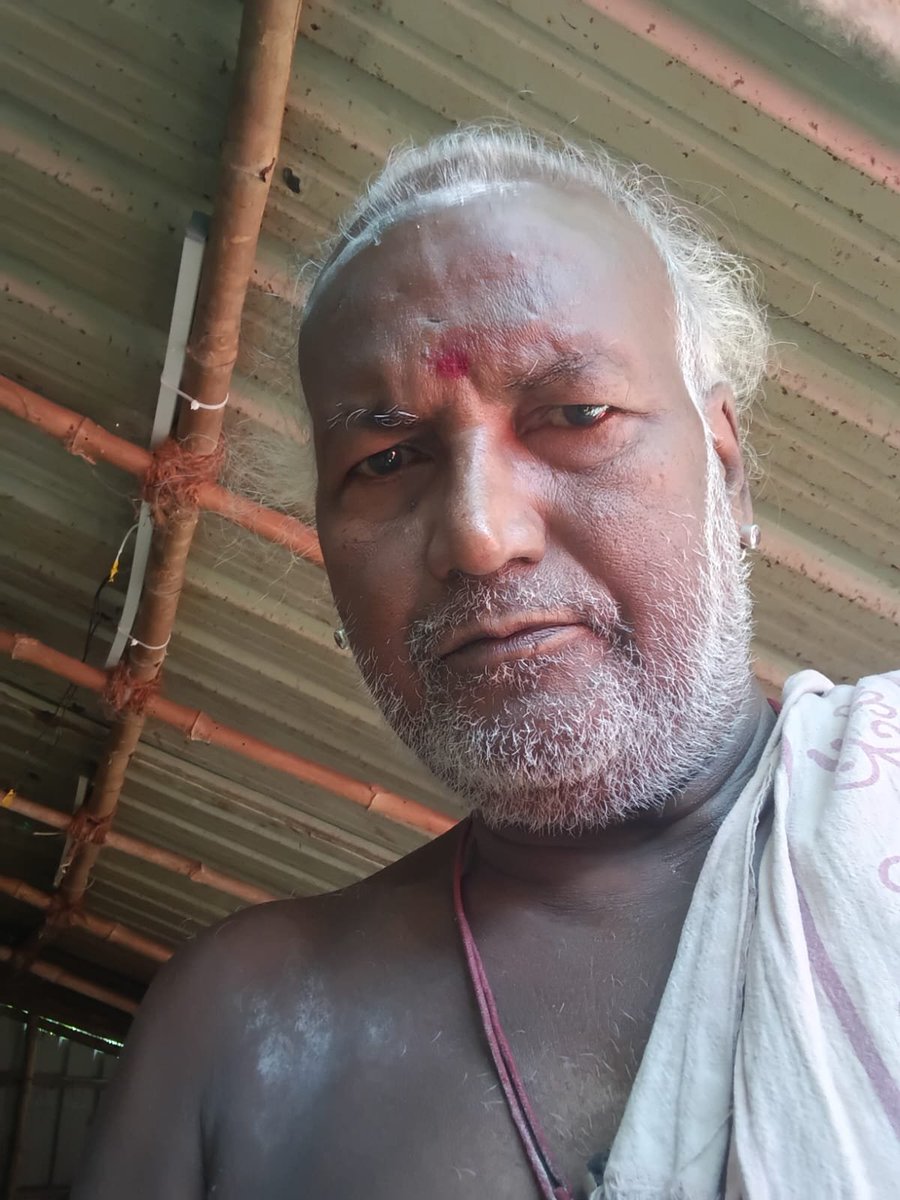
சேதினிபுரம் சிவன் கோவில் அர்ச்சகர் – ஸ்ரீ ஜெயராமன் கணபதி ஐயர் (67) அவர்களுக்கு தற்போது நிதியுதவி மிகவும் தேவைப்படுகிறது.
ஸ்ரீ ஜெயராமன் கணபதி ஐயர் அவர்கள் பல ஆண்டுகளாக மிகுந்த பக்தியுடனும் அர்ப்பணிப்பு உணர்வுடனும் சிவபெருமானுக்கு கோவில் கைங்கர்யம் செய்து வருகிறார்.
அவருக்கு குழந்தைகள் இல்லை;
நிலையான வருமானமும் இல்லை.
அவருடைய மனைவி திருமதி காமாட்சி (63) அவர்கள் உடல்நலக்குறைவால் பாதிக்கப்பட்டு, கவனிப்பும் மருத்துவச் செலவுகளும் தேவைப்படும் நிலையில் உள்ளார்.
மேலும், அவர்களிடம் ஒரு பசுவும் உள்ளது.
அந்தப் பசுவை அன்புடன் பராமரித்து வருவதுடன், அதற்கான தீனி மற்றும் பராமரிப்புச் செலவுகளையும் அவர் ஏற்றுக்கொள்ள வேண்டியுள்ளது.
இதுவும் அவருடைய பொருளாதாரச் சுமையை மேலும் அதிகரித்துள்ளது.
நிலையான வருமானம் இல்லாத நிலையில், குடும்பச் செலவுகள் மற்றும் மருத்துவச் செலவுகள் அதிகரித்து வருவதால், இக்குடும்பம் தற்போது மிகவும் சிரமமான பொருளாதார சூழ்நிலையில் உள்ளது.
எனவே, ஆஸ்திகர்களும் சனாதனிகளும் தங்களால் இயன்ற அளவு நிதியுதவி செய்து, இந்த குடும்பத்திற்கு ஆதரவளிக்குமாறு பணிவுடன் கேட்டுக்கொள்கிறேன்.
இந்த குருக்களுக்கு தயவுசெய்து ஆதரவளிக்குமாறு அன்புடன் கேட்டுக்கொள்கிறேன்.
🙏 நமஸ்காரம்.
வங்கி விவரங்கள்
பெயர்: ஜெயராமன் கணபதி ஐயர்
வங்கி: இந்தியன் வங்கி
கிளை: சேங்கலிபுரம் கிளை, திருவாரூர்
கணக்கு எண்: 6940649962
IFSC: IDIB000S104
GPay: 9659232244
🙏 ஓம் நமஃ சிவாய 🙏
PITRUDOSHA : 𝐓𝐡𝐞 𝐔𝐧𝐩𝐚𝐢𝐝 𝐊𝐚𝐫𝐦𝐚 𝐎𝐟 𝐘𝐨𝐮𝐫 𝐋𝐢𝐧𝐞𝐚𝐠𝐞
I am going to say something that most astrologers either do not know or will not say openly.
Pitru Dosha is not a ghost. It is not some dark energy sitting on your family that a pandit can remove in three hours if you pay enough. I have seen people spend lakhs on rituals and walk out of it with the same problems they walked in with.
It is an unpaid family bill. That is all it is.
When you were born, you did not arrive with just your own karma. You came carrying three layers. Your own past life karma, visible in the D60. Your mother's lineage karma, visible in the D40. And your father's lineage karma, the unfinished business, the broken promises, the harm done to people who could not fight back, visible in the D45.
Most astrologers never open D40 and D45. They look at D1, say a few things, and send you home. The D45 is where your paternal bloodline's unresolved account actually lives. What was left behind. What was ignored.
What was owed and never paid. The universe does not cancel those debts. It just waits for someone in the family capable of settling them. And here is the thing nobody says out loud.
Why you? Why not your sibling or your cousin who seems to have none of these problems? The classical tradition is clear on this. The most spiritually aware person in the family tree gets assigned this responsibility.
Not as punishment. Because they are the one actually capable of resolving it. You are not the most burdened person in your family. You are the most qualified. Now what does it actually look like in a chart.
Sun conjunct Saturn. Sun aspected by Saturn. Sun sitting with Rahu. These are the classic signatures. Sun is the soul, the father, the accumulated light of the ancestors. Saturn is karma, consequence, and the weight of what was left unpaid.
When these two are in tension in the chart, it means somewhere upstream in the paternal lineage, power was misused. Someone weaker was wronged. A responsibility was walked away from. That shows up in the native's life as career blocks, problems with authority figures, delayed recognition, or difficulty having children.
The ninth house and the D12 Dwadashamsha show the condition of the ancestral account. Ninth lord in the 6th, 8th, or 12th, the account is in deficit. More was taken than given back.
The eighth house of the Navamsha, the D9 shows the specific nature of the debt. What planet sits there tells you through which relationship and which area of life that old karma is being settled right now.
What actually resolves this.
The Gayatri Mantra, 24 syllables, consistent daily japa, is what the tradition places above everything else for lineage karma. Not once when you are worried. Every day. The tradition holds it lightens karmic weight across seven generations and I believe that completely.
Service to living parents. Not grand rituals after they are gone. The ninth and fourth house blessings live in the people who are still here. Start there.
Panchakshari, Om Namah Shivaya for the solar disturbance. Om Namo Bhagavate Vasudevaya for restoring harmony in the home and lineage.
You are not cursed. You are carrying something your bloodline left unresolved and you have the capacity to close that account. When you do, those same ancestors become the strongest protection your children will ever have.
As Pitru Paksha approaches, save this. Share it with your family. The healing of a lineage starts with one person who understands what is actually happening.
— Tushar Singh Rajput
((𝐃𝐢𝐬𝐜𝐥𝐚𝐢𝐦𝐞𝐫: This post draws from classical Jyotish principles including the Brihat Parashara Hora Shastra, Divisional Chart tradition, and Jaimini Sutras. Every chart is unique, and general principles do not replace a personal reading.))
𝐝𝐨 𝐲𝐨𝐮 𝐤𝐧𝐨𝐰 𝐰𝐡𝐢𝐜𝐡 𝐩𝐥𝐚𝐧𝐞𝐭 𝐬𝐢𝐭𝐬 𝐢𝐧 𝐲𝐨𝐮𝐫 𝟖𝐭𝐡 𝐡𝐨𝐮𝐬𝐞 𝐨𝐟 𝐍𝐚𝐯𝐚𝐦𝐬𝐡𝐚? 𝐜𝐨𝐦𝐦𝐞𝐧𝐭 𝐛𝐞𝐥𝐨𝐰
𝗦𝗼𝘂𝗿𝗰𝗲𝘀: 𝗕𝗿𝗶𝗵𝗮𝘁 𝗣𝗮𝗿𝗮𝘀𝗵𝗮𝗿𝗮 𝗛𝗼𝗿𝗮 𝗦𝗵𝗮𝘀𝘁𝗿𝗮 — 𝗗𝗶𝘃𝗶𝘀𝗶𝗼𝗻𝗮𝗹 𝗖𝗵𝗮𝗿𝘁𝘀 𝗔𝗱𝗵𝘆𝗮𝘆𝗮; 𝗝𝗮𝗶𝗺𝗶𝗻𝗶 𝗦𝘂𝘁𝗿𝗮𝘀 — 𝗔𝗿𝘂𝗱𝗵𝗮 𝗣𝗮𝗱𝗮 𝗦𝘆𝘀𝘁𝗲𝗺.
புளியோதரை புராணம்! - எழுத்தாளர் சுஜாதா அவர்கள் எழுதியது!!
ரெஃப்ரிஜிரேட்டர் கண்டு பிடிக்கும் முன்பே தமிழன் “வச்சு வச்சு” சாப்பிட்டது புளி சாதத்தைத் தான்.!
ஒரு வாரம் ஆனாலும் கெடாது.! அக்காலத்தில் வெளியூர் பயணங்களில் நம் கால்களே டாக்சியாக இருந்த காலத்தில் நம் பாட்டன்களின் பசியைப் போக்கிய வழிச் சோறு என்பது புளிச் சோறே! என்பது 100% உண்மை.!
எப்போதும் சுவை மிகுந்த உணவுகளின் பட்டியலில் டாப் 5 இல் இடம் பிடிக்கக் கூடிய ஒரு உணவு புளியோதரை.! உப்பு, இனிப்பு, புளிப்பு, துவர்ப்பு, கார்ப்பு, கசப்பு என அறு சுவைகளும் உள்ள உணவு புளியோதரை.. இதன் நிறத்திலேயே அதன் தரத்தை அறிந்துவிடலாம்.. இதன் புராணம் மிகச் சுவையானது!
புளியோதரைக்கு மணமும் நிறமும் இரு கண்கள்.. முதலில் புளியோதரைக்கு வடிக்கும் சாதத்தின் பதம் மிக முக்கியம்.. அது புதுமணத் தம்பதியர் போல பின்னிப் பிணைந்து குழைந்து இராமல்.. திருமணமாகி 10 ஆண்டுகள் ஆன தம்பதிகள் போல சற்று ஒட்டியும் ஒட்டாமலும் இருக்கும் பதமே
சாலச் சிறந்தது..
அடுத்து நிறம்.!
புளியோதரை ஆழ்ந்த மஞ்சளில் இருப்பது மிகச்சிறப்பு.! சாதத்தை வடித்து ஆறவிட்டு பயன்படுத்துதல் புளியோதரைக்கு சரியான சமையல் முறையாகும்..
அடுத்து எண்ணெய்.. நீங்கள் பில்கேட்ஸ் குடும்பமாக இருந்தாலும் எண்ணெய்க்கு பதிலாக நெய் எல்லாம் சேர்க்கக்கூடாது.. நல்லெண்ணெய் என்னும் ஏக பத்தினியை மட்டும்..
ஏற்றுக் கொள்வான் இந்த புளியோதரை என்னும் ராமச்சந்திர மூர்த்தி! அதிலும் செக்கில் ஆட்டிய புனிதவதி எண்ணெய் எனில் எந்தச் சீரும் வாங்காமல் சிறப்பாக இணைவான் இவன். அடுத்து புளி.. நேற்று முளைத்த புதுப்புளி கூடாது.!
பழம் புளியே புளிக் காய்ச்சல் செய்வதற்கு மிகச் சிறந்தது..
புதுப்புளியில் புளியோதரை புளிக்கு பிறந்த பூனையாகிவிடும்.! பழம் புளியில் தான் அது புலியாகும்! அடுத்து மிளகாய்.. நல்ல தரமான வதக்கும் போதே நெடியேறும்.. காரசார காய்ந்த மிளகாய் தான் பெரும் சிறப்பு, அடுத்து இதற்கு மிகுந்த சுவை சேர்ப்பது நிலக்கடலைப் பருப்புகள்.!
நிலக்கடலையும் புளியோதரையும் நல்ல நண்பர்கள்!
நல்லெண்ணெய் கமகமக்க ஒரு வாய் அள்ளிச் சுவைக்கையில் வாயில் அரைபடும் புளியோதரையின் நிலக்கடலை பத்து பாதாம் பருப்புகளுக்குச் சமம்.! புளியோதரைக்கு மிகப் பொருத்தமான சாம்பார் எதுவெனில் துவரம் பருப்பு போட்ட மெல் இனிப்பில் சின்ன வெங்காயம்..
அல்லது சிவப்பு பூசணி சாம்பார் தான்! கத்திரிக் காய் சாம்பாரை விட எண்ணெய்/புளிக் கத்திரிக்காய் வதக்கல் இன்னும் பிரமாதம்.. இஞ்சி, பருப்பு, புதினா, கடலை, நவதானியம், இப்படி தேங்காய் சேர்க்காது புளி சேர்த்து அரைக்கும் துவையல்கள் நீண்ட நாள் உபயோகத்திற்கு.. பொட்டுக் கடலை தேங்காய் வைத்து அரைக்கும் துவையல் இன்ஸ்டண்ட் சுவர்க்கம்.!
மதுரையில் சித்திரான்னங்களுக்கு பேர் போன சவுராஷ்டிரா சமூக நண்பர்களுடன் பழகிய போது அவர்கள் வீட்டில் செய்யும் புளியோதரைக்கு கருப்பு கொண்டைக் கடலை சுண்டலை தந்தார்கள்.. சுவாரஸ்யாமாக சாப்பிட்டால் சுவை ஆஹா.. அள்ளியது..! கூடவே இஞ்சி மிளகாய் சட்னி வேறு!
முருங்கை, முள்ளங்கி போன்ற காய்கறிகளின் தன்மையால் அக்காய்களைக் கொண்டு வைக்கும் சாம்பார்கள் நல்ல புளியோதரை சாப்பிடும் உன்னத உணர்வை கெடுத்துவிடும்.. என் அம்மா இதற்கு மாங்காய் போட்டு சாம்பார் வைப்பார்.. இது புள்ளத்தாச்சி பெண்களுக்கு பிடிக்கும்டா தம்பி என்பார்!
அம்மாவுடன் வீட்டில் அடிக்கடி வந்து பேசும் சில கர்ப்பிணி அக்காக்களின் ரகசியம் அப்போது தான் தெரிந்தது.! ஆயிரம் தான் புளியோதரை வீட்டில் செய்தாலும்
பெருமாள் கோவில் புளியோதரையின் தரமே வேறு..
ஒரு பெண் புகுந்த வீட்டில் இருந்து தன் தாய்வீட்டிற்கு 1 மாதம் விடுமுறையில் வந்தது போல..
புளியோதரையின் தாய்வீடு பெருமாள் கோவில்.!
அங்கு வந்து விட்டாலே அதற்கு ஒரு தனிக்
கு(ரு)சி வந்துவிடும்.! திருப்பதி, மயிலை, திருவட்டார் முதலிய பெருமாள் கோவில் புளியோதரைகளுக்கு நான்
ஹேமநாத பாகவதர் பாண்டிய நாட்டிற்கு அடிமை என எழுதித் தந்தது போல எழுதித் தரச் சொன்னால்..
கொஞ்சமும் தயங்காமல் மனதார எழுதித் தருவேன். என் பாட்டியின் ஸ்டைல் சிறிது சுண்டை வத்தல் நன்கு வதக்கி அதை இடித்துத் தூவுவது.!
பெருமாளே வந்து கையேந்தும் பக்குவத்தில் மிகப் பிரமாதமாகச் செய்வார்.
புளியோதரையை புண்ணியச் சோறு என்பார்! கல்யாண சமையல் சாதம் என்ற மாயாபஜார் படப் பாடல் வரிகளில்..
“புளியோதரையில் சோறு மிகப் பொருத்தமாய் சாம்பாரு” போல அருமையான புளியோதரை கிடைத்துவிட்டால் நாம் எல்லாருமே கடோத்கஜன்கள் தானே!!!
எழுத்தாளர் சுஜாதா அவர்கள் எழுதியது.
அப்படியே இங்கு எத்தனை பேருக்கு புளியோதரை ரொம்ப பிடிக்கும்னு சொல்லிட்டு போங்க 😋😋❤️❤️🥰🥰
Today is Tim Cook's last day as CEO at Apple.
I first met Tim in 2014 and I've been fortunate to call him a mentor and friend ever since. I want to share something about him that I've found remarkable.
He's the best example I've seen of an old Zen saying:
"What do you do before enlightenment? Chop wood, carry water. What do you do after enlightenment? Chop wood, carry water."
When we met, I was just starting my career in finance. I was getting to the gym at 4:45am so I could get to the office by 6:30. Tim happened to be one of a tiny group of others who showed up every morning at that early hour.
For the first six months, I had no idea who he was. I wasn't in tech and, having played college sports, I was frankly quite oblivious to the entire business world.
I remember being shocked after someone told me that the guy I was talking to in the mornings was the CEO of Apple.
For two reasons:
1. He had zero pretension about him. I never would have known how important or powerful he was.
2. He was already successful. Why the hell was he waking up at 4am to go to the gym?
Now, to be fair, in 2014, there were still questions about whether he was going to be an impactful successor to the legend that was Steve Jobs. A lot of people weren't sure he would be able to fill those enormous shoes.
But a few years later, he was still there. He had created a trillion dollars of value. People were calling him one of the best CEOs in the world. And he was still showing up at 4:45am. Still doing the same thing.
Chop wood, carry water.
As you start to experience success, notoriety, and achievement, it’s easy to lose sight of the work that got you those things in the first place. It’s easy to get distracted by results. By recognition. By the illusion that success somehow exempts you from the basics.
It doesn’t.
The outcomes may change. The titles may change. The scale may change. But the work doesn’t.
Chopping wood and carrying water means showing up when no one is watching. Doing the boring work well. Being reliable. Executing consistently. Returning to fundamentals even when you think you’re above them. Especially then.
Tim has been an example of that in my life. I'm grateful for having been able to see it up close.
And I also know that whatever he does next, the same thing will apply.
Chop wood, carry water.
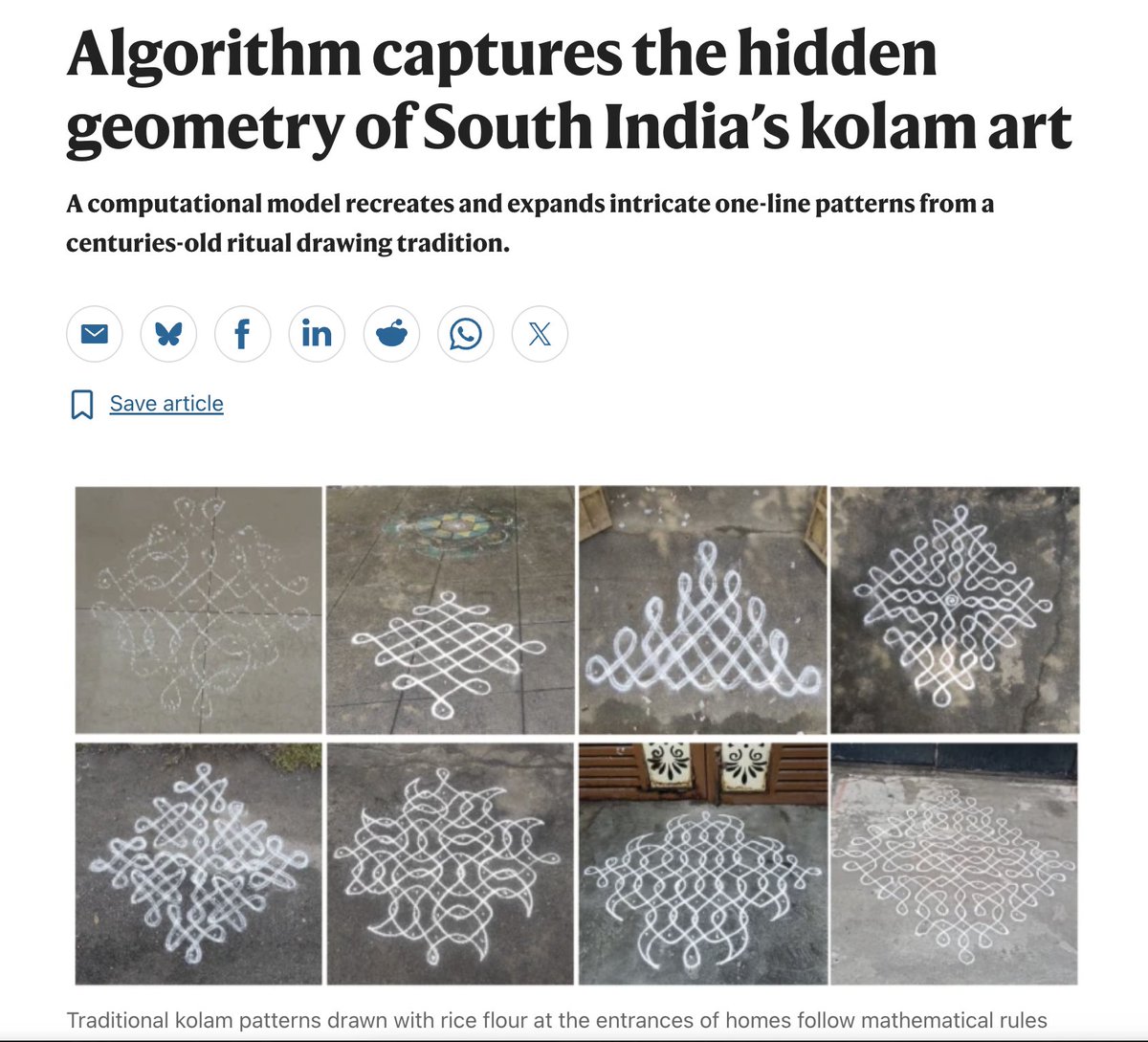
Every Morning, Women Across South India Draw Something Computer Scientists Are Still Trying to Fully Understand.....
Before sunrise, a woman steps outside her home, bends down with a fistful of rice flour, and draws a grid of dots on the threshold. Then, without lifting her hand, without a single straight edge / ruler, she loops a single continuous line around every dot, weaving, curling, closing back on itself, until a complex, symmetrical pattern sits glowing white against the swept earth.
By evening, footsteps and wind will have worn it away.
Tomorrow, she will draw a new one.
It is called kolam / Muggu / Muggulu / Hase / Rangole / Golam....
It is done for beauty, for ritual, for welcoming the day, learned by watching, by feel, by memory, passed down more as muscle habit than written rule.
Most who draw it would not describe it as doing mathematics, though some teachers and skilled practitioners do talk about grid size, symmetry, and how many ways a pattern fits a given number of dots.
And yet, when a small group of mathematicians and computer scientists formally studied what her hand was actually doing, they found something genuinely rigorous sitting underneath the ritual.
In 1974, three Indian mathematicians: Gift Siromoney, Rani Siromoney, and Kamala Krithivasan, working at Madras Christian College, published a paper in the journal Computer Graphics and Image Processing with a title that sounds almost like a joke until you read it: "Array Grammars and Kolam."
They were not writing folklore. They showed that many kolam patterns could be generated by context-free array grammars, treating the patterns as 2D picture languages, built either from primitive tiles / by drawing on a labeled grid.
It is a 2D cousin of the same broad family of rule-based systems computer scientists use for defining formal structure, not literally the specification format behind languages like Python or C, but a genuine, related branch of formal language theory.
That paper became an important, genuinely real early contribution to a small research niche, picture languages and array grammars, a field that also drew on earlier formal-language work by researchers like Azriel Rosenfeld.
Kolam patterns turned out to fit what Rosenfeld's framework calls cycle grammars, capturing sequences of moves that loop back on themselves, expressible as graph theory, as turtle-like step by step drawing commands (literally the same "turtle graphics" logic taught to kids learning to code today), and researchers have shown many kolam families can be modeled using L-systems, the recursive rewriting framework Aristid Lindenmayer developed in 1968 to model how plants branch and grow, 1 of the major toolkits behind plant like and certain fractal computer graphics, alongside other separate approaches like escape-time fractals.
I am not saying, L-systems were built from kolam. It is just that mathematicians later found kolam patterns were a natural fit for the same rewriting logic, a genuine, well-documented structural match, not a claim that kolam shaped computer science's own development.
Japanese researchers Kiwamu Yanagisawa and Shojiro Nagata spent years formally analyzing kolam's "morphological" rule structure through the 2000s, converting patterns into numbers and linear diagrams, publishing repeatedly in the journal Forma.
Indian researchers have kept extending the mathematics further still, papers on arXiv in 2025 apply modular arithmetic to kolam dot-patterns to work out which designs can be drawn in a single unbroken stroke.
And in a genuinely fresh sign of how alive this field still is, a paper introducing a new "gating structure" algorithm for one-stroke kolam generation was published in March 2026 in npj Heritage Science, a Nature-family journal, which also references a pattern-generation dataset used in student competitions.
A floor art practice, drawn daily in Tamil Nadu and neighboring states by, on one specific estimate, over a quarter million skilled practitioners of the more intricate sikku style alone, and far more broadly across millions of households in simpler forms, passed down purely through memorized rule and muscle memory, with no written mathematical notation ever involved, turned out to encode genuine combinatorial and topological structure.
One thing I’ve learned in life: never stop.
Things may not always go according to my plans. Some efforts may fail, and some paths may lead somewhere completely unexpected. But that doesn’t mean I should stop moving.
There’s a simple rule in sales: the more you try, the greater your chances of success.
So keep trying.
Try again.
Try differently.
Just don’t stop.
A guy with zero coding knowledge just got a phone call from the Prime Minister of India for the side project he created as a hobby.
@thekaipullai loved history. Learnt everything he could about it. But for years, he had no medium to share what he knew. His knowledge just sat inside him like millions of others who have deep expertise but no way to express it.
Then AI happened.
Without writing a single line of code himself, he built https://t.co/vZpWif5zUf. A website where anyone can explore Indian history in an interesting, visual way. Not a startup. Not a funded venture. Just a hobby project built with curiosity and AI tools.
And that side project got noticed by the Prime Minister himself. He spoke to Kaipullai Out of his packed schedule, he took time to appreciate the person behind the effort.
Think about what actually happened here.
A history enthusiast became a builder. A hobby became a nationally recognised platform. This is the best use case of AI I have seen in recent times.
For decades, ideas died inside people because they could not code. Teachers, traders, doctors, farmers, everyone had knowledge worth sharing but the technical wall was too high. That wall has collapsed.
I keep telling this and I will say it again. You do not need to be a programmer anymore. You need a curious mind and the willingness to learn how to use AI.
The people who learn to work with AI in the next few years will build things that used to need entire teams. The ones who ignore it will watch from the sidelines wondering how a “non technical” person built what they could not.
Something extraordinary actually happened today.
Stuff so extraordinary, that even if it comes as a dream, you dismiss it as something that is impossibly improbable.
Thanks to your support and blessings, today I had the ultimate honor and privilege of having a conversation with our honorable Prime Minister on Mann Ki Baat about https://t.co/CIr1xkvilD
I still can't believe that he actually spoke to me, asked me about the website, its features and some questions on general history too. I am still in a daze.
For an amateur builder like me, i don't think there is a greater recognition or validation than this.
This conversation has given me enough motivation to take BharatRajya to the next level and make it the ideal history reference and visualization website for everyone.
Thank you @narendramodi ji, for encouraging people like us and inspiring us to achieve greater heights.
These is one conversation I will not forget in this lifetime. Or maybe even the next.
And rest assured sir, I won't let you down.
This Sunday, not a startup. A 9 year old Polymath Bridging Paninian Grammar with Modern Code
Before the rest of Bengaluru even wakes up, he has already chanted 6 chapters of the Bhagavad Gita from memory. He can break down every single word, root, and rule of Paninian grammar across all 700 shlokas.
By mid morning, he is standing in a 12th grade labs, working through complex chemistry experiments alongside students nearly twice his age.
By evening, he sits in front of a terminal, compiling self-taught C and Python code to engineer custom hardware prototypes, build offline edge AI voice assistants, and deploy apps downloaded across the globe.
His name is Vrishvardhan Sharma and he is not a product of commercial coaching.....
He is a 9 year old polymath operating at the precise, breathtaking intersection where 2,500 year old Sanskrit computational logic meets the frontiers of modern software engineering.
His story is about what happens when ancient Indic scholarship (Shaastras) meets self-taught modern tech in a mind that operates purely on curiosity.
Originally hailing from Patna (mother side) and Jaipur (father side) and now based in Bengaluru, Vrishvardhan’s academic and spiritual depth developed at an astonishing pace:
Age 5: Memorized the entire Bhagavad Gita and was blessed to recite complete Gita at Shringeri infront of personal audience of Shankaracharya Vidhushekhar Bharati ji.
Age 6: Winning the National Gita Medal. Today, he has completed 526+ full Gita Parayanas, chanting 6 chapters every morning and analyzing every shloka grammatically.
Age 8: Memorized the Ashtadhyayi (Panini's masterwork on Sanskrit grammar), winning a National Gold Medal competing against university level postgrad scholars.
Linguistic Versatility: Achieved fluency in 6 languages, with the ability to read and write in 13 scripts. He personally handwrote the Gita in 11 different Indian scripts, dedicating the work to the spirit of Ek Bharat Shreshtha Bharat.
Vedic Mastery: Attained the status of a Ghanapathi of Shri Rudram (Namakam and Chamakam), 1 of the most complex, rigorous modes of Vedic chanting and memory retention known to human tradition.
Yet, rather than remaining exclusively within classic academic frameworks, Vrishvardhan taught himself programming languages like Python and C, applying computational logic directly to modern software problems.
Instead of following commercial app frameworks filled with popup ads / aggressive paywalls / artificial gamification tricks, Vrishvardhan builds tools centered on human cognition and cultural connection.
- KannadaVardhan: Created after moving to Bengaluru to help users pick up Spoken Kannada naturally. Built on what he terms "The Sahaj Way", an ambient cognitive process where users learn by listening, guessing, receiving gentle corrections, and speaking without the anxiety of rigid grammar charts.
- GitaVardhan: A clean, user-focused digital interface designed for deep engagement with scripture.
- Offline Voice-Command Gita Assistant: A tiny custom hardware prototype engineered to run voice commands locally, processing requests completely offline without reliance on internet servers or data tracking.
Vrishvardhan’s dual mastery of Panini’s Ashtadhyayi and modern code is where his greatest potential lies.
Panini’s 4,000 algorithmic rules written 2,400+ years ago are widely recognized by computer scientists as the world's 1st formal, context-free generative grammar system, the direct intellectual ancestor of modern programming languages and natural language processing (NLP).
By combining formal Sanskrit computational linguistics with software architecture, Vrishvardhan represents a rare bridge between India's intellectual heritage and modern deep-tech innovation.
While Vrishvardhan's parents carefully limit public media exposure to shield his growth, his work shows what is possible when deep root discipline meets unstructured modern curiosity.
A 9 year old is building to solve problems, bridge cultures, and explore the boundaries of learning.
Bharat is really rising. 🙏🙏
PS: I have written this with his parents’ direct approval. I had also told his father that, at any cost, he needs to be protected from all the noise and negativity on SM.
And she revealed in an interview, MLV too did not charge her Sishyas.
AK calmly replied to a question as to how feasible this is, she earns money from Cutcheris which is more than sufficient for her
She consideres training Sishyas as Vidya Daanam and a Punyam🙏 2/2
In this era of commercialisation, I was astounded to hear Violinist Vidushi A Kanyakumari is not charging her Sishyas even Re 1 as Tuition Fee!
She has close to 40 sishyas now
She also has not charged any sishya for the past 4 decades
She accompanied MLV for 20 years 1/2
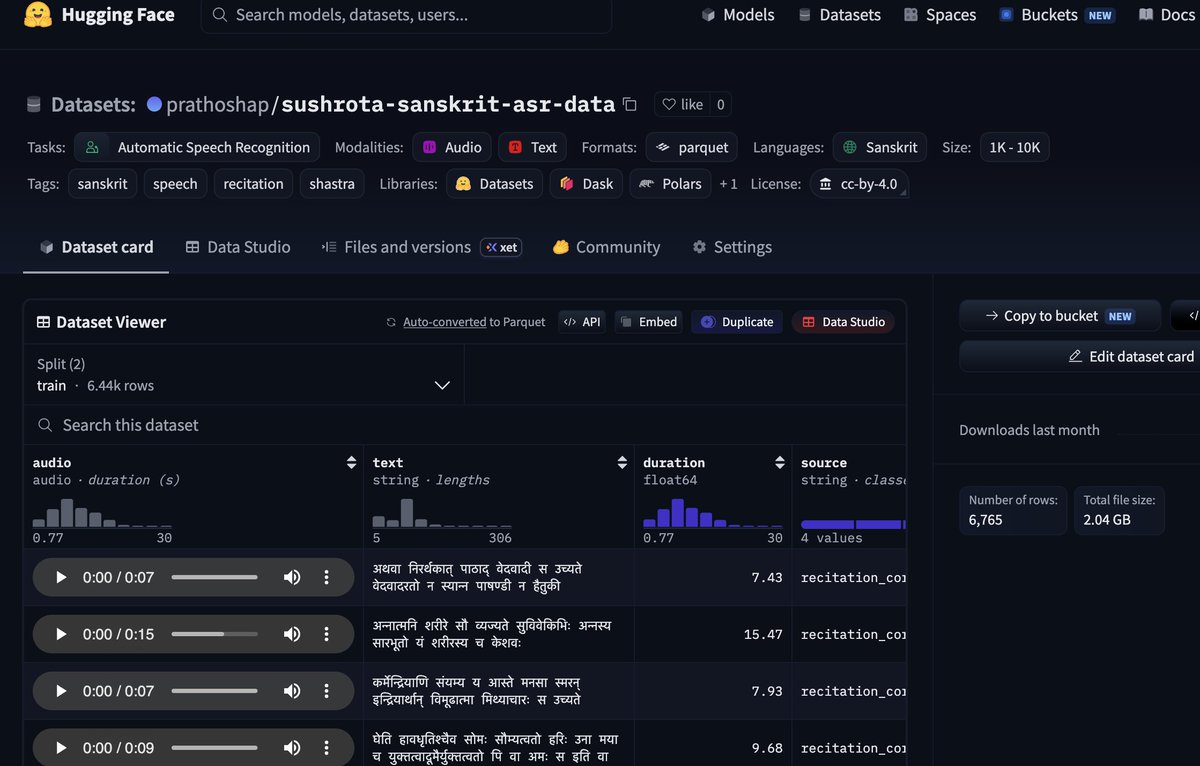
On this auspicious day of Hayagreeva Jayanti, I am open-sourcing the data and models for Samskrutam-Chant Speech-to-Text (ASR), named सुश्रोता. ~ 18 h of utterance-level annotated Shastric text, 1,500 contributors. Powers वाग्बोधिनी. Links in the first reply.