Muse Spark 1.3 is rolling out today with frontier performance almost too cheap to meter. This is the biggest jump we've made so far on coding and agentic work. Try it in Muse Code and our API.
Next up 🍉 and Muse Spark open weights releases coming soon.
Muse Code is out of beta and now built to handle bigger, more complex engineering tasks. Developers can get started with one command today:
curl -fsSL https://t.co/0RApZrEJMv | bash
A while ago, a colleague who had no idea about my work read this research agenda essay and found it interesting that I also talk about its evolution: from an idea, a technical challenge, or a referee comment to another paper. He suggested editing and sharing:
https://t.co/vIKG2mPNz3
Sensors, signals, and sensors are everywhere, including our devices, networks, online services & activities, enterprise data flows, vehicles, financial transactions, essential monitoring of our stuff and ourselves (industrial, medical, health, sports, retail,…), etc.
This book covers the most important methods of modern signal and systems analysis. It develops in parallel the methods of analysis for continuous-time and discrete-time signals and systems.
Get it at https://t.co/fUprBVc5xB
A senior Anthropic engineer just dropped 11-page PDF on "Loop Engineering" for agentic systems.
The shift: you stop prompting the agent. You build the system that prompts it instead.
Schedule → Discover → Build → Verify → Repeat
Every loop runs one turn, five moves:
• Discovery: it finds its own work - failing CI, open issues, recent commits - instead of being handed a list.
• Handoff: each task gets an isolated git worktree so parallel agents don't collide.
• Verification: a second agent, told to assume the code is broken, reviews the first. The "thing that can say no."
• Persistence: results get written to disk, never left in a context window that gets flushed.
• Scheduling: an automation wakes it on a timer. That's what makes it a loop.
The key insight: an agent grading its own work always praises it.
This 11-page PDF changed how I'm building agentic systems today.
Read it now, then explore the article below.
this PhD student had 47 interviews and 4 offers before she was hired at OpenAI.
she practiced with her “notes on LLMs” and math and they’re a goldmine. super concise and organic and shared to everyone for free. you can use her notes or her topic list to study on your own.
Web scraping will never be the same.
(100% open-source visual search at scale)
PixelRAG is a retrieval system that skips HTML parsing completely.
Instead of scraping a page into text and embedding chunks, it screenshots the page and retrieves the image. A vision-language model reads the answer straight off the pixels.
Why that matters: parsing is where web RAG quietly loses information.
- A single HTML-to-text parser can drop 40%+ of a page.
- Tables, charts, and layout get flattened or thrown out.
- Swapping parsers alone can move accuracy ~10 points on the same docs.
PixelRAG indexes the page a person actually sees. The team built a visual index of all of Wikipedia, 30M+ screenshots, and it still beats the strongest text RAG baseline by 18.1% on text-only QA.
The repo also ships a Claude Code plugin that gives Claude eyes.
It lets Claude screenshot any URL and read the rendered page instead of scraping the DOM. So you can hand it a live page, an arXiv paper, or your local site and ask what it actually looks like.
One setup script. No MCP server, no backend.
How the pipeline works:
- Renders each document (web, PDF, image) to image tiles.
- Embeds them with Qwen3-VL-Embedding, LoRA fine-tuned on screenshots.
- Builds a FAISS index and serves a search API.
A stronger reader model lifts accuracy with no re-indexing, since the index is just pixels.
Everything is open-source under Apache-2.0.
GitHub repo: https://t.co/qun9TjAdmw
Talking about RAG, I recently wrote an article on a new approach that makes retrieval much more efficient by cutting corpus size by 40x, reducing tokens per query by 3x, and improving vector search relevance by 2.3x.
The article is quoted below.
This is a super exciting release - Claude Fable 5 is the same underlying model as Mythos but with added safeguards. The benchmarks are great and it's SOTA on everything by a margin but I'll add that *qualitatively* also, this is a major-version-bump-deserving step change forward (imo of the same order as Claude 4.5 was in November), peaking especially for long problem-solving sessions on very difficult problems. You can give it a lot more ambitious tasks than what you're used to, the model "gets it" and it will just go, and it's never felt this tempting to stop looking at the code at all (but don't do this in prod!). The model still has quirks that people will run into and the safeguards are configured to be a little too trigger happy for launch, which can hopefully be tuned over time.
I feel a lot of things changing as working software increasingly comes out on a tap. The Jevon's paradox kicks in and I feel my own demand for software growing substantially. You can ask for anything - explainers, visualizers, dashboards, bespoke single-use apps (e.g. a full wandb that is hyper-specific just for your project), you can 10X your test suite, auto-optimize code, run giant research projects with custom HTML for the results, anything! "Free your mind" (Matrix ref). Really looking forward to all the things people build!
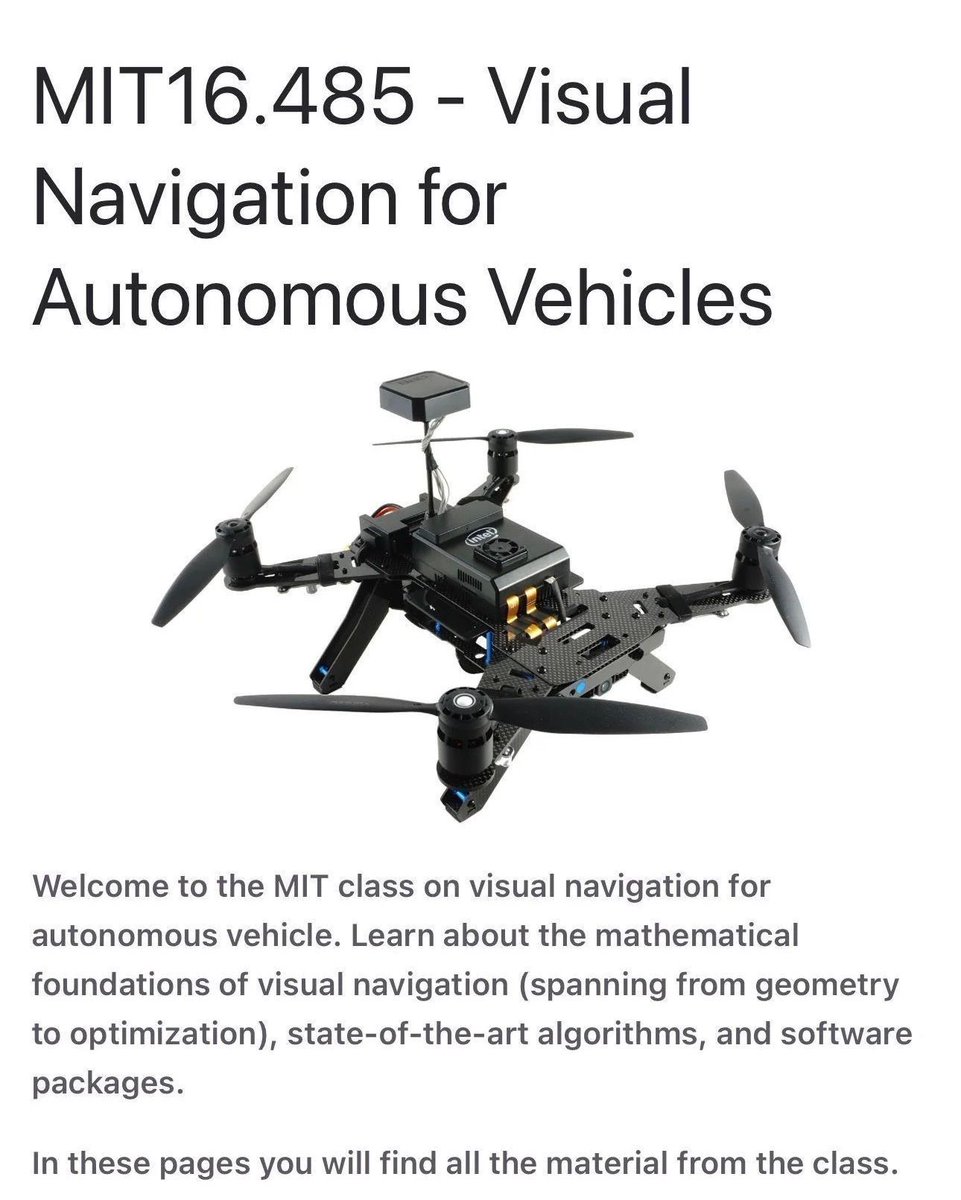
A full MIT course on visual autonomous navigation.
If you work on robotics, drones, or self-driving systems, this one is worth bookmarking‼️
MIT’s Visual Navigation for Autonomous Vehicles course covers the full perception-to-control stack, not just isolated algorithms.
What it focuses on:
• 2D and 3D vision for navigation
• Visual and visual-inertial odometry for state estimation
• Place recognition and SLAM for localization and mapping
• Trajectory optimization for motion planning
• Learning-based perception in geometric settings
All material is available publicly, including slides and notes.
📍https://t.co/Wt5mr6NPao
If you know other solid resources on vision-based autonomy, feel free to share them.
——
Weekly robotics and AI insights.
Subscribe free: https://t.co/9Nm01QUcw3
If you're using Claude Code for research: stop making it read directly from PDFs
We've introduced a SKILL.md that fetches structured, AI-friendly paper overviews from alphaXiv 👀
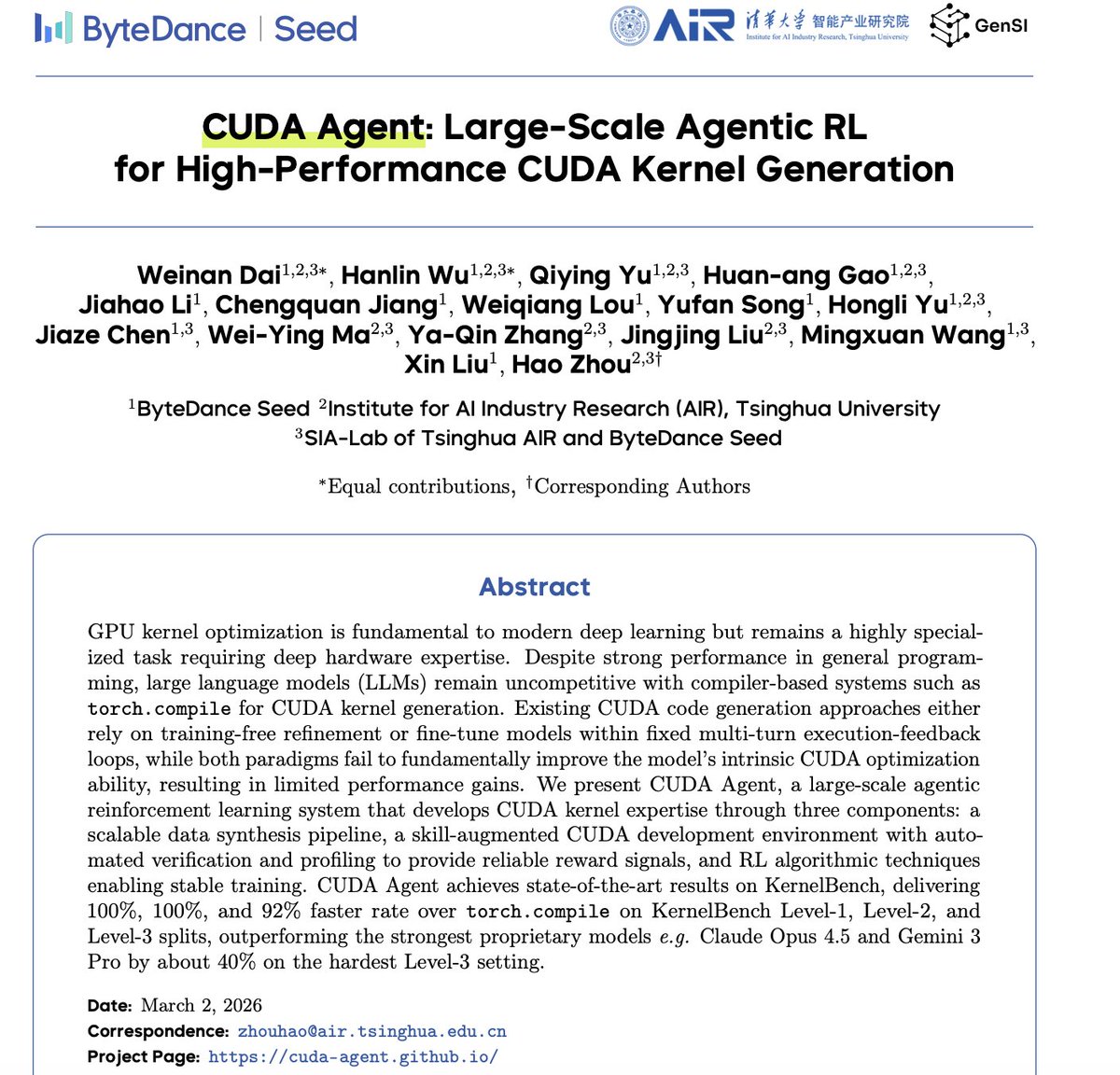
ByteDance just published something I've been waiting for someone to build: CUDA Agent!
It trained a model that writes fast CUDA kernels. Not just correct ones — actually optimized ones.
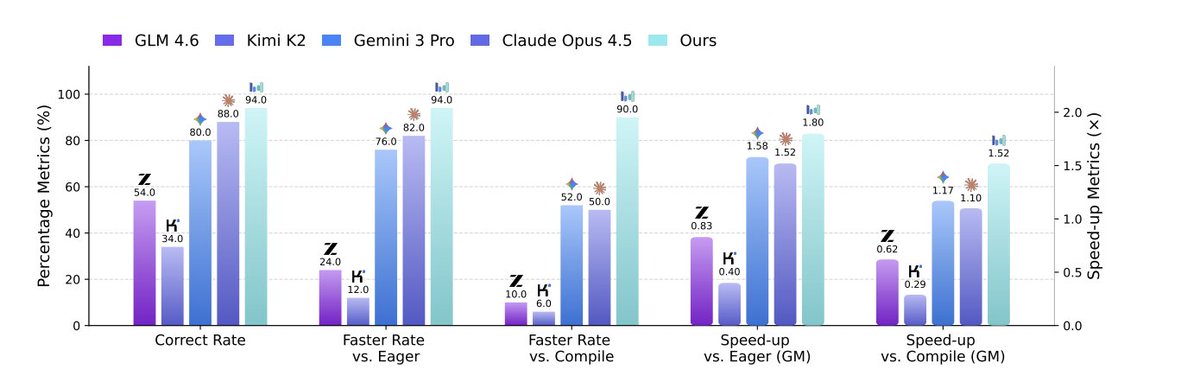
It beats torch.compile by 2× on simple/medium kernels, ~92% on complex ones, and even outperforms Claude Opus 4.5 and Gemini 3 Pro by ~40% on the hardest setting.
The key idea is simple but kind of brilliant:
CUDA performance isn’t about correctness, it’s about hardware. Warps, memory bandwidth, bank conflicts — the stuff you only see in a profiler.
So instead of rewarding “did it compile?”, they reward actual GPU speed. Real profiling numbers. RL trained directly on performance.
That’s a big shift.
Paper: https://t.co/EYx7QKosgk
Project: https://t.co/pTCfzQIBes