I wrote about the Chinese math kids turned AI superstars, and what it’s like meeting my much smarter (and richer) classmates in Silicon Valley.
https://t.co/ruPKSkdn2z via @restofworld
China's leading AI assistant apps according to QuestMobile. Note, just the persistent strength of ByteDance's Doubao.
Ahead of its expected payment plans, will be interesting to see how this affects the usage base. We are likely to see a new Seed model soon to justify the new plans.
The China watcher sphere on X is currently dominated by geopolitics, tech dominance, he green transition, and macro finance. But framing issues exclusively through the lens of "great power competition" masks the intense, complex social changes happening on the ground.
A recent viral controversy in Shenzhen perfectly illustrates what we are missing. (https://t.co/GtBtMFozE2)
Last week, a man and a woman got into a physical altercation at a bus stop after she tried to stop him from smoking. Both were detained and refused to settle. In response, police subjected the woman to a forced strip search—sparking massive public outrage regarding law enforcement overreach.
But the controversy itself isn't what caught my attention. It’s the woman at the center of it: 29-year-old Wang Ronghao.
It turns out Wang is a meticulous, active chronicler of the grueling service industry. Over the past 9 years, she has worked at Haidilao, Hema Fresh, Lawson, and various other gig economy jobs, documenting the crushing reality of modern labor. Reading her diaries, you realize that the mechanisms of control over labor have evolved right alongside economic development, taking on terrifying new forms. (A report from 2025: https://t.co/0qqWA9E0F3)
Her writings expose the invisible, often dehumanizing architecture required to maintain "extreme service":
Algorithmic Panic: At Hema grocery, strict "30-minute fresh delivery" timers force kitchen workers to literally reach into 100°C steamers without gloves to grab RFID tags just to avoid algorithmic penalization, leaving them covered in burns.
Panopticon Management: At Haidilao hotpot, a relentless reporting culture and surveillance enforce "16 zero-tolerance rules." If a customer pours their own water before a server can sprint over to do it, the server faces docked pay and public reprimand.
Systemic Overwork: A total deprivation of basic human needs. Convenience store clerks are forced to stand for 10+ hour shifts even when the store is empty, and workers battle for corners on the street just to sleep for 20 minutes.
I don’t want to frame this merely as a "China labor story." It is clear that we are seeing the exact same algorithmic exhaustion in Amazon warehouses and among Uber drivers in the U.S. It could be any country.
The very "substrate" of society is shifting globally. In both countries, and in many others, the driving forces are identical: the relentless optimization of technology and the unchecked leverage of large, powerful companies.
It is not a question of which country is "better" or who is winning a geopolitical rivalry. Beneath the high-level macro narratives and great power posturing, this is plainly an age-old labor struggle, evolving alongside technology, that never actually left.
For the first time ever, the “Fab 5” of China smart EV startups NIO Xpeng Li Auto Xiaomi* and LeapMotor “WeiXiaoLiXiaoLing” were all profitable in the same quarter.
Li Auto and LeapMotor as well as Xiaomi’s Smart EV AI and Other New Initiatives were profitable for FY25. NIO and Xpeng trying to get there for FY26.
Let that sink in a bit.
*Xiaomi with an asterisk as it is already an established brand in smart phones and electronics while others are pure plays.
Rumor: TSMC Arizona’s Fab 4 is already fully booked despite they haven’t yet broken ground, as Apple, Nvidia, AMD and Qualcomm seek more USA production for supply chain security, media report, adding TSMC projects in the US, Japan and Germany could account for 20% of TSMC’s production by 2028. $TSM $NVDA $AAPL $AMD $QCOM #Semiconductors #Arizona #semicondutor https://t.co/J10N4hjCDK
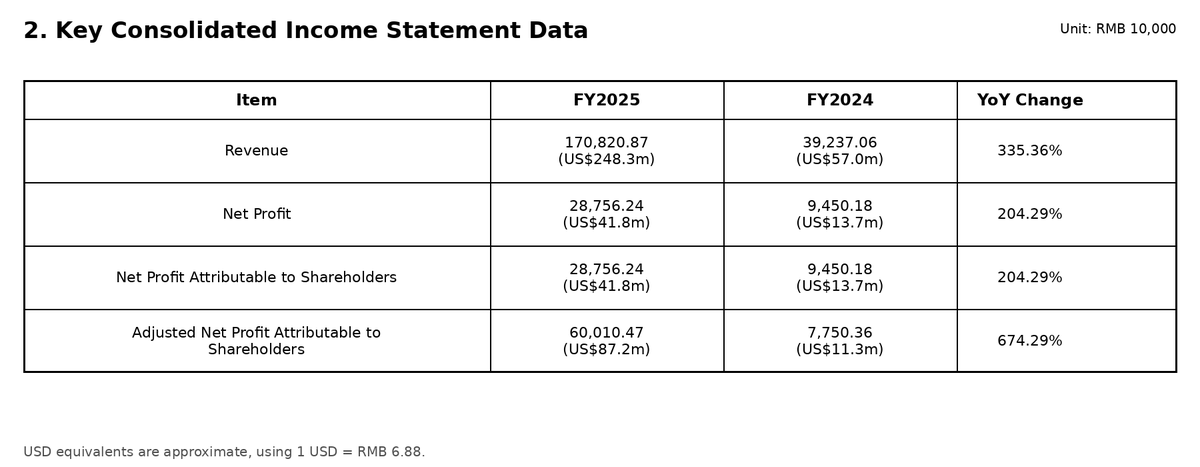
Incredible, lol, robot maker Unitree just filed for IPO and not only do they make money, their adjusted net margin is 35%, putting it on par with software companies. Humanoid fever is only going to increase from here I think :) At @TechBuzzChina we have some new special projects in this area we are announcing soon!
Some stats:
- Unitree’s STAR Market (Shanghai) IPO has been accepted, with a planned raise of RMB 4.2 billion (US$611 million) and an implied initial post-money valuation of at least RMB 42 billion (US$6.1 billion)
- 2025 revenue reached RMB 1.71 billion (US$248 million), - up 335% YoY, while adjusted net profit exceeded RMB 600 million (US$87 million), up 674% YoY.
- In the first 9 months of 25, humanoid robot revenue reached RMB 595 million (US$86 million), surpassing quadruped robot revenue of RMB 488 million (US$71 million) for the first time.
- Unitree shipped over 5,500 units last year, occupying 32.4% of the global humanoid market
- Of the IPO proceeds, the biggest chunk, RMB 2.02 billion (US$294 million), will go toward robot model R&D, followed by RMB 1.11 billion (US$161 million) for robot body R&D. Another RMB 445 million (US$65 million) is earmarked for new product development and RMB 624 million (US$91 million) for a manufacturing base.
The “genius girl” who previously worked at DeepSeek and was recruited by Lei Jun for Xiaomi AI is now on Twitter as well. It feels like more Chinese AI talent is realizing they can come here, speak for themselves, and build influence directly. I’m all for the added interaction and transparency.
No joke, I got this on the way out of the bathroom. Jensen Huang happened to walk by with security and asked if he’d answered my earlier question — I said I had one more. “You said you got China purchase orders, that means you got the green light from both sides?” He said yes.
Photo from Shenzhen: huge crowd of Chinese people (lots of grannies!) lining up to get help installing OpenClaw.
One thing about tech diffusion in China that I feel is underdiscussed and that I’ll admit I don’t fully understand, is how open people of all ages are to jump into new tech. Feels very different from the AI suspicion/resistance you see in the U.S.
Similar with mobile payments and the shift to cashless. Street vendors in the lowest tier cities setting up WeChat Pay and Alipay QR codes almost overnight and Chinese grannies happily using payment apps with no problem at all. And yes that kind of grassroots adoption helped mobile payments scale extremely fast and allowed China to basically skip the credit card phase.
My conjecture is that if something similar happens with AI tools the speed of AI diffusion in China could look very different from what we see in other countries, which obviously would have major implications...
The best take I heard on the Anthropic versus OpenAI and DoD issue that I think is worth sharing (which I had AI help me paraphrase below):
First, Anthropic has always needed to differentiate itself from OpenAI. Competing purely on model performance is difficult. Competing on governance and perceived responsibility could be more defensible.
Second, the political environment is not fixed. There will likely be a new administration within a few years, and federal departments may not operate the way they do today. The regulatory landscape around AI is still evolving and could shift quickly.
Third, there is a long-term risk calculation. In sensitive government contexts, models may be used in decisions with serious consequences. When something goes wrong, accountability can expand beyond the agency itself. A model provider could become an easy target.
Fourth, there is also the view that AI is quickly becoming a populist issue on both sides of the aisle. Concerns about job displacement, defense applications, and opaque decision systems cut across party lines. Companies are being divided into those seen as thoughtful about these issues and those who are "reckless."
From that perspective, Anthropic may be choosing reputational insulation over short-term expansion.
Interesting - Chinese Premier Li Qiang posing for a pic with Merz + German and Chinese academics - including @m_huotari from Merics, which is still officially sanctioned by Beijing.
There we have it, the first price undertaking deal in the EU-China EV saga
The European Commission has just accepted a tightly controlled price undertaking for one Chinese‑built VW Group EV model – the CUPRA Tavascan – instead of applying full countervailing duties.
This is going to be a very interesting week for investors who monitor China's AI sphere.
After the whole of last year was spent talking about which Chinese AI company will go public first - the answers are here this week and there are two!
https://t.co/RAo8oZQxxA
One of China’s most famous VCs loudly dissed humanoids, but has been quietly doubling down on this robotics company instead
Allan Zhu, GP at GSR Ventures, is one of the more recognizable figures in China’s venture world. He made his name in mobile internet and the sharing economy, has held some early contrarian views on AI, and is well known for his blunt skepticism toward humanoid robots, calling them “all demos, no real value.”
Yet filings now show that his fund has invested in three consecutive rounds of an entirely different type of robotics company: Suzhou Shihang Intelligent Tech. Shihang builds underwater robots for ship-hull cleaning, subsea inspections, and other tasks that are dangerous, repetitive, or costly for humans to perform.
I really like this example. In interviews, I’m often asked about robots displacing human workers. And while displacement is and will for sure happen, especially in certain repetitive roles, people tend to overlook the huge category of work that is actually unsafe for humans. Underwater repair is an obvious case. We also saw bridge and tunnel maintenance being done by wall-scaling robots on our AI trip in July.
Even in more familiar automation areas, like logistics autonomous vehicles which I’ve written about, the strongest adoption comes from companies that cannot hire enough labor. I think automation will (or should!) fill labor shortages long before it replaces labor broadly. This is logical because, unless the cost advantage is overwhelming, deploying machines requires significant upfront capex and organizational redesign.
Shihang stands out because its applications are reportedly already commercial, meaningfully safer than human alternatives, and economically rational. It fits into a category I think deserves more attention: robots doing what humans cannot or should not do. In many ways, this may be a valuable but underappreciated framing for the next wave of industrial robotics.
China’s Yutong Bus may not have been a household name - but it is the world’s biggest bus maker. Following Norway's report of a "kill swtich"on the Chinese e-bus, the UK and Denmark have started their own investigations.
https://t.co/Ah5zxU8SVY via @nbcnews
Where are China's EV exports going to? Europe and Asia (incl. Central Asia and Middle East) dominated by far last year.
Awesome new report by @mazzocco_ilaria and @Ryanfeath on the rise of Chinese EVs and what this means for the Global South: https://t.co/6Z5HdDh0h5
Chinese EV brands appear to be drawing heavily from luxury Western car designs, banking on familiar aesthetics to attract buyers while keeping prices low. For the brands being copied, legal enforcement can be a challenge
New from @_ananyaaa and @kinlinglo https://t.co/ic184MBAoo