Passionate and curious about "what", "why" and "how" (in the same order) things work, but major "bite" is technology & people. Build & Learn (in the same order)
Today we introduce Open Math Model: open models and tools for mathematics.
Built for everyday research, shaped by the mathematical community, and developed in the open.
Read our co-founder Terence Tao’s blog:
https://t.co/PqLQqUoUXk
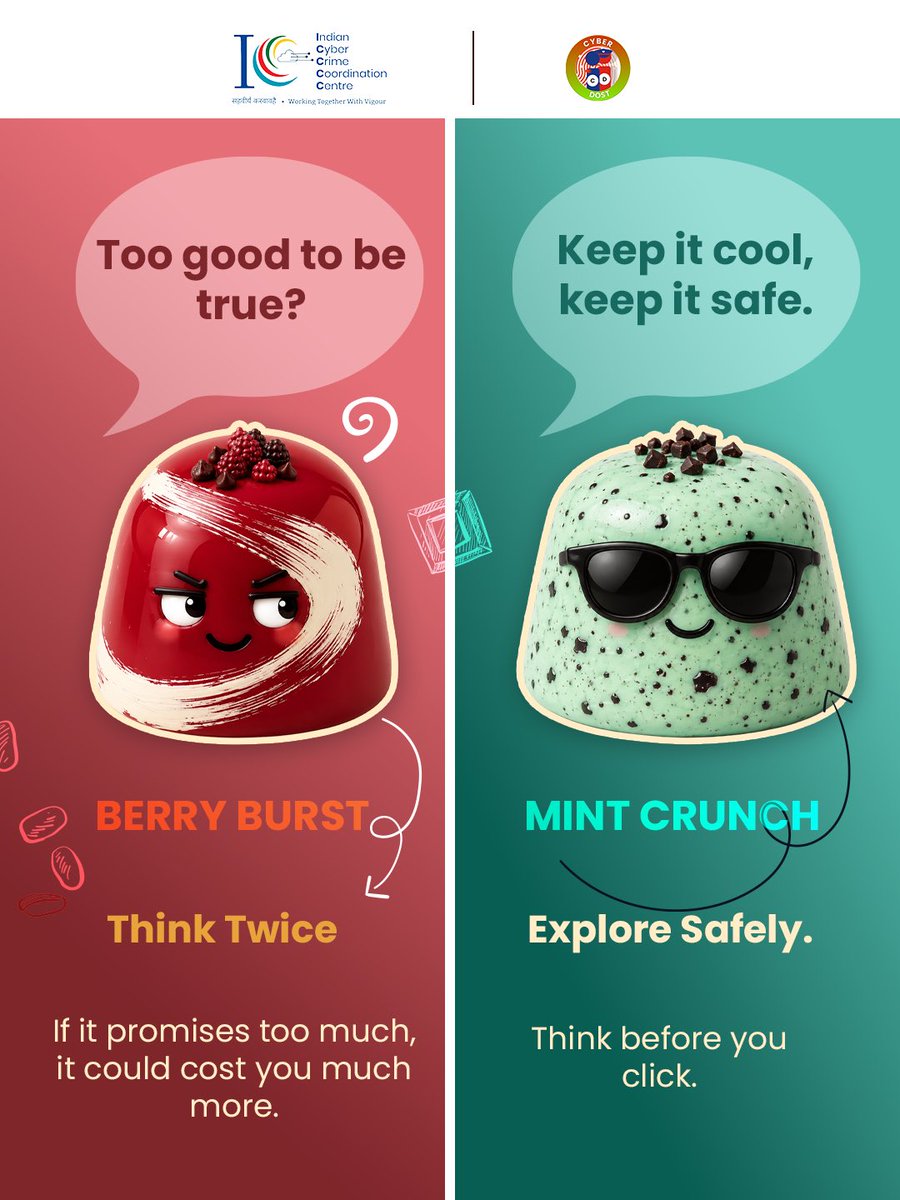
This International Chocolate Day, we’re giving Cyber Safety a sweet twist! 🍫🛡️
From offers that seem too good to be true to links that need a second look, remember - not every tempting offer deserves a bite. 😉
If you are a victim of cyber fraud, immediately call 1930 or report it at https://t.co/8W7L5b3Hrx
#WorldChocolateDay #CyberDost #CyberSafety #CyberAwareness #OnlineSafety #DigitalSafety
We Must Pace the Frontier: I’ve written a new essay on why the AI industry should slow down, with a three-part plan for doing so.
Anthropic is unilaterally committing to the first of these steps. We’ll provide third-party evaluators with permanent, employee-level access to our systems, so that they can verify adherence to our safety measures, report on incidents, and assess models’ alignment during training.
You can read the full post here: https://t.co/OGyPb7yaYt
So I've got a ton of DMs about the future of software engineering and to answer everyone I'll write it here.
First of all, I don't really think that software engineering will be gone anytime soon. It will evolve. For those who has a head on their shoulders, it has already evolved. Others will fail to see it first but they eventually will.
So, the first thing that changed is code review. There will be none of it except for several high stake cases where proof of correctness is needed, such as banking, contracts, planes, bridges, skyscrapers, health, missions to other planets, etc
This means that if you are working as a shit coder (which is about 90% of coders), you will not be asked to write code anymore. And that's ok: a shit coder's code looked like shit anyways, so writing it by hand full time was an insult to humanity.
But that doesn't mean that shit coder will have less job. To the contrary: your manager will expect more code from you not less. Don't you really think your manager or his VP manager or VP's C-suite manager will start vibe coding themselves? This doesn't scale: there are not enough of them and they are too expensive.
The remaining 10% of software engineers, those who have already been working on this high stake software will use AI to write two kinds of code:
1. One off data transformation from one format into another verifiable format. In this case, they will validate the result not the code.
2. A screen-size readable code that they will actually read and fix by hand or iterate with AI until they line what they read.
Architects of such high stakes software will still design the dependency graphs of modules in the projects. They will indicate which modules will be given to shit coders and which ones to software engineers.
Architects of any high stake software project will still have to understand compter science foundations, cloud computing foundations, database foundations, internet protocol foundations, security foundations, maintainability foundations, CPU foundations, parallelism foundations, algorithm complexity, machine learning, etc.
UX people will still be responsible for UX decisions and will have to know ergonomics, user psychology, experiment design, etc.
So, it's an evolution not a disruption.
This is why I'm still writing fundamental textbooks and building a world's best self-education platform.
Knowledge of how things work is now even more important than ever, because the era if narrow specialization in software industry is gone. Everyone now can build a new Microsoft or Google in a matter of a month, alone, and the employer's expectation will be the same: "Tomorrow I need my own OS with blackjack and hookers. Do the necessary and ping me when it's done."
Grok’s speech-to-text now powers the entire Grok ecosystem
From Grok Build to Grok Bot to the Grok app and everything around it, voice is now one of the easiest ways to interact with Grok
and the reliability is insanely good
I use it constantly and I have never, ever had a reliability issue. Not even once did it fail or give me an error
that matters way more than people realize
If you talk for 5 or 10 minutes and the transcription fails at the end, everything you just said is gone. That instantly kills your trust in using voice for anything serious
With Grok, you just talk
Daniela Rus, CSAIL Director & MIT Professor, has been named one of @TIME's 100 most influential people in AI.
Rus describes her work at CSAIL & Liquid AI as "all about the science & engineering of intelligence, & especially embodied intelligence": https://t.co/0q3un8AmXB
i’m seeing SO many US companies shift away from frontier models to open source in the last 4 weeks.
cost and privacy are big factors but more so people are realising fine-tuning and training their own models have certain advantages big labs can’t necessarily offer them.
bridgewater using thinking machines models, jane street running models locally on their own gpu cluster, airbnb using chinese open models
openrouter usage of chinese models specifically is through the roof.
Steven Sinofsky says the culture of a big company is as fixed as a law of physics, and that's why they don't crush startups:
"It's weird that they teach disruption as a theory in the business school, when really it should just be a fact in the physics department."
"You always think, 'Oh my God, we're just gonna crush all of these little companies.' You always think that when you're at the big company, and then you realize they never get crushed."
"The startups don't aim straight at the incumbents. And the incumbents just don't pay attention... Microsoft is worried way more about what Amazon and Google are doing."
"The elements of disruption that matter are the cultural ones of being a big company, and those are constant. Those are the laws of physics."
"We're at a magic moment... you don't have to go build a data center and build your own egress and call AT&T. Now you're up and running in the first hours of your first dinner."
@stevesi
This era (driven by AI) is full of fear and opportunities. What matters is where our attention is, "Attention is all you need".
https://t.co/VLWcdjZ442
Elon Musk in this 2012 interview:
" My proceeds from PayPal after tax were about $180M, $100M of that went into SpaceX, $70M into Tesla, and $10M into SolarCity and I literally had to borrow money for rent."
$SPCX $TSLA
Brad Smith is Neuralink’s 3rd human recipient overall, the first with ALS, and the first non-verbal patient
He received the N1 brain implant on November 8, 2024. ALS had left him fully paralyzed and unable to speak, so the implant is now his only way to communicate
Using only his thoughts, Brad can:
• Move a cursor on a MacBook Pro at blazing speed
• Edit entire videos (he created & posted the first video ever edited purely by brain control)
• Type messages and speak using an AI voice cloned from his own pre-ALS recordings
• Control a motorized AI webcam
His family now hears his real, warm voice again....not robotic text-to-speech
As of early 2026, Brad (@ALScyborg) is doing incredibly well
All of this was powered by Neuralink’s brain-computer interface. The future is awesome 🧠💻