I strongly agree with this. More broadly, I think we're in like 95th%ile worlds relative to my prior expectation of how safety-concerned leading AI companies would be
Calling all writers, showrunners, storytellers 🚨
We’ve officially launched Netflix NextGen India Writers' Program 🚀
This is an opportunity for all early career writers with a maximum of 3 years of experience in screenwriting to bring your original ideas to life and develop them directly for Netflix. Your story deserves the biggest stage.
Apply now 👇
🔗 https://t.co/qWwZSyWP9Z
@acorn Applies when policy is not insulated from distributive politics? Education in Singapore, say, may be an example.
And applies in the opposite direction (less non-K, more K) when K policy only factors in present generations (i.e. assumes non-diversity across generations)?
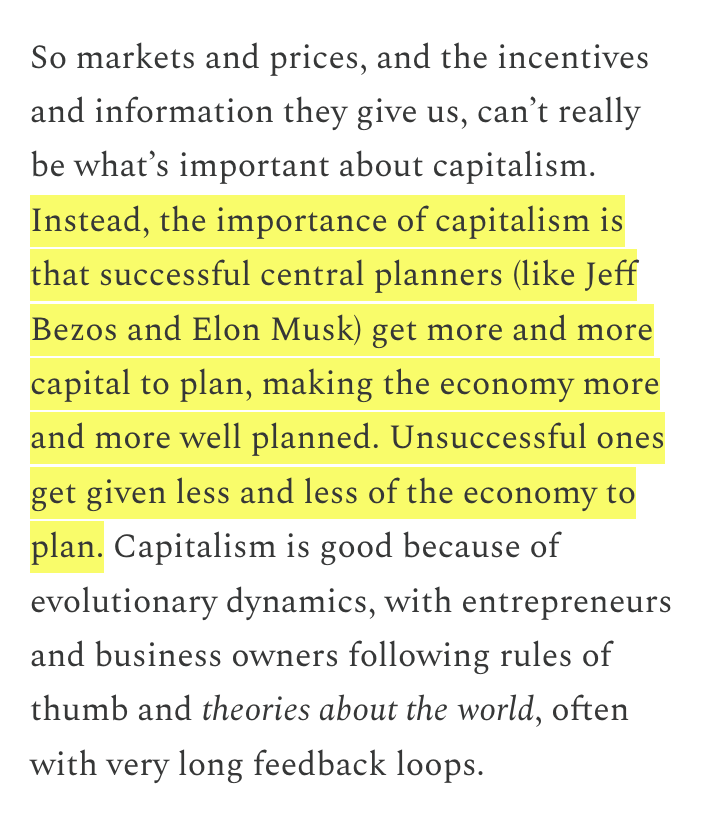
I’m really excited about the Strep A Vaccine Fund we’re launching today. IMO the basic case here is a great recipe for impact:
→ A huge problem: ~1% of total annual deaths worldwide (>600k)
→ Super neglected: ~$14M/yr of R&D globally before this, ~50x less than malaria which has similar mortality
→ Newly tractable: new human challenge models and earlier diagnostics should speed the path to an approved vaccine
Grateful to our partners Adam and Abigail Winkel, Good Ventures, Lucy Southworth, @ThePatchworkCLT, and a few anon donors for getting us to >$140M at launch. We’re continuing to actively fundraise and think we could effectively spend >$200M over the next few years. Our goal is to double the number of Strep A vaccine candidates in clinical trials and have at least one ready for Phase 3 trials by the end of 2030.
And I’m thrilled to be betting on Katharine’s vision here! As a grad student, she co-invented the R21 malaria vaccine that’s now reaching millions of kids. I’m hoping to see hundreds of millions of future Strep A vaccine doses with her fingerprints on them.
@tyler_m_john@tyler_m_john I co-founded and am building https://t.co/NgeJYaLt0b
Further updates on the website are underway (esp. related to our work in a and around the Delhi Summit). But I'd love to share more information over email meanwhile!
Have you seen the new AI safety paper? It's on Guidelight. It's literally on Forethought. You can probably find it on Foresight. Dude it's at Coefficient. Just go to the Future of Life. It's hosted at Lighthaven. It's on Longview. Just open Conjecture. It's at Elicit.
I don’t know if it was AI or not (it’s hard to tell, and some sentences did feel suspiciously manicured), but I think it showed that expectations for brilliant prose writing have dipped a lot.
Compare for example this brilliant - and very human - eulogy for an adult friendship.
Singapore’s Foreign Minister, Dr Balakrishnan casually explaining how he built his own AI agent (a 2nd brain for diplomacy) using Claude & WhatsApp integration etc. on a Raspberry Pi
“You cannot govern a technology you have only been briefed on.” 🇸🇬
The launch of @AlterMagIndia's Issue #4 asks a simple question: what does it take for a country to know itself?
Mahalanobis, ISI, and a story about institutions, data and what comes next.
22nd May, Bangalore - don't miss out
https://t.co/W1YFQEw7Vl
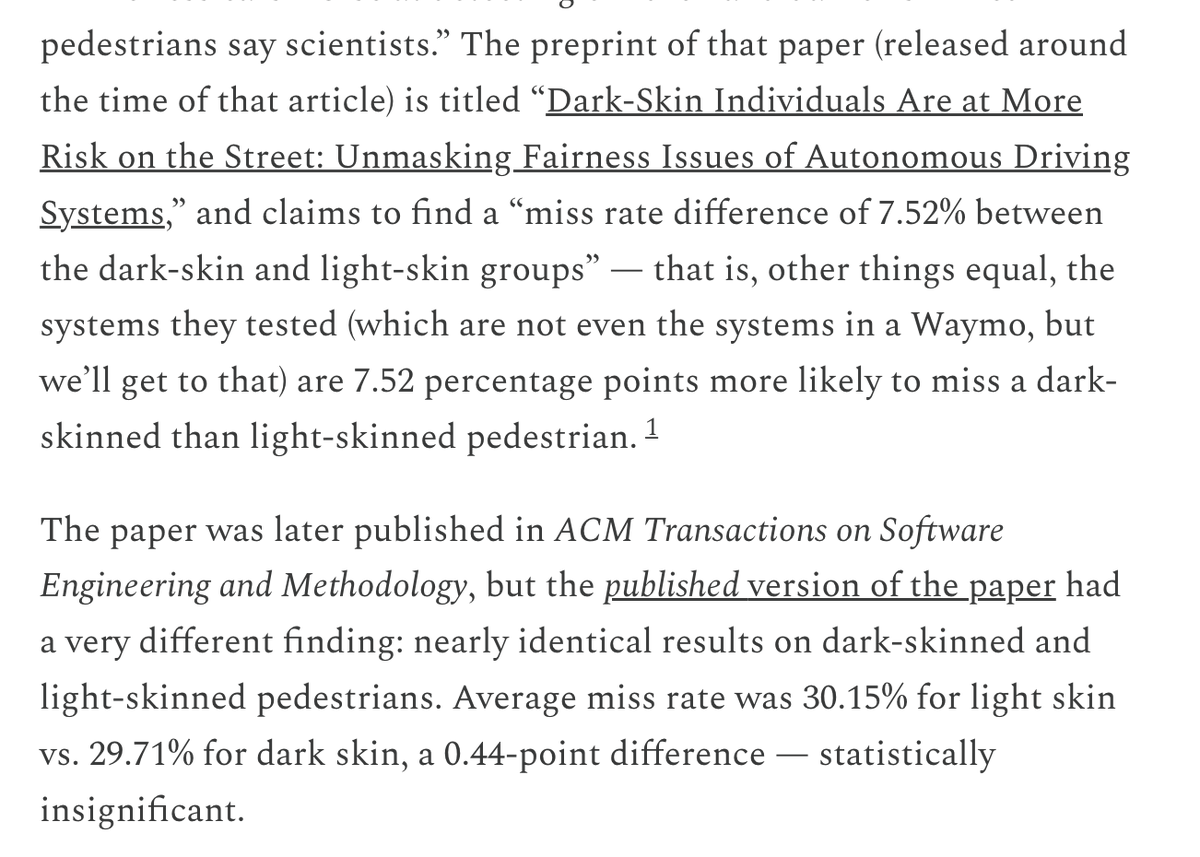
Are autonomous vehicles (self-driving cars) “less able to detect people of color”? That’s what I read in The Atlantic this weekend, in Xochitl Gonzalez’s “People Who Don’t Like People Are Making All of Our Decisions.”
It appears to be entirely false.
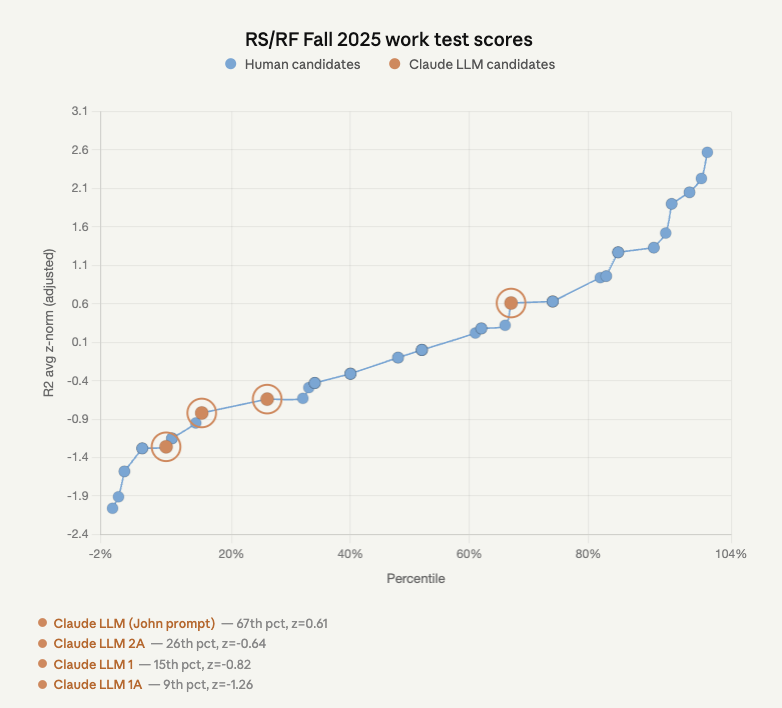
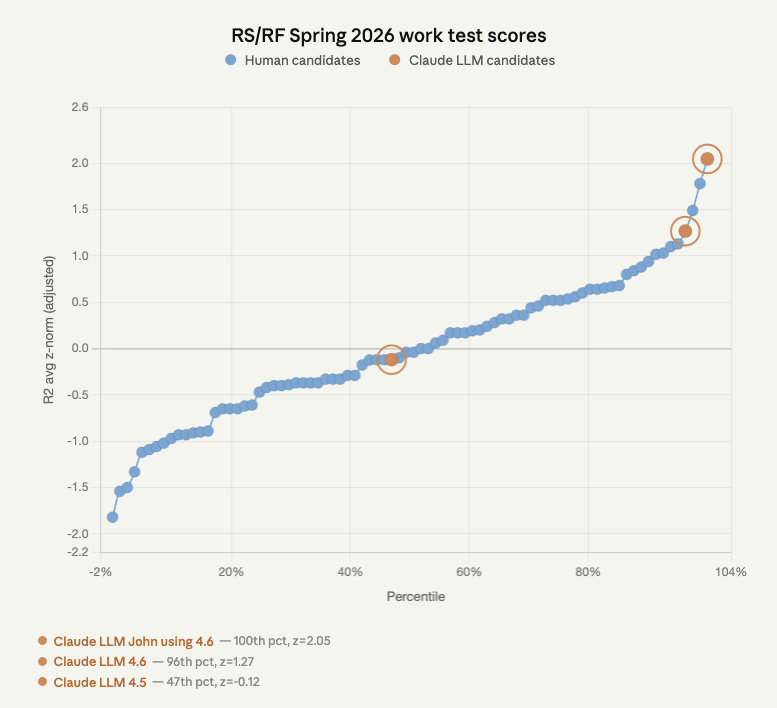
Well, it was bound to happen eventually. We've been seeding LLM-generated answers into our Research Scholar work tests at @GovAIOrg to see how they'd score blind.
Last round: the best AI submission was 81st percentile.
This round: Claude Opus 4.6 with some prompting got the highest score in the pool.
Mechanics: We copy-pasted the work test – which consists of e.g. reading a claim and explaining their view on it's likelihood of being true – into chatbots. The work test document itself contains an example answer and the grading rubric, so the model gets the same priming a candidate would. The winning Clopus entry was slightly prompted on top of that (roughly: "make it sound more like GovAI"); the unprompted version came in 4th.
Validation: To double check the results, we had a staff member re-rated the top submissions blind, including the AI ones. Scores moved down a bit but not by much.
Lessons:
- We're going to need to redesign our work tests. Either we'll have to remove people's ability to use LLMs, or figure out a test that works when people do use LLMs.
- People don't seem to be using AI as much as they perhaps should be. Our worktest did allow people to use LLMs, though we did slightly discourage it as we said we didn't expect the best answers to come from just pasting in the questions.
- AI automation is coming not just for AI research and safety, but also for AI governance.
@oliverwkim Also is interesting because there were a lot of people who were manufacturing skeptics because of automation risk, but that's now coming potentially for services too
I believe one of the most important problems is to detect the nature and extent of AI used. Take paper reviewing for example, where many conferences allow reviewers to use LLMs to polish their reviews but not to generate its contents. However, can such polishing-only policies be even enforced?
Our recent #ICML paper answers this question in negative, and shows how even the best AI-text detectors misclassify a non-trivial fraction of LLM polished reviews as fully AI-generated.
This is work led by my amazing students: Rounak Saha (@ahaskanuor), Dayita Chaudhuri (@doyitach) and Naveeja Sajeevan in collaboration with @GurushaJuneja and Nihar Shah. (1/n)🧵
PALO ALTO NETWORKS on MYTHOS: "In our testing, three weeks of model-assisted analysis matched a full year of manual penetration testing, with broader coverage."
🚀 Applications are now open: Constellation's Astra Fellowship 🚀
Fully funded, 5-month fellowship at our Berkeley research institute. Pair with mentors across empirical AI safety research, strategy, and governance at @ConstellOrg!
📅 Apply by May 3rd (begins Sep 2026)
🔗 https://t.co/pxtOduDBFh
Maybe the Institute should also have an in-house historian (or just prompt Claude to be one)?
There's probably a lot of useful internal data (e.g. Slack archives) that could contextualize near-term decisions and help future people understand how we navigated this period