all of my imessages & email now run through a single agent interface.
i still text, but i deleted every email client from my phone & canceled every email subscription or app i had.
gmail is basically just a database to me now. increasingly so are the rest of google’s services. i.e. i never want to manually write an email, create a doc, build slides, organize a calendar, or manage files again. i just want to express intent & have the underlying systems of record updated correctly. i think now you’ll see apps disappear quickly. many will become databases at best or entirely obsolete at worst.
the agent will be the default interface to your personal & professional life.
Two years at DoorDash. I do not say this lightly.
We are extremely close to the burrito arriving before you decide you want it.
We are not asking for a ban. We are asking for a pause.
I’m sharing this in case it helps someone make a more informed decision about getting LASIK eye surgery - my husband had LASIK 18 months ago, and it has been a total nightmare ever since…🧵
Today, @ducklabs_com is joining @awscloud. The move is expected to be completed by early September.
Joining AWS gives DuckLabs the resources and reach to bring DuckDB, DuckLake, and the Quack protocol to many more developers and organizations – and to pursue ideas at a scale that would have been difficult for us to reach alone.
The DuckLabs team will remain together in Amsterdam and will continue working for the Duck Stack community as an AWS subsidiary.
Most importantly, #DuckDB and the other open source components of the Duck Stack will remain free and open source under the MIT license, with the non-profit DuckDB Foundation continuing its stewardship of the projects.
This is a significant moment for DuckLabs and the Duck Stack community. It marks the end of one chapter that we are immensely proud of, and the beginning of another that we believe will take DuckDB much further.
Read the full announcement here: https://t.co/ayzbna3gxQ
#AWS
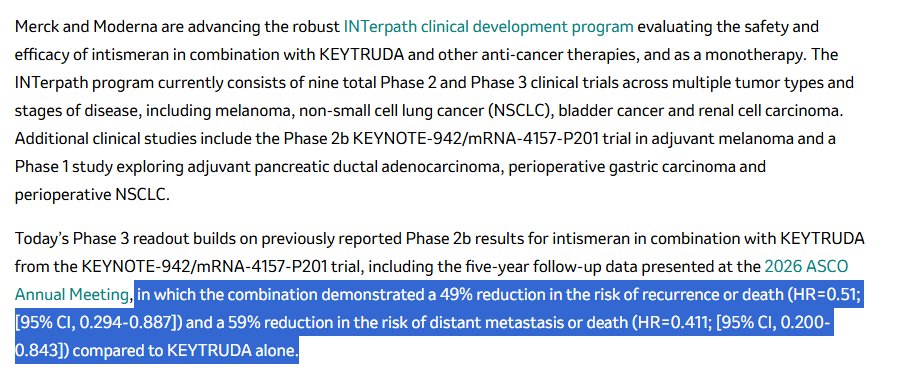
This is freaking huge: For the first time, a AI-assisted personalized mRNA cancer treatment has succeeded in a Phase 3 trial.
Moderna and Merck sequence each patient’s tumor and compare it with their healthy DNA. AI then helps identify which of the tumor’s mutations are most likely to trigger an immune response.
From those targets, Moderna produces an individual mRNA treatment encoding up to 34 neoantigens, The earlier Phase 2 trial followed patients with surgically removed high-risk melanoma for five years:
- 68.8% remained cancer-free, compared with 49.1% on Keytruda alone
- 49% lower risk of recurrence or death
- 59% lower risk of distant metastasis or death
Now the much larger Phase 3 trial involving 1,137 patients has also succeeded.
Absolutely incredible. Dario was right: cancer will be cured in just a few years!
The reality is what we are seeing unfold is Nvidia speedrunning the creation of a synthetic hyperscaler.
Apologies in advance to all the investors who are stuck in their priors that this will trigger.
But what is a hyperscaler? Strip it down and it’s a scaled infrastructure collective of CPUs, networking, storage with a development platform on top. It fulfills two purposes. Financial: it pools and smooths the financial obligations of its users, renting infrastructure as opex instead of capex. And Operational: it builds software that makes consumption the underlying primitives simple by abstracting them away.
The hyperscaler makes a healthy 35-40% operating margin by buying hardware at bulk pricing, pooling scale to get a lower cost of capital, and driving utilization of that hardware with software that shares and shards workloads across many customers.
But in the age of AI, the atomic units of compute changed. Training (massive coherent clusters) and inference (agentic workloads) - require a fundamentally different configuration of resources. These new workloads require dramatically more accelerated compute, shifting the design target from multi-tenant utilization (the cloud era) to absolute workload performance (the AI era). The economics of the data center inverted. A giant, redundant fleet of Amazon Basics CPUs and storage doesn’t work when the job is synchronous training and one straggling node stalls the entire cluster. For inference, tokens per watt and time to first token dominate the economics, not how many VMs you can pack in a box. And none of it works in a world of limited power (at least in the West. Maybe in China).
As Nvidia built more compute and sold it to the hyperscalers, it faced a fundamental problem. The hyperscalers had classic innovator’s dilemma - expecting 35-40%+ op margin, along with an underlying desire to commoditize Nvidia's 75% GMs with their Amazon Basics equivalent. Pay an ASIC vendor a 25% margin instead of Jensen’s 75%, then stack your own 40% on top! They owned the customer relationships too, enterprises developed on AWS, Azure, GCP and their data was captive there too. But most important of all, these companies moved at their own pace. They were not scrappy or hungry to operate at the pace Nvidia or the AI labs felt was necessary to build out compute to fulfill the demand in front of them. They would never look at retrofitting a 35MW site outside of Ashburn, Virginia!
Meanwhile, a group of hungry entrepreneurs noticed the fat margins the hyperscalers earned renting what was basically stock Nvidia hardware with limited software on top, and started building businesses around it. Nvidia - skeptically at first - recognized that working with these partners would lead to faster development cycles and competitive fires and pressures for the ecosystem. Thus the neoclouds were born.
The software these neoclouds co-developed with Nvidia were purpose built for the new workloads. They solved the new problems and requirements operating the new infrastructure needed. They were ready with hotswaps, they did predictive maintenance, they built new storage software that was built for training with cheaper ingress and egress fees, because their competitive drive was to win workloads, not to lock in enterprise data on their platform. And it was working - AI labs started preferring to work with them over the hyperscalers. Common complaints on the incumbents: too slow, too particular with how their clusters were built, virtualization and networking overlays that made GPU clusters underperform stock Nvidia reference designs. Neocloud bare metal was cheaper too as their teams built AI software, not a cloud data warehouse business. And they were happy to run at half the margin (~20%) that the big guys would never accept.
But the hyperscalers still had one structural advantage: their balance sheets. Investment grade. Able to fund speculative capacity ahead of demand and rent it out at much higher spot rates. The neoclouds couldn’t play that game as lenders would only finance hardware that was already contracted with offtake. And more expensive if that offtake were the labs which at an earlier point were much more speculative. If only they could build ahead of demand, they could maybe earn the kind of returns Elon is achieving on Colossus.
But the twist is that balance sheet edge is eroding in real time. Google just printed its first negative-FCF quarter and raised $50B equity. Microsoft is carrying $329B of leases signed but not yet commenced. Even the IG balance sheets hit the wall - more capital had to come from somewhere else.
And that's how we got to where we are today. Look at what Nvidia has actually built. The operational half of a hyperscaler: DSX OS and Mission Control to run and operate GPU fleets, DSX reference designs and Omniverse digital twins as hardened playbooks for building a data center itself. Dynamo for inference serving. All the old secret sauces of the hyperscalers built specifically for new age data centers that they have led the way in architecting. Offered to any hungry, technically competent team with a serviceable site.
And then the financing half: the revenue share and credit support model that smooths utilization across a distributed fleet the way multi-tenancy used to. Support the operator, release capacity to demand, share in upside, and now bring $500B of third-party capital to the table. Nvidia standardized the asset with reference designs, proved the compute was “fungible and transferable across customers and operators” and showed infrastructure investors DD unlevered yields across 7-8% hurdles. Those investors wet their beaks on early special situation financings, saw the paybacks, and understood the demand was global. That’s why Jensen spent 2025 flying around Europe, the Middle East, and Southeast Asia - these are the ground zero for new compute sites. The reality is that this didn’t happen just over the last 3 months. CoreWeave master agreement in 2023, the $6B spot reserve backstop in 2025 (to sponsor capacity for the inference clouds), the Blackrock AI Infrastructure Partnership in 2024, Brookfield’s $100B fund with Nvidia in 2025, KKR Helix with Nvidia in 2026. And now six independent financing platforms. Chess!
So now the three fears by name. Circularity? Monday was the opposite with Apollo, BlackRock, Blackstone, Brookfield, Goldman Sachs, and KKR bringing third party capital, independently underwritten apart from one another, replacing Nvidia’s balance sheet rather than just extending it. Useful lives / underwritability of these assets? CoreWeave just disclussed A100s, 6 year old silicon contracted through 2029 and pushed 25% price increase on its fleet in July. The collateral is aging more like an aircraft than a smartphone as feared. Market share? If you don’t see that the platform of Nvidia and the fungibility of this compute is the reason why this is even possible - the skeptics themselves are making the bull argument. The complaint that these platforms keep capital tethered to Nvidia and away from other ASICs / accelerators… $500B that can only buy Nvidia reference architecture is a moat dressed up as a risk.
So what were you doing when the first synthetic hyperscaler was built under your nose? :)
All views expressed are my personal views. Does not reflect the views of Altimeter or Nvidia or anyone else. Full disclosure I/we may hold positions in companies mentioned. Purely for discourse and thinking - no financial advice.
The next few years in SF will be incredible.
Many big lab employees will leave . The idea of sailing into the sunset is temporal and will quickly subside. Inevitably, they will start their own companies and absorb a tremendous amount of venture capital. This will lead to an abundance of innovation.
On the negative side, a lot of this innovation will be in the largely overlapping homogenous areas where their skillets lie. We see this already: many companies doing AI for quant trading, drug discovery, material discovery, robotics, new AI architectures, hardware. Competition in such disciplines will be severe.
Yet on the positive side, never in history could you raise this quantum ($100M+) of risk capital out of the gate and the space of invention that begets is unprecedented. People will take swings that were once not viewed as VC backable businesses. And yes, beyond just buying loads of compute to train models. Moonshot ideas which usually only worked under the comfort of a big company. Instead of 100, there may be 1000 startups dubbed “neolabs”.
Many will invest capital of their own. They will all pay top dollar to attract talent. They will poach large swathes of academia out of their labs to help.
Many will not find the hunger to succeed and get lazy from their riches. The more successful ones will acquire them if they are colleagues they liked.
The amazing ones will succeed immeasurably. And this will beckon a new renaissance we won’t be able to fathom from where we are now.