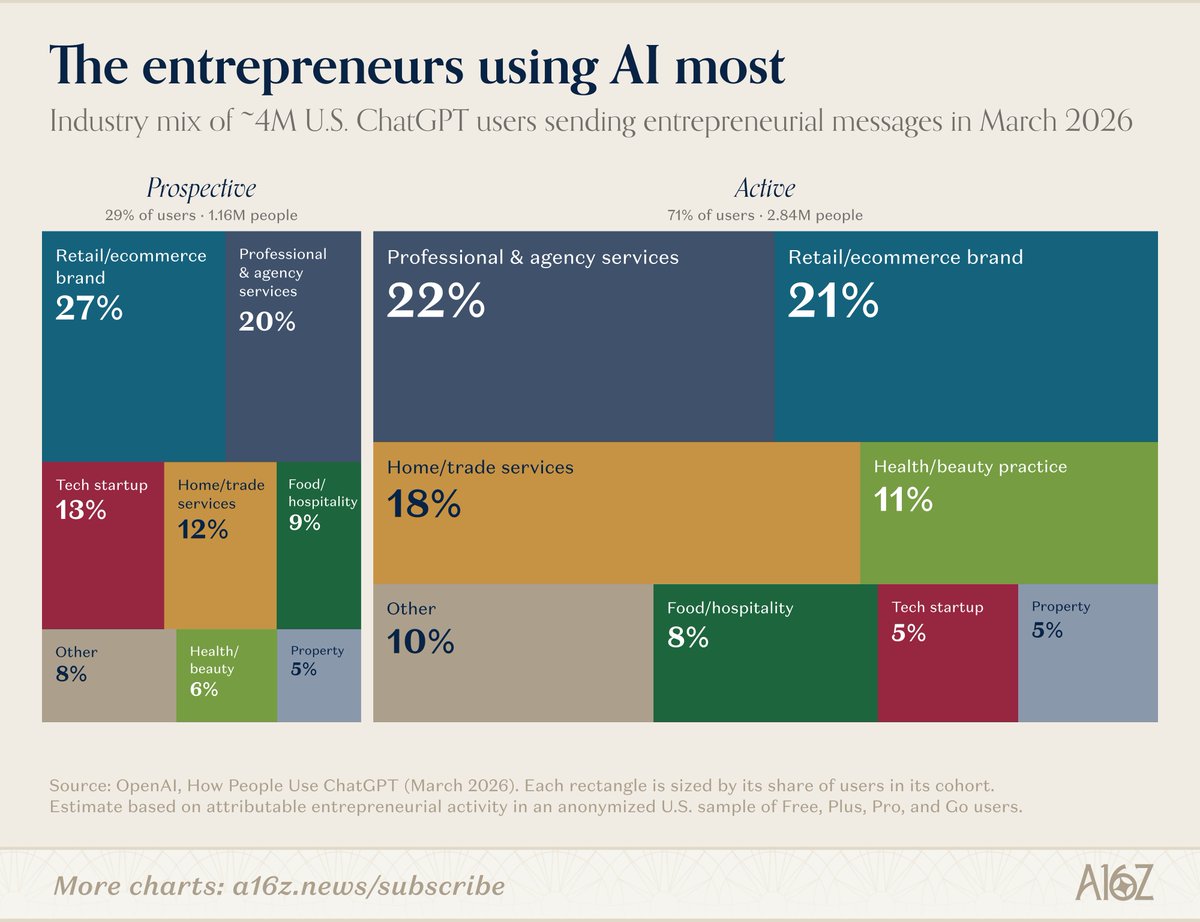
The businesses getting the most out of AI right now aren't tech companies.
They’re plumbers, agency owners, dentists, Etsy sellers.
New data from @OpenAI (cc @RonnieChatterji) makes the pattern clear: tech startups account for about 5% of ~active~ U.S. users doing entrepreneurial work with ChatGPT.
The other 95% are spread across services, retail, healthcare, and trades.
AI adoption for entrepreneurship isn’t concentrated in tech. It’s happening inside everyday businesses, folding into routine work that used to be slower or outsourced or entirely overlooked.
I have changed my mind on how AI will impact jobs in America.
Previously, I believed AI would replace many entry level roles typically filled by young employees. The technology would then work its way up the organization and eventually reduce the total number of jobs in a company.
The data is saying something different, so when I get new information I am willing to change my mind.
The number of software engineers being hired has been increasing. The number of open software engineer roles is growing.
The number of new college grads who get hired has increased 5.6% over the last 12 months. The unemployment level for people aged 20-24 years old who have a college degree has fallen from nearly 9% to almost 5% as well.
The Wall Street Journal recently wrote “AI created 640,000 jobs between 2023 and 2025 in the U.S., according to an analysis by LinkedIn of job posting data, including new white-collar positions such as Head of AI and AI engineer.”
And I am starting to see companies throughout our portfolio aggressively hiring to keep up with the demand for their products and services.
If AI can make employees more productive, which is widely accepted as fact, then companies are going to want as many productive units of labor as possible. This is a key reason why I am changing my mind.
AI appears to be a magical technology that will make companies more productive and more profitable. The net result will be more corporations, more startups, and more jobs.
All three are big, positive wins for the American economy.
This is exactly what we have been betting on @EnablSystems for the past few months.
We have already worked with real estate brokerages and marketing agencies in India.
And we found out pretty quickly just how fragmented the data is.
I’ll be sharing more about our findings.
If you read this and don’t understand why it’s happening it’s an opportunity to reset your understanding of how the real world works.
The real world will need a ton of help actually getting agents going in the enterprise. Companies have legacy tech stacks they need to modernize, data in tons of fragmented tools, knowledge that isn’t captured or digitized, and change management needed to actually utilize agents effectively. And they have to do all this while still running their business day-to-day, unlike startups.
This is why there is so much opportunity for companies (software or services) to actually deploy agents in specific domains and workflows. This remains a big opportunity for both existing services providers but also tons of new startups as well. Every new technology wave produces a new era of consulting firms that can deliver on that technology.
It’s also why the FDE model is going to be alive and well for a long time because companies will want to have their vendor actually help drive the change management and implementation for their new workflows.
The people aren’t going away. Far from it.
This is the future we are building at 8090. Our Software Factory is giving the companies that adopt it a new way to think about software.
Build v buy was never as simple as it sounded. If you build you have complex maintenance issues. If you buy, you also generally double or triple your budget with services.
The new way is to focus on the business logic and have Software Factory create something bespoke.
Fits like a glove, highly tuned for you, low maintenance costs.
Try it here: https://t.co/fkfTXgdfXK
Sequoia's thesis that the next $1T company will sell work, not software, is the most important reframe in AI right now.
The argument: if you sell a copilot, you're competing with every new model release. But if you sell the outcome — books closed, contracts reviewed, claims handled — every AI improvement makes your margins better, not your product obsolete.
The key insight most people miss: for every $1 spent on software, ~$6 is spent on services.
The entire SaaS playbook was about capturing the software dollar. The AI playbook is about capturing the services dollar — at software margins.
Not "AI for accountants." The AI accounting firm.
Not "AI for lawyers." The AI law firm.
The companies that figure this out won't look like SaaS companies. They'll look like services firms rebuilt on software infrastructure.
That's a fundamentally different company to build, fund, and scale. And most founders are still building copilots.
Our run-rate revenue has surpassed $30 billion, up from $9 billion at the end of 2025, as demand for Claude continues to accelerate. This partnership gives us the compute to keep pace.
Read more: https://t.co/XgSjL0And7
Honourable mentions:
@chamath - Money at stake + unfiltered opinions on AI.
@pmarca - If Marc Andreessen is writing about it, it matters.
@naval - Shaped how an entire generation thinks.
@jack - Using AI to dismantle 2,000-year-old org structures.