GTS Report 2026, submitted by the TN Govt is entirely based on The Great Trigonometrical Survey of India, Volume 29, 1899.
The report says there are two stations
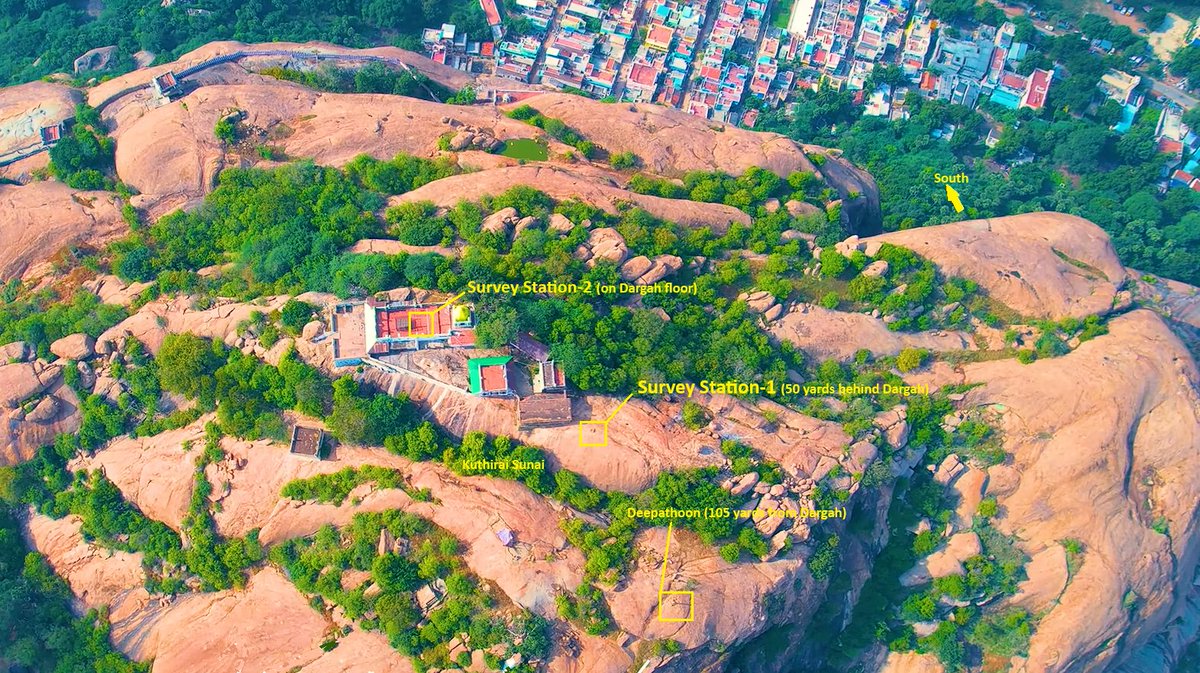
Station 1 - 50 Yards North West of mosque
Station 2 - 53 yards South East of mosque on centre of platform of the mosque.
There is no mention about a third spot or a 7 feet stone pillar in the British GTS report, 1899. How did the TN Govt fix a third spot as “GT Pillar” and drew a triangle in contradiction to GTS report 1899 which they're relying on. The TN govt had fraudulently introduced a “GT Pillar” on the hill stations other than the 2 stations mentioned by the British. There is no mentioning of a third apot or GT pillar in British report of 1899. TN govt has included a new third spot named GT Pillar only because they could not include the Deepa Thoon as per British specifications in 1899 report.
தமிழக அரசு இதையும் சர்வே கல் என அழைக்கும் முன், ஒரு சாமானியர் தனது ஊரில் உள்ள தீபத்தூணை விளக்கி, திருப்பரங்குன்றத்திற்காக குரல் கொடுத்துள்ளார்.
#Thiruparankundram
@tskrishnan Govts change, attitude doesn't.
Coordinates mentioned in the GTS report clearly differ from the location of the deepathoon & even if the existing deepathoon was repurposed as a survey pillar that doesn't alter facts.
Sheer desperation to discredit, only to appease a section.
Can you list out the achievements of HRCE ? Fact is that the temples which survived for thousands of years have not been able to withstand 70+ years of the departments control and some are struggling for survival and that's only till their properties are protected.
Look at the arrogance...People like her and Tarun Vijay have this 'white man's burden syndrome'. They think of us Tamil Hindus as people who need to be taught and enlightened.
Please mind your own business. We know how to take care of our temples.
This is the typical @BJP4India attitude because of which they will always be rejected in TN.
#HRCE kindly get out of all Hindu Temples in TN.
This will be the biggest Samaththuvam move.
Dear Devotees,the money u put in the Hudials in TN Temples is used to fight against Hindu temples only.
Kindly have this in mind when unr visiting temples.
HR&CE. The state government body that oversees Hinduism's Ruthless & Complete Eradication. Some say it is Evangelisation, but it does not matter.
Wish the court junks the petition with a firm rebuke to the HRCE department which is doing everything in its capacity to curtail the worship rights of Hindus.
BREAKING: Tamil Nadu’s HR&CE Commissioner has moved the Supreme Court seeking review of its November 20 order allowing the Karthigai Deepam to be lit at the disputed stone pillar on Thiruparankundram hill as a one-time measure.
மதுரைக்கு வந்த சூஃபிக்களின் பிரச்சார வரலாறு அறிவோம் !
14-ஆம் நூற்றாண்டில் (கி.பி. 1311–1335 காலகட்டத்தில்) டெல்லி சுல்தானகப் படைகள் மதுரை மீது படையெடுத்தபோது, கோவில் சிலைகள் சிதைக்கப்படும் அபாயம் ஏற்பட்டது. அப்போது மூலவர் சுந்தரேசுவரரைக் காக்க கோவில் ஸ்தானிகர்கள் (பூசகர்கள்) ஒரு சமயோசிதத் திட்டத்தைச் செயல்படுத்தினர்.
மூலவர் கருவறையைக் கல்லால் சுவர் எழுப்பி மூடி, அதன் மேல் மணல் கொட்டி மறைத்துவிட்டு, படையெடுப்பாளர்களைத் திசைதிருப்ப வெளியே இருந்த அர்த்தமண்டபத்தில் வேறொரு சிவலிங்கத்தை வைத்தனர்.
வந்த படைவீரர்கள் வெளியே இருந்த சிலையே மூலவர் என நம்பி கடப்பாரையால் தாக்கி உடைத்துவிட்டுச் சென்றனர்.
இதனால் உள்ளே இருந்த மூலவர் திருமேனி எந்தப் பாதிப்புமின்றித் தப்பியது. சுமார் 48 ஆண்டுகள் பூஜையின்றி இருந்த கருவறை, 1371-ல் விஜயநகர இளவரசர் குமார கம்பண்ணர் மதுரையை மீட்ட பிறகே மீண்டும் திறக்கப்பட்டது.
மூலவரைக் காக்கத் தன்னைத் தியாகம் செய்த அந்த மாற்றுச் சிலையே, சாட்சியாக இன்றும் அங்கு வைக்கப்பட்டுள்ளது.
THE DEBATE ON DEEPATHOON OF THIRUPARANKUNDRAM
As on date the most debated issue is whether the stone pillar standing atop the Thiruparankundram hill about 100 meters to the NorthWest of the Sikandar Dargha is a Deepathoon - a pillar for lighting a lamp - or a survey pillar. Those who want to prevent the Karthikai Deepam being lit atop the hill are trying hard to prove that to be a Survey pillar.
Because, if it is proved that the pillar indeed is a Deepathoon then one has to accept that there was a tradition of lighting lamp atop the hill since centuries. That will demolish the claim of the Muslims and others that the tradition was to light a lamp atop the Ucchi Pillayar temple which is at a much lower level behind the temple on the North side of the hill and hence there is no need to light it on the pillar on the hill claimed to be a Deepathoon. Let us look into what the evidences speak.
>> The Judgment & Conduct of Trigonometric Survey
First, there is a mention in the 1923 judgment “ the attempts on the part of the Hindus to put up lights at the summit of the hillock on which the mosque stands, one in the year 1862 and other in the year 1912 and in both cases the Magistrate interdicted the lighting because it was not customary to put a light there and probably because a breach of the peace was apprehended”. The Muslims also have concurred with this. Commonsense is sufficient to deduce that the container in which the Hindus attempted to light a lamp in 1862 existed there and it was nothing but the Deepathoon. Now, one needs to establish whether this pillar existed before the Great Trigonometric Survey by the British or installed to assist in the survey.
The instruments used for this survey viz. Troughton and Simms’ 24-inch Theodolite No.1 and Barrow’s 24-inch Theodolite No.2 had a weight of around 280kgs. Smallerinstruments used for secondary triangulation and on hill stations weighed over 90kgs. It is recorded that even getting them to the top of hill stations was an arduous task with dozens of men at work.
To mount these equipments precisely they used existing features like forts, mosques, temple towers, etc, or in their absence built a solid, circular and isolated pillar of masonry of about 2.5 feet in diameter and 1 to 6 feet in height with a mark at the center. Compare this with the 8 feet stone pillar found behind the Dargha that has a square cross section of about just 1 feet. It would be beyond commonsense to claim that the surveyor would have mounted 90-280kg equipment with a 2 feet base on a pillar of 1 feet width and that too at 8 feet height at the edge of a hill top. Also the stone pillar has a circular cup like cavity at the top which should have been carved for holding oil and wick. A Theodolite would have required a flat surface to hold it firmly.
Also it is said that there was an image of Hanuman on its side which has been vandalized at some unknown period. All these evidences point to the fact that the stone pillar that is installed North West of the Dargah is indeed a Deepathoon.
>> Trigonometric Survey Report
Now let us look at what is recorded in the survey report. The publication named “SYNOPSIS OF THE RESULTS OF THE OPERATIONS OF THE GREAT TRIGONOMETRICAL SURVEY OF INDIA VOLUME XXIX. DESCRIPTIONS AND CO-ORDINATES OF THE PRINCIPAL AND SECONDARY STATIONS AND OTHER FIXED POINTS THE GREAT ARC-SECTION 8° TO 18° OR SERIES А OF THE SOUTHERN TRIGON” published in 1899 by OFFICE OF THE TRIGONOMETRICAL BRANCH, SURVEY OF 1899 under the orders of MAJOR-GENERAL C. STRAHAN, R.E., SURVEYOR GENERAL OF INDIA lists on Page 298 (PDF Page 361) two survey stations marked on the Thiruparankundram hill referred to as Sikandarmalai. These are listed with the names Sikandarmalai No.1 h.s (hill station) and Sikandarmalai No.2 h.s (see image):
Sikandarmalai No.1 h.s : “On an isolated rocky hill about 550 to 600 feet high and on the high road from Madura to Sevalpati, at the E. end of a large tank, about a mile N. of the village of Něllayúr, 44 miles 8.W. of Madura, and 6 miles N.E. of the town of Tirumangalam: táluk Madura. The station is marked by a circle and dot engraved on the rock in situ, towards the N.W. side of the summit, and about 50 yards N.N.W. of the mosque on the top of the hill. 1871”
Sikandarmalai No.2 h.s : “On a well-known rocky hill, about 53 yards S.S.E. of Sikandarmalai No. 1 h.s.: táluk Madura. The station is marked nearly in the centre of the platform of the mosque on the summit of the hill. 1808-9”
These are secondary stations that were used for triangulation of areas along with the principal and secondary stations in the surrounding geographical area, as listed in the observation tables on several pages.
Clearly both are engraved on the rock itself in the form of a circle around a dot. There was no pillar at all. The survey equipment is usually mounted on top the marker with the center aligned to the dot. Of the two, the No.2 was marked during the survey in 1808-09 and No.1 was marked subsequently during the survey in 1871. The claim of the opposite party is that the Station-1 is nothing but the Stone pillar. The actual No.1 station exists as of date about 50 yards from the center of the Dargah as mentioned in the report where as the stone pillar is about 105 yards away. Further, the question arises as to why the surveyor had installed only one stone pillar when two survey stations are mentioned.
Thus the survey report itself provides enough evidence to deduce that the stone pillar is not related to the conduct of survey and should have been erected for a purpose other than that.
More details on the Deepathoon is covered excellently in the Judgment of THE HON'BLE MR.JUSTICE G.R.SWAMINATHAN in his judgment on 1/12/2025.
#ThiruparankundramDeepam #ThiruparankundramCase
Just 2 kms from Pudukkottai, stands a grand 7th century temple with rich history, Thiru Gokarnam. Dedicated to Shri Gokarneshwarar and Shri Bhrihadambal, this rock cut temple houses the majestic Maha Ganapati.
Ambal here was the kuladevata of Pudukkottai kings. She is also famously called as Araikasu Amman. Once, royal artifacts were retrieved after praying to HER. Hence kings honoured HER by releasing a coin with HER image on one side. Hence she is called 'Arai kasu amman'. Pudukkottai kings called themselves 'Brihadambaldas' out of their deep devotion to her.
Vetrivel Muruha!
GREAT NEWS for HINDUS !
Hon'ble Supreme Court PERMITS lighting the lamp on the Deepathoon by the Temple Devasthanam on 24.11.2026 (Subject to Final Order to be passed after detailed hearing)
No. of persons to participate, time and route, etc., will be decided by the District Collector who shall be the Nodal Officer.
No member of public to be allowed. No procession.
No slogan raising.
ASI would prescribe conditions required for preservation of the areas on the HOLY HILL.
The impugned order of the Hon'ble Division Bench is stayed in the meantime.
The ancient Chellur Mahadeva temple was lying closed. The revival by UgraNarasimha Charitable Trust has made it a centre of spirituality, where Ayyappa devotees start Sabarimala vrata with prayers at the Ayyappa shrine here.
A traditional Hindu temple connects society to the Gods, the roots of Hindu civilisation.