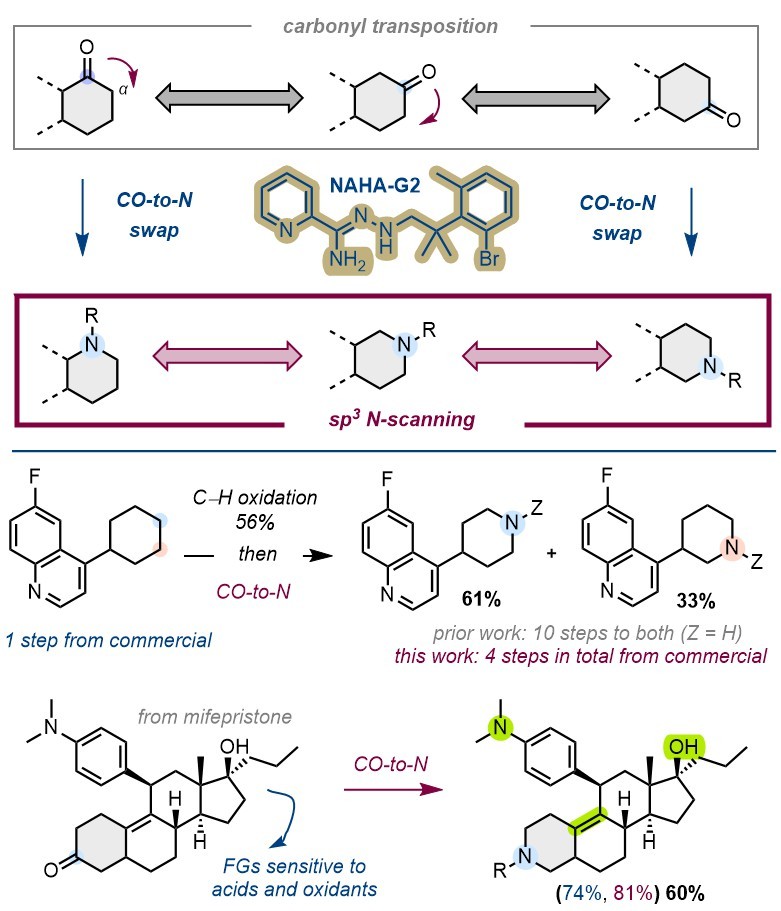
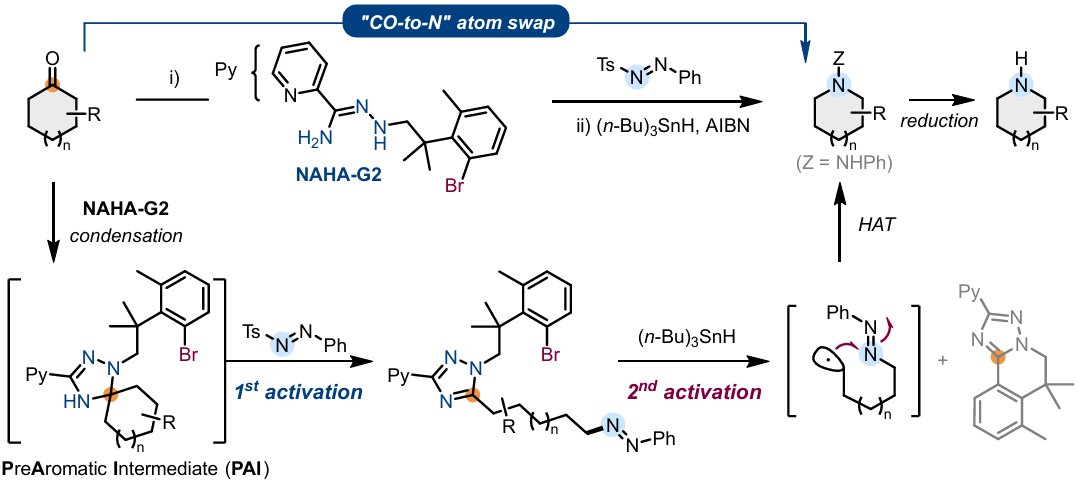
Our recent work on aliphatic CO-to-N atom swap enabled by NAHA chemistry, now online in @ScienceMagazine ! Congratulations to Zining, Zhehan and @RongYehhh !
https://t.co/wvtKrbLgYY
Check out our recent work on aliphatic C-to-N atom swap enabled by NAHA chemistry! This strategy enables access to diverse saturated N-heterocycles from cyclic ketones or cyclic alkanes. See: https://t.co/k9fPrEJdV8
🚀New advance toward asymmetric α‑Alkylation of Aldehydes.
✨Lead by Kezhi @KryptonChen, we report a branched-selective α-alkylation of aldehydes with unactivated olefins — enabled by a pyrazole mediator and a chiral Ir catalyst. Congrats!
https://t.co/k0XRh17VuG
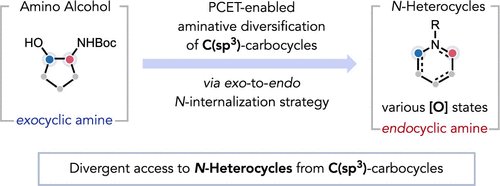
… and another one this week from the Knowles Lab, “Ring Expansions of 1,2-Amino Alcohols to Amine Heterocycles Enabled by Proton-Coupled Electron Transfer,” in @J_A_C_S.
Nice work Danny and Rob: https://t.co/hpvY18hzHg
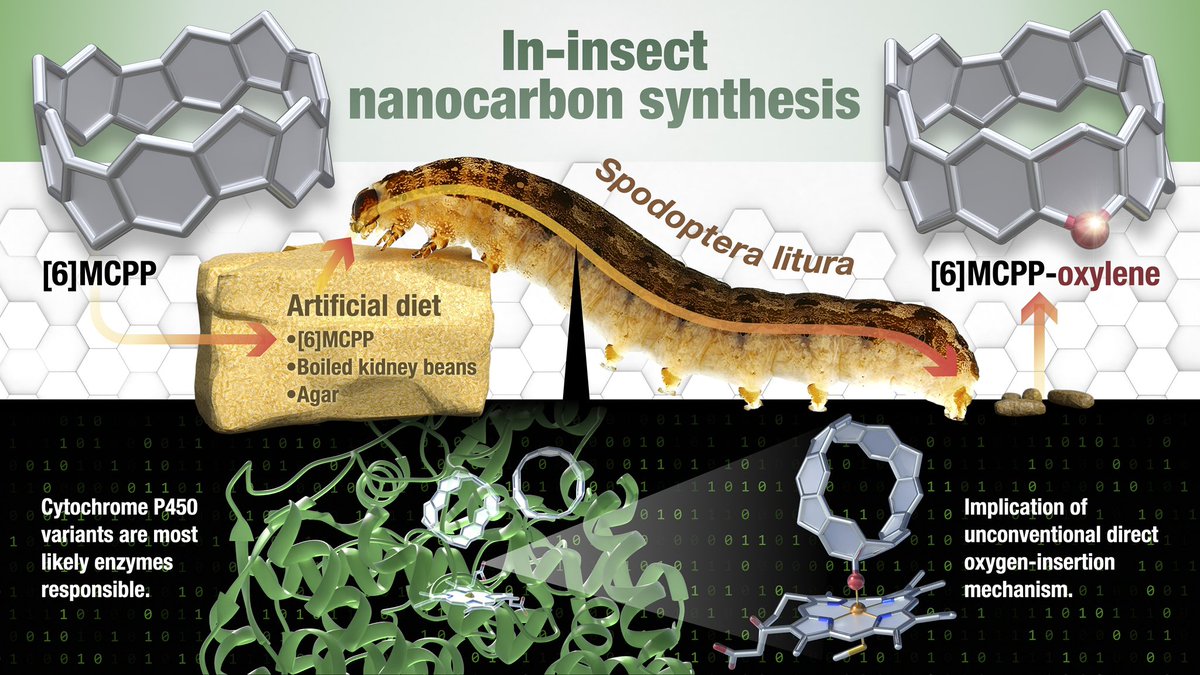
Our in-insect nanocarbon synthesis is now out in @ScienceMagazine. Enjoy our crazy campaign feeding molecules to insects densely packed with diverse enzymes and let them produce new functional compounds! Many thanks and huge congrats to all involved!!
https://t.co/WjS2TU6f8w
Excited to share that “Palladium and Norbornene Cooperative Catalysis: Fundamentals and Applications”—edited by Guangbin—is now available via Wiley!
https://t.co/09m3eawqa6
🚨RADICAL RETHINK: STEREORETENTIVE CROSS COUPLING UNLOCKED🚨 Today in @ChemRxiv (https://t.co/zGZFCsK7aK) the first method for stereoretentive radical cross-coupling is disclosed. No fancy ligands or redox needed—just a Ni-diazene twist. 120 years after Gomberg, a new chapter begins.
Quick summary:
Since Gomberg discovered free radicals over 120 years ago and Kochi pioneered radical cross-coupling in the 1970s, this field has surged with interest for linking C(sp3) fragments. Unlike traditional polar methods (e.g., Suzuki), radical cross-coupling excels with saturated systems, offering mild conditions and chemoselectivity to build complex molecules from common fragments. Until now, enantiospecific radical cross-coupling was deemed impossible due to rapid racemization, but today that changes with readily available sulfonylhydrazides and a simple Ni-catalyst. This stereoretentive approach, enabled by a unique Ni-diazene transition state and driven by loss of N2, skips chiral ligands and redox steps, opening new possibilities for synthesis.
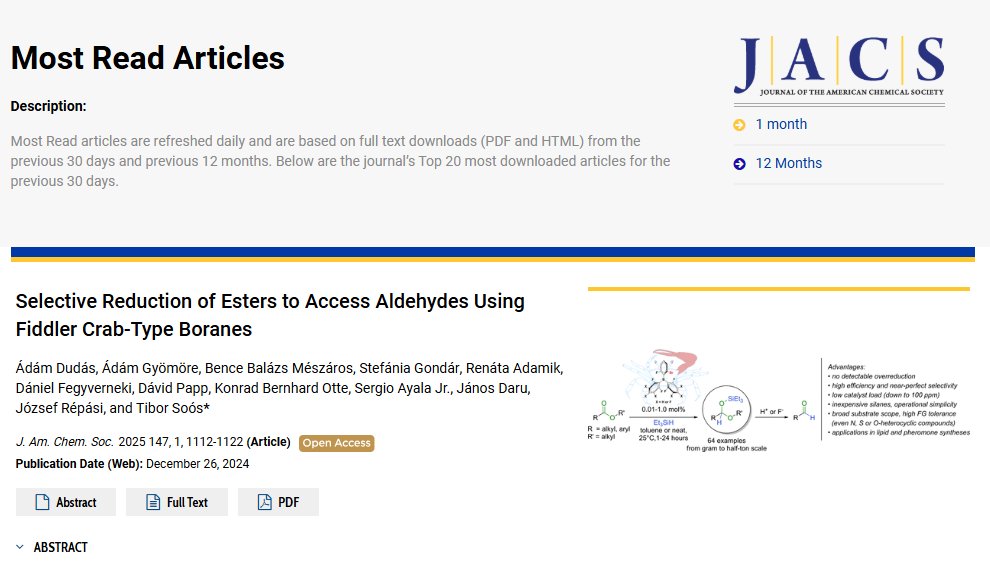
Exciting news!🎉 Our paper about the selective reduction of esters to aldehydes is currently the most read article in @J_A_C_S with over 12,000 reads in just two weeks! Huge thanks for the great feedback! Stay tuned for more exciting FLP chemistry soon!
https://t.co/DfBzv71zQQ
We are excited to announce that Guangbin Dong has won the 2024 Mitsui Chemicals Catalysis Science Award. The highly prestigious award honors contributions to the sustainable development of chemistry in catalysis science @GBD_Lab@UChicagoPSD@UChicagoPME
https://t.co/mx6bW1VZ7y
We are excited to announce that Guangbin Dong has won the 2024 Mitsui Chemicals Catalysis Science Award. The highly prestigious award honors contributions to the sustainable development of chemistry in catalysis science @GBD_Lab@UChicagoPSD@UChicagoPME
https://t.co/mx6bW1VZ7y
Thrilled to share our latest work in @Nature in collaboration with the Davis Group at @RosFrankInst & @OxfordChemistry. We developed a 'cap & glycosylate' strategy that directly transforms native sugars into glycosides & glycoproteins! @ChemNUS#glycotime https://t.co/eO25pDQ505