Day-12 #30Lit challenge 🙇🏽♂️
A day closer to my goals
-> Learned about a way to map a trajectory
->Started a series named PULSE(More details in upcoming post)
#100DaysOfCode#talk
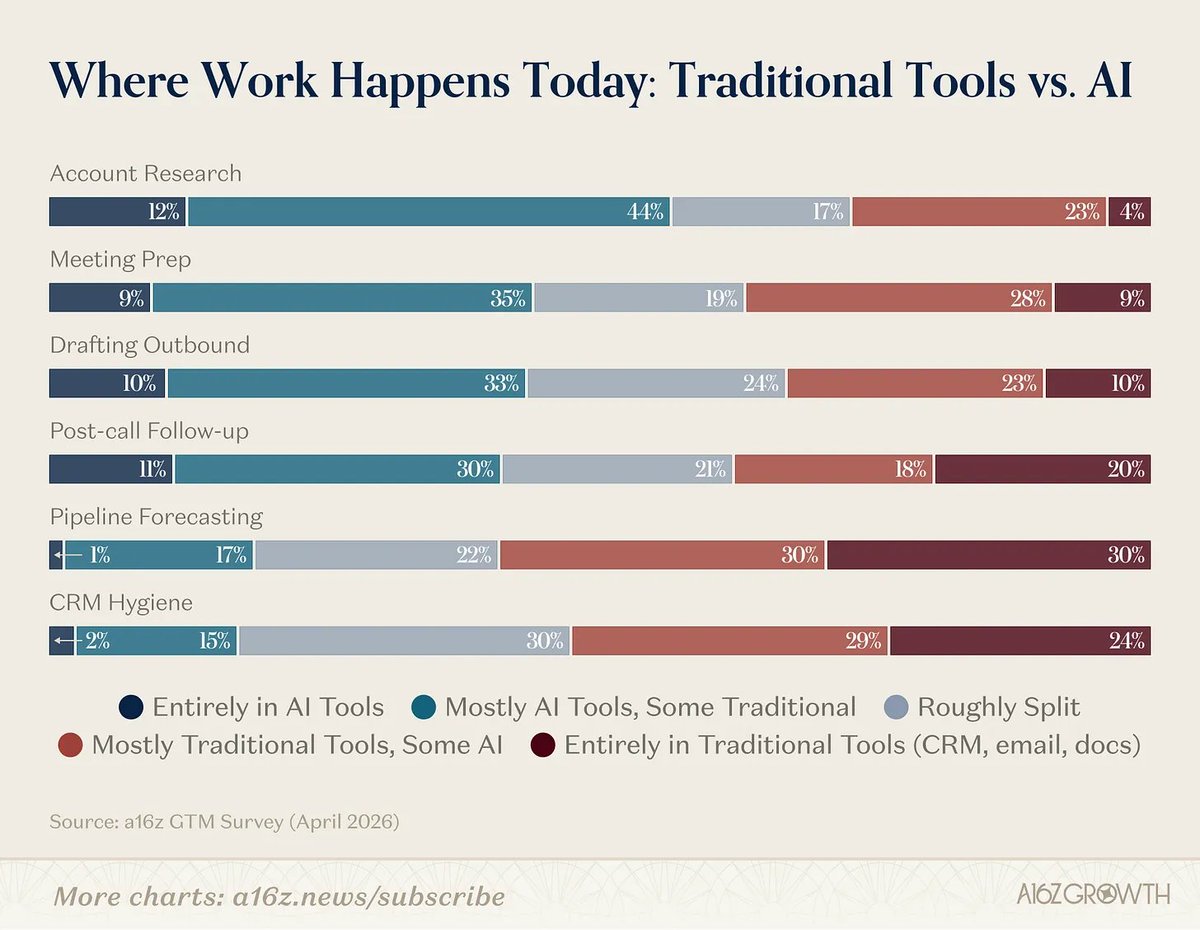
From "System of Record" to "System of Intelligence"
In the next decade, you want to own the system of intelligence that pulls from the system of record, becomes the user’s one-stop shop for gaining context and taking action, and turns the SoR into something that’s primarily consumed at the API layer.
The reasoning layer that sits above the database is where a new generation of companies is being built, and it’s where the majority of the next decade’s enterprise value of GTM software will end up.
Full piece from a16z's Gio Ahern, Steph Zhang, and Alex Immerman: https://t.co/2udG6l6SSx
New podcast on sales - Sell the Truth.
00:00 Be Credible
03:18 “Yes, And”
04:31 Selfish Honesty
05:37 Charisma Is Confidence + Love
07:56 Don’t Manage, Lead
11:16 Hunt Together
14:51 Feed Your (Good) Obsessions
18:57 Sell the Truth
21:07 Good Deal or No Deal
23:39 The Age of Nonlinear Returns
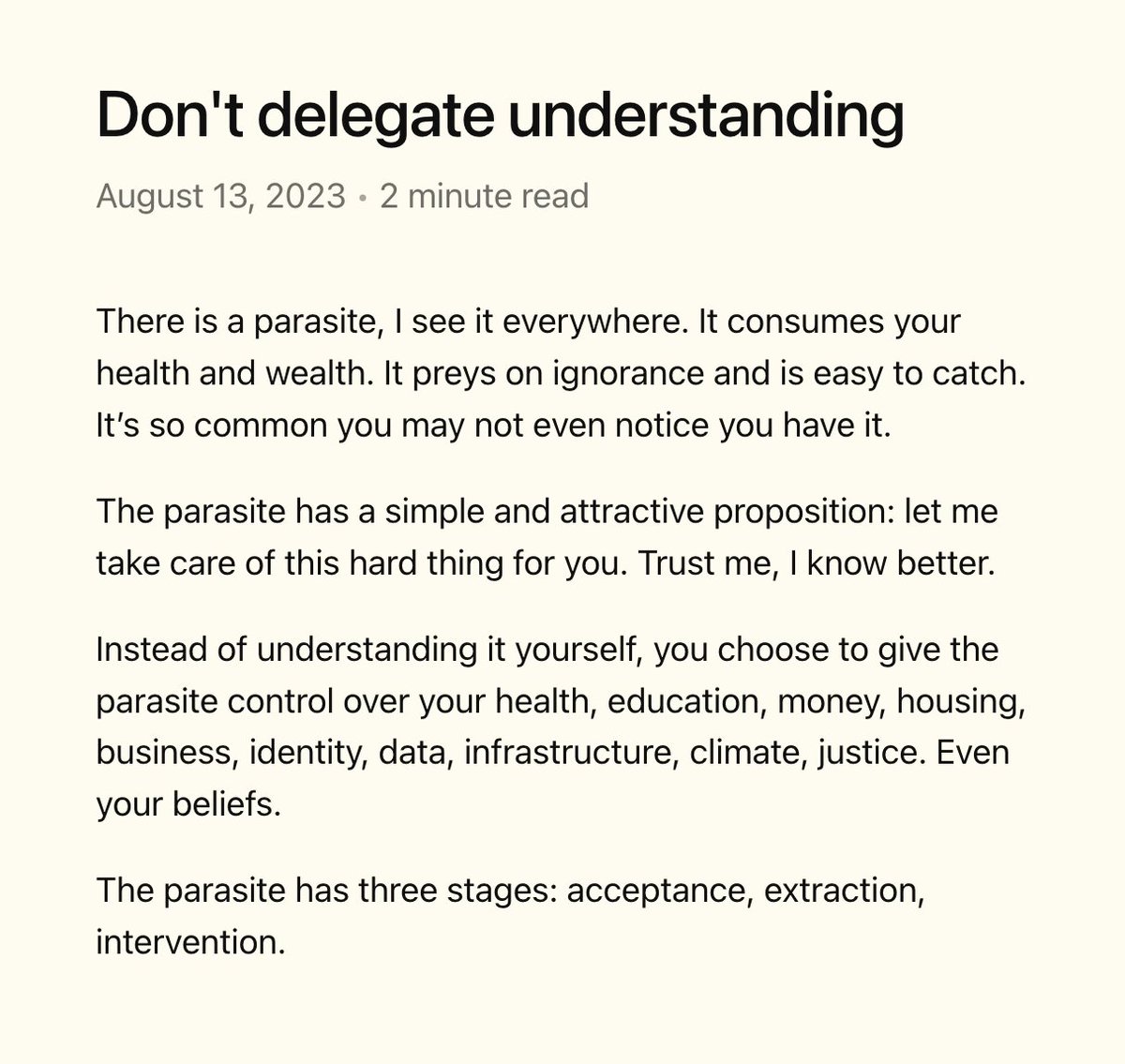
Don't delegate understanding
There is a parasite, I see it everywhere. It consumes your health and wealth. It preys on ignorance and is easy to catch. It’s so common you may not even notice you have it.
The parasite has a simple and attractive proposition: let me take care of this hard thing for you. Trust me, I know better.
Instead of understanding it yourself, you choose to give the parasite control over your health, education, money, housing, business, identity, data, infrastructure, climate, justice. Even your beliefs.
The parasite has three stages: acceptance, extraction, intervention.
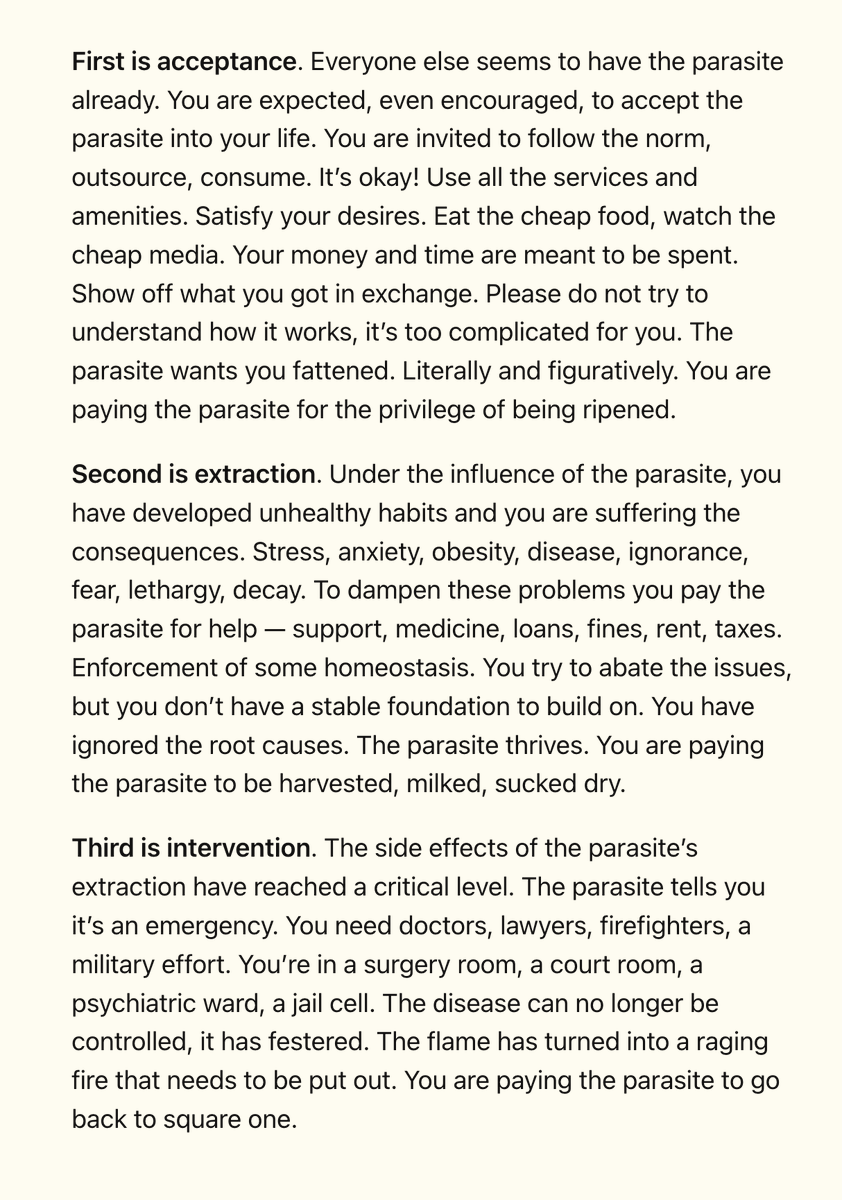
First is acceptance. Everyone else seems to have the parasite already. You are expected, even encouraged, to accept the parasite into your life. You are invited to follow the norm, outsource, consume. It’s okay! Use all the services and amenities. Satisfy your desires. Eat the cheap food, watch the cheap media. Your money and time are meant to be spent. Show off what you got in exchange. Please do not try to understand how it works, it’s too complicated for you. The parasite wants you fattened. Literally and figuratively. You are paying the parasite for the privilege of being ripened.
Second is extraction. Under the influence of the parasite, you have developed unhealthy habits and you are suffering the consequences. Stress, anxiety, obesity, disease, ignorance, fear, lethargy, decay. To dampen these problems you pay the parasite for help — support, medicine, loans, fines, rent, taxes. Enforcement of some homeostasis. You try to abate the issues, but you don’t have a stable foundation to build on. You have ignored the root causes. The parasite thrives. You are paying the parasite to be harvested, milked, sucked dry.
Third is intervention. The side effects of the parasite’s extraction have reached a critical level. The parasite tells you it’s an emergency. You need doctors, lawyers, firefighters, a military effort. You’re in a surgery room, a court room, a psychiatric ward, a jail cell. The disease can no longer be controlled, it has festered. The flame has turned into a raging fire that needs to be put out. You are paying the parasite to go back to square one.
The three stages of the parasite are interdependent. Every stage benefits someone who is not you. Everyone tells you this is just the way it is. Never mind that the parasite is living large.
Why? Extraction and intervention pay well. Education and prevention do not. The incentives are aligned to make the parasite persuasive. You are alone against a coordinated system that is exceedingly effective at packaging problems you should never have with solutions you should never need. A symbiotic loop.
You must recognize the parasite in its earliest form.
To inoculate yourself don’t delegate understanding. If you build your own understanding you will be the one who earns the dividends.
Built clawsweeper, which runs 50 codex in parallel around the clock, scans issues/prs deep and closes what is already implemented or what makes no sense.
Closed around 4000 issues today, a few thousand are in the pipeline. (rate limits are rough) https://t.co/AiNNDcvGke
There’s $1T up for grabs for agent-first startups and this window is WIDE open. Probably 10,000+ niches.
How it plays out:
1. Every SaaS company follows salesforce and goes headless within 18 months
2. a new category of "agent-native" startups emerges that treat salesforce, HubSpot, workday etc as dumb backends. the startup IS the agent. the SaaS is just the database.
3. the entire consulting/services industry around enterprise SaaS gets compressed into software. the agent replaces the implementation team.
4. outcome-based pricing becomes default. nobody pays per seat when the "seat" is an agent making 10,000 API calls a minute. you pay when revenue hits your account.
5. the winning founders are ex-operators who understand a vertical workflow cold. the code is the easy part. knowing that a property manager spends 14 hours a week on lease renewals? that's the insight worth $100M.
6. distribution becomes the moat. when anyone can wire agents to APIs, the company with the audience and the brand wins. media + agents is the new SaaS. There’s a rush to incubate live/short form shows.
7. Silicon Valley goes all influencer. Roy lee gets this. Pat Walls gets this. Sam Parr gets this.
8. the first $1B agent-native company in each vertical will look nothing like the SaaS it replaced. smaller team, higher margins, no implementation cost, no churn from bad UX because there is no UX.
the fastest path to wealth right now: find an industry that still runs on dashboards, phone calls, and spreadsheets. build the agent-native version. charge per outcome. own the workflow end-to-end.
someone reading this right now is going to build a $100M company off this exact shift. tell me about it on the @startupideaspod when you do. Im rooting for you.
Less reading, less bookmarking, more building.
the last wave rewarded people who built pretty interfaces on top of ugly data.
I think this wave rewards people who build smart agents on top of exposed APIs.
Or who just build the APIs themselves
Here we go
What I told 2,000 future founders in Bengaluru today:
1/ We believe we are at the start of a second wave of Indian companies that will build world-class AI native products for the global market. Emergent and Giga are the model of the future.
2/ Just because a space seems crowded doesn't mean it's too late. Zepto, Emergent, Giga - none were first movers. Second mover advantage is real.
3/ In fact, a good formula for finding startup ideas is to look at ideas that are showing some promise and just execute them better. Execution is everything: if you're an exceptional engineer, and you can build and move faster than your competitors, you'll win.
4/ There is every reason to believe Indian teams can beat US teams building global products. The level of engineering talent here is on a whole different level, and that's the key input.
5/ In the AI era, the best founders are the ones building at the edge of what's technically possible. You need to be experimenting wth the latest models, the latest open source projects.
6/ Stay in the flow of information. Watch the right podcasts, follow the right people on X. With AI changing this fast, you need to know what the smartest builders are thinking.
7/ Most of the best startups don't come from someone explicitly trying to start a company. They start from someone building a project just for fun, or tinkering with a new technology because they are curious. India needs more of this "tinkering" culture - this is how you have novel ideas when technology is shifting quickly.
8/ Founders are getting younger. Aadit was 18 when he started Zepto. The Giga founders were 20 when they came to SF. Young people who can learn very fast have the advantage right now.
9/ The best founders are pushing AI coding to the max. You can now write 20K lines of code / day. One person can do the work that just a year ago would take a 100 person team. The best builders are taking advantage and building at Garry Tan speeds.
In 14 minutes, this Anthropic engineer who wrote "Building Effective Agents" will
teach you more about building them right than most developers figure out on their own
in months.
Bookmark this for the weekend. Then read the builder's guide below.
Every time I see a tweet saying “I can vibe code this in a weekend” - I think of the slack notification system..
It takes time, persistence and effort to get the details right.
Sure, a lot of simple workflows will get vibe coded away. And maybe you can put this in Claude Code and get the code right in one shot.
But quality, depth and great systems will still have value and take time. You can’t vibe code lessons.
Now and forever.