Our work on mammalian sperm heterogeneity and sperm-level natural selection is now out in @ScienceMagazine:
https://t.co/up54qi1iPg
We've added lots of new data and analysis since the @biorxivpreprint came out last year. I'll highlight the new findings here! (1/n)
TWEETORIAL: PHATE, our dimensionality reduction and #dataviz method featured on the cover of today’s @NatureBiotech! To help spread the word, @scottgigante and @dbburkhardt put together this #tweetorial for you. https://t.co/76BRdy5NV0 (1/10)
After being told of BRCA1 mutation,
up to 50% women opt for prophylactic mastectomy
Should this be so?
For "monogenic" forms breast ca, colorectal ca, & heart attack, we find polygenic background powerfully modifies risk
New on @medrxivpreprint
https://t.co/JKteEV5MYu
@RaquelDiasSRTI and I wrote a review on #DeepLearning in clinical and genomic diagnostics.
Read it here 👇 https://t.co/hxxaiZnEgG
Our own #NeuralNetworks for genotype imputation... coming soon.
New paper in @CellCellPress!
We provide an empirical and theoretical evaluation of the expected outcomes of selecting human IVF embryos for traits such as height or IQ. 1/10
With @ehudkar, Or Zuk, @ToddLencz, and others.
https://t.co/w48Ai47ndh
New paper in @CellCellPress!
We provide an empirical and theoretical evaluation of the expected outcomes of selecting human IVF embryos for traits such as height or IQ. 1/10
With @ehudkar, Or Zuk, @ToddLencz, and others.
https://t.co/w48Ai47ndh
WOW WOW WOW
Reconstituted Cohesin caught live extruding DNA loops!
Turns out it needed an energy boost from its friends NIPBL and MAU2
"single human cohesin complexes form DNA loops symmetrically at up to 2.1 kbp/second."
Iain Davidson et al., Peters lab
https://t.co/lmym6TJ3ce
Geneticist version:
No.
No.
No, that's not what heritability means
No.
Yes, complex traits are complex
No.
CRISPR won't fix everything
No.
Epigenetics doesn't mean what you think it means
No.
Yes, Darwin is still right
@pjie2 @RCFbio@manoliskellis@SimoneImmler Super interesting, yes, would love to study zebrafish expression. Functional traits ie longevity leading to organismal differences give more credence to widespread heterogeneity in sperm. Also interested in how the maturation process for spermatozoa differs in zebrafish
@manoliskellis@RCFbio Great point! Yeah, we didn’t have a good system for checking for coupled fitness. But it would be worthwhile to see the expression signature in other tissues for the GIMs that are under selection pressure as a starting point
Our work on a new source of sperm heterogeneity is finally up on biorxiv:
https://t.co/LNBEwcBOya
Bottom line, we think we've found a set of mammalian genes enabling natural selection between sperm that is far more prominent than we guessed.
Tweet summary to follow:
Our work on a new source of sperm heterogeneity is finally up on biorxiv:
https://t.co/LNBEwcBOya
Bottom line, we think we've found a set of mammalian genes enabling natural selection between sperm that is far more prominent than we guessed.
Tweet summary to follow:
That's a classic case of evolutionary conflict, and probably the reason most genes aren't GIMs. But it's not a problem for sperm-specific genes, paralogs, and isoforms. Evolution should make these more likely to be GIMs then...
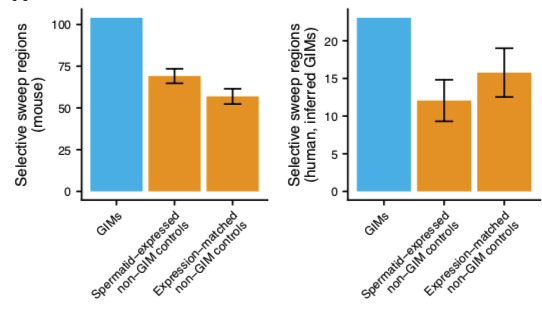
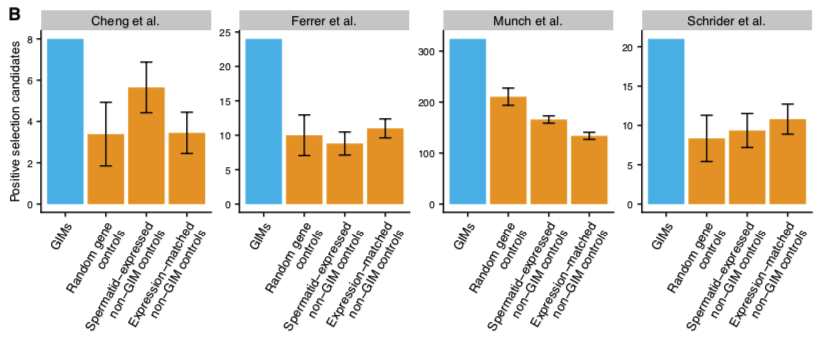
It turns out GIMs are enriched for mouse and human selective sweeps, meaning they experience evolution faster than other genes!
But is that a good thing? What if what's good for the sperm is not good for the organism?
GIMs have allelic bias at the RNA level - but does this translate to the functional level? If so, we should see signatures of biased inheritance when GIM alleles have different function.
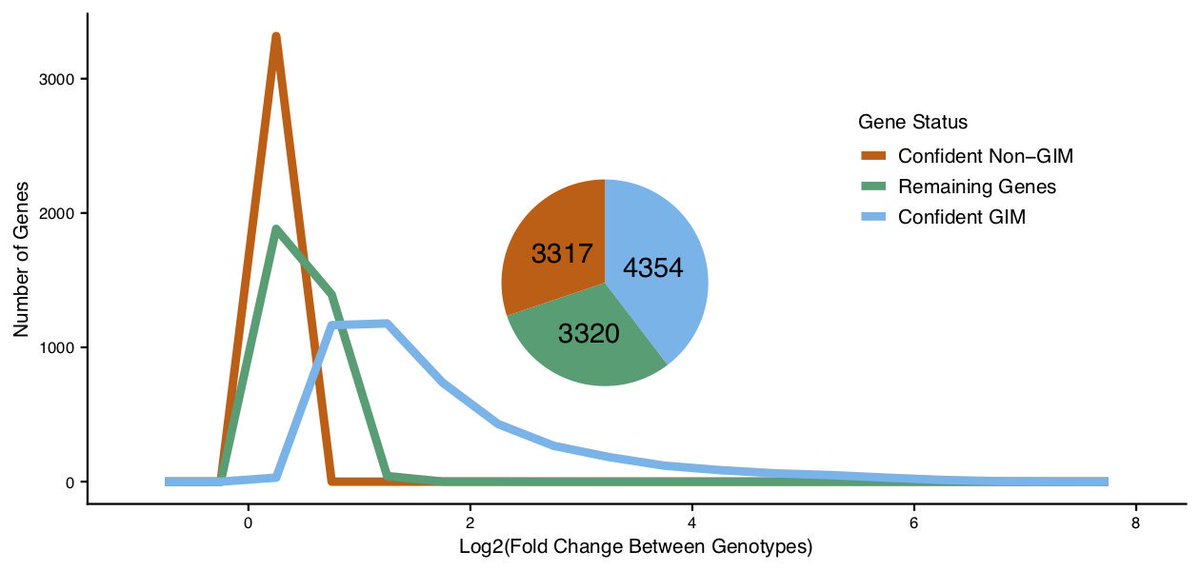
We used scRNAseq to ask, "are there other genes like the t-complex"? We hoped to find 5-10 examples. We were shocked to find that about a third of genes had biased allelic expression toward the haploid genotype! We call these genes GIMs (genoinformative markers) for short.