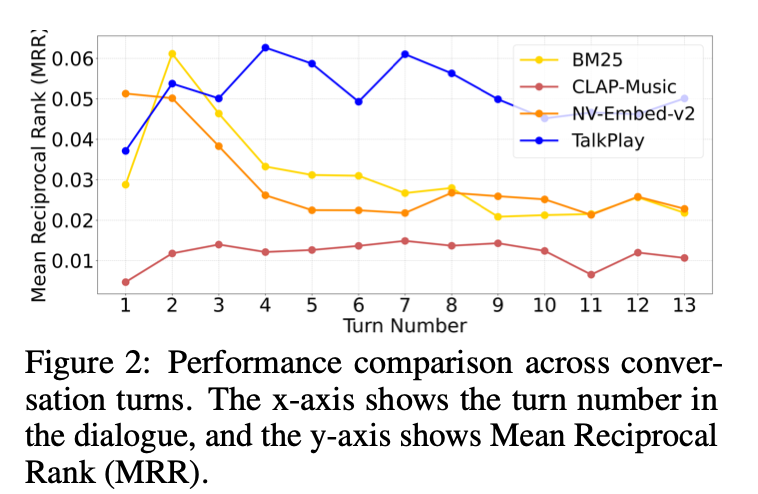
🧵we updated the TalkPlay paper significantly.
1. check out the performance comparison. LLM-based recsys does great job over multi-turn chat and recommendation.
@SeungHeon_Doh
How many academic papers are written with the help of ChatGPT? To answer this question, we analyzed 14mln PubMed abstracts from 2010 to 2024 and looked for excess words:
** Delving into ChatGPT usage in academic writing through excess vocabulary **
https://t.co/yorlDLjozw
1/11
These 94 lines of code are everything that is needed to train a neural network. Everything else is just efficiency.
This is my earlier project Micrograd. It implements a scalar-valued auto-grad engine. You start with some numbers at the leafs (usually the input data and the neural network parameters), build up a computational graph with operations like + and * that mix them, and the graph ends with a single value at the very end (the loss). You then go backwards through the graph applying chain rule at each node to calculate the gradients. The gradients tell you how to nudge your parameters to decrease the loss (and hence improve your network).
Sometimes when things get too complicated, I come back to this code and just breathe a little. But ok ok you also do have to know what the computational graph should be (e.g. MLP -> Transformer), what the loss function should be (e.g. autoregressive/diffusion), how to best use the gradients for a parameter update (e.g. SGD -> AdamW) etc etc. But it is the core of what is mostly happening.
The 1986 paper from Rumelhart, Hinton, Williams that popularized and used this algorithm (backpropagation) for training neural nets:
https://t.co/f52IcDNitR
micrograd on Github: https://t.co/GaTd16jRnB
and my (now somewhat old) YouTube video where I very slowly build and explain:
https://t.co/EPGG6kd5Yz
I'm thrilled and humbled to share that our work on new releases has just been awarded the "Best Industry Track Paper Award" at #ECIR2024!
Congratulations to all members of our music recommendation team at @Deezer! 👏
@ecir2024@researchdeezer@lea_ibrd@xbenji
한국음악지각인지학회 학술세미나가 3월9일 토요일 오후 1시에 서강대에서 열립니다. 제가 키노트를 맡게되었는데 많은 관심 부탁드립니다! 사전등록:https://t.co/TvsbYsv5NI
I'll give a keynote presentation to KSMPC (music perception and cognition), which will be hosted at Sogang Univ.
I love music most when it’s live, in the moment, and expressing something personal.
This is why I’m psyched about the new “DJ mode” we developed for MusicFX: https://t.co/UiBbOaR7zU
It’s an infinite AI jam that you control 🎛️. Try mixing your unique 🌀 of instruments, genres, or favorite foods--whatever your 💚 desires. Hone your skills as a prompt DJ to create a smooth, consistent set.
I’ve been having a blast learning to express my own musical ideas with this unique instrument, and I’m stoked to see how others use it!
We’re working on lots more features to unlock your creativity, so stay tuned!
Our new paper is out!
💡"MusicMagus: Zero-Shot Text-to-Music Editing via Diffusion Models"
📰arxiv: https://t.co/siSGR5fLiD
🎶demo: https://t.co/08eRxurZXU
🎥video: https://t.co/PtgcHqwpGI
Multimodal AI BGM Generator https://t.co/1zlU7Pg2AL (https://t.co/rBtK6Ztpn0), BETA ver. released. Please check this out.
Craft copyright-free music uniquely tailored to your preferences using prompts, scene imagery, or reference music. (And, this is free during the BETA period)
Enhancing the image caption quality was the key in Dalle-3.
What would we need in music generation then?
Music captions, a lot of music captions.
Do we have them? No.
But.. we got 🔥 LP-MusicCaps 🔥
https://t.co/aTxQ9PTVNs
#ismir2023
My PhD student @taejun_kim_ proudly shares this nice demo and working model of metrical and functional structure analysis (beat, downbeat, segmentation, and structure labeling all in one single model).