Three more checks decide who scales:
⚙️ automate the costliest job, not the loudest
🧰 two systems you own > seven you don’t
🔒 know & secure every automated thing on your floor
🏭 A robot helped build 30,000+ cars at BMW. Toyota and Amazon are running them too.
So why do 80% of US factories still run ZERO automation — and why do most robot pilots never make it past the demo?
40 years on the plant floor already taught us why 🧵https://t.co/r2J00p4NUz via @LinkedIn
The fix is boring on purpose:
• a clear stop a human can hit
• every action safe to repeat
• limited access
• it talks to the line
The robot you can still switch off is the one still running next year.
When an automation project dies, the autopsy almost never says “the robot couldn’t do the job.”
It says the robot couldn’t talk to anything else. No work orders in. No records out. No alarm when it broke.
The robot is an island.
The tech is here. Automate 2026 this week is packed with “physical AI” — robots that see, decide and act on a real line. Robot density has doubled in 7 years.
The machine isn’t the bottleneck. Everything around it is.
The most fundable AI idea sitting unbuilt right now:
SOC 2 for AI agents.
Every deployer is liable for what their agents do. EU AI Act + state rules require risk management.
No incumbent owns the category.
Market: $7.6B → $183B by 2033.
Someone's going to build this.
This is a fascinating direction from @karpathy.
The idea of autonomous research loops where:
• Humans iterate on prompts
• Agents iterate on code
• Training runs continuously searching for better architectures
This is essentially “self-improving research infrastructure.”
The real opportunity is building systems where AI agents become research collaborators — discovering architectures, optimizers, and datasets faster than human teams.
I’m increasingly convinced the next generation of startups will look like AI research factories, not traditional software companies.
#AI #Agents #ResearchEngineering
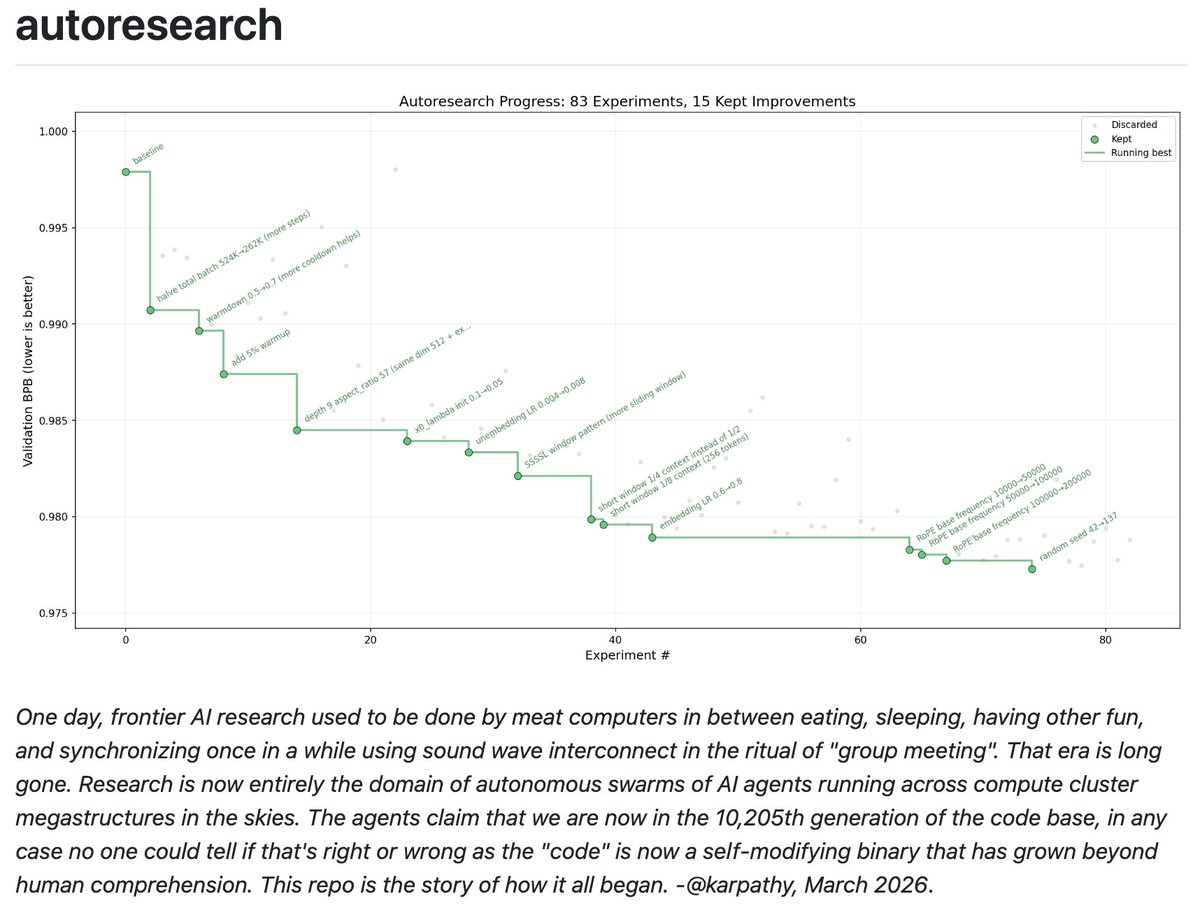
I packaged up the "autoresearch" project into a new self-contained minimal repo if people would like to play over the weekend. It's basically nanochat LLM training core stripped down to a single-GPU, one file version of ~630 lines of code, then:
- the human iterates on the prompt (.md)
- the AI agent iterates on the training code (.py)
The goal is to engineer your agents to make the fastest research progress indefinitely and without any of your own involvement. In the image, every dot is a complete LLM training run that lasts exactly 5 minutes. The agent works in an autonomous loop on a git feature branch and accumulates git commits to the training script as it finds better settings (of lower validation loss by the end) of the neural network architecture, the optimizer, all the hyperparameters, etc. You can imagine comparing the research progress of different prompts, different agents, etc.
https://t.co/YCvOwwjOzF
Part code, part sci-fi, and a pinch of psychosis :)
I packaged up the "autoresearch" project into a new self-contained minimal repo if people would like to play over the weekend. It's basically nanochat LLM training core stripped down to a single-GPU, one file version of ~630 lines of code, then:
- the human iterates on the prompt (.md)
- the AI agent iterates on the training code (.py)
The goal is to engineer your agents to make the fastest research progress indefinitely and without any of your own involvement. In the image, every dot is a complete LLM training run that lasts exactly 5 minutes. The agent works in an autonomous loop on a git feature branch and accumulates git commits to the training script as it finds better settings (of lower validation loss by the end) of the neural network architecture, the optimizer, all the hyperparameters, etc. You can imagine comparing the research progress of different prompts, different agents, etc.
https://t.co/YCvOwwjOzF
Part code, part sci-fi, and a pinch of psychosis :)
@aureliengeron Fantastic work. The visualization of the dimensions ($B, L, d_m$) throughout the block effectively demystifies the Mamba architecture. It’s rare to find such high-quality educational material on these newer State-Space Models made freely available. Much appreciated!
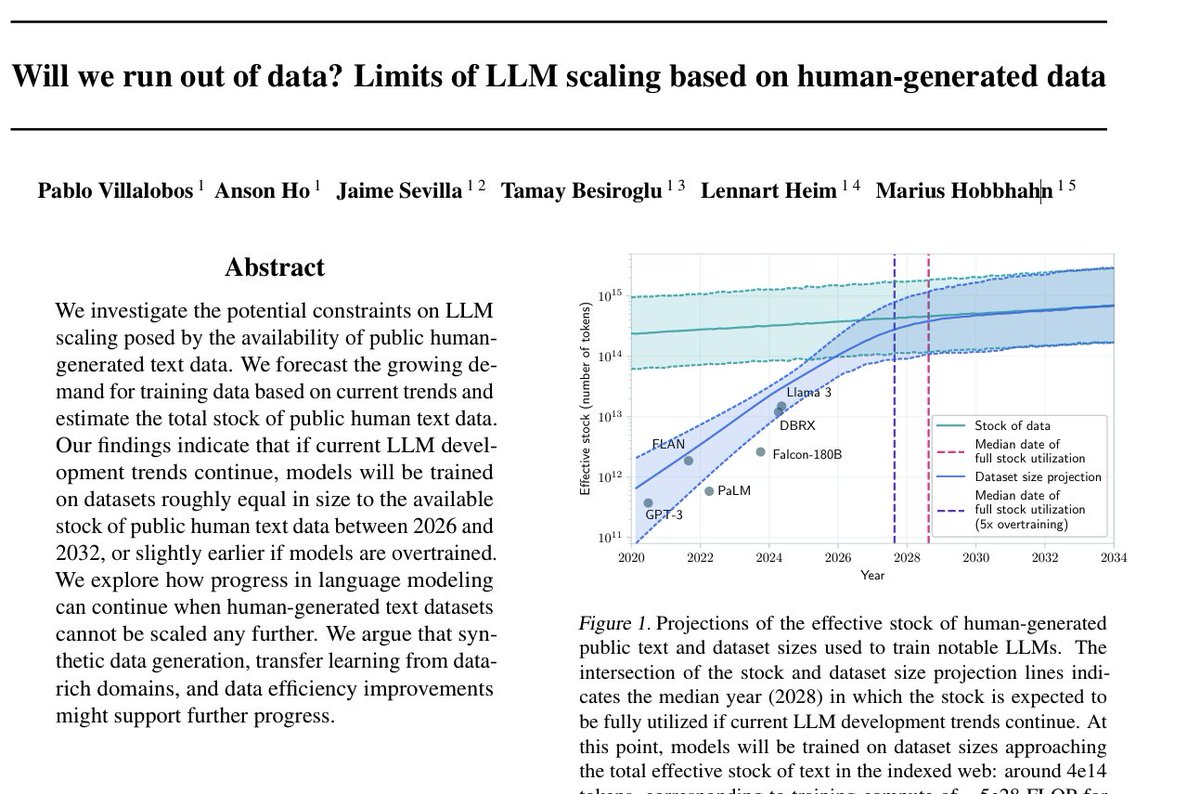
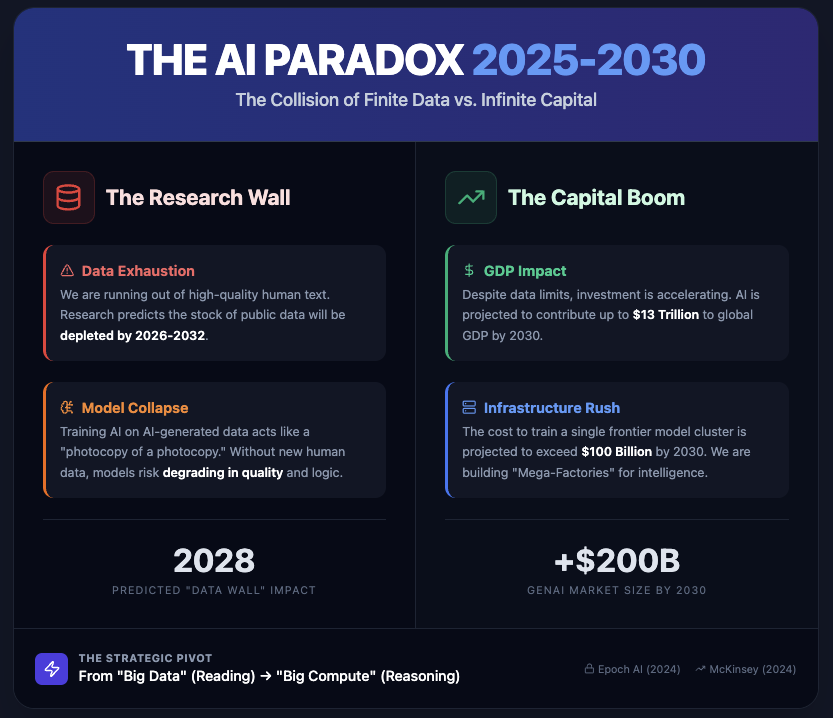
The "Paradox" Angle (High Impact)The 2025 AI Paradox: 📉 Data Supply: Depleted by ~2028 📈 Capital: $13T GDP boost by 2030
We can't just "read" more internet. We have to "think" deeper. The shift from Big Data ➡️ Big Compute is here. 🧠⚡️
#AI#TechTrends#GenAI