“If this is the beginning of the new,
perfect Aquarian age,
my work is to quiet my mind,
open my heart and relieve suffering.
Or if this is armageddon,
the end of the world,
my work is to quiet my mind,
open my heart and relieve suffering."
– Ram Dass
My biggest takeaways from @danshipper:
1. The future of work will happen inside Codex or Claude Code. Instead of putting AI into your SaaS tool, you’ll use your SaaS tools inside your favorite AI agents' in-app browser. Dan spends all his time in Codex now—writing documents, managing email, doing research, everything. He's using Google Docs, PostHog, and everything he needs within the agent's in-app browser. The agent can see what he’s doing, and has all of his context, so he and his agent collaborate quickly and super effectively.
2. Automation is a lie—every automation needs a human. Dan's company doubled in size this year despite being incredibly AI-forward. Why? Because in order to make automation work well, you need humans making sure everything keeps working. This is why benchmarks are misleading—they measure AI on problems we’ve already framed and can score, but there’s always a higher frame.
3. PMs will win the AI era. Marcus, a former PM who previously ran Axios’s writing product, joined Every after getting super AI-pilled. Now he runs their product Spiral, and ships faster than anyone on the team. He pairs technical knowledge with spiky product sense, deep user empathy, and an eye for what matters. Dan thinks any PM who gets really AI-native will be incredibly dangerous because the building is done for you—what matters is figuring out what to build and if it’s great.
4. Full-stack designers are becoming superheroes. Designers used to make beautiful interactions that engineers didn’t want to build or couldn’t execute properly. Now designers don’t need to hand things off; they can build it themselves. Designers are naturally creative people, and AI is the perfect tool for them because it lets them bring their vision to life without the traditional bottlenecks.
5. SaaS is not dead. In fact, Dan is bullish on SaaS stocks. When users bring their own AI (via Codex or Claude Code) to use SaaS products, the user—not the SaaS company—pays for tokens. This saves SaaS company’s margins. Since the agents need their own seats, Dan predicts that agents will create massive new demand for SaaS because there will be tons of agents using these products at high volume.
6. Every company will have one “super-agent” inside their Slack that every employee will use. Dan initially thought every employee would have their personal work agent, like a shadow AI org chart, but he’s completely flipped his view. He realized agents need humans who care about them. When someone gets tired of maintaining their personal agent, it becomes useless. The winning model is one forward-deployed engineer or AI-savvy person who maintains a company-wide agent (like Shopify’s River or Viktor), and then it trickles down to more specialized team agents as models improve and become less fiddly.
7. The AI job apocalypse is not happening, but you do need to evolve to stay relevant. Models make yesterday’s human competence cheap. But because everyone uses the same models, it all looks the same if you use it the default way; it becomes commoditized slop. Humans then take that frozen competence and use it to make something new and interesting for their specific situation. The key: “ride the models”—use them for everything you do, try new models when they drop, keep turning over rocks.
8. We will read way more AI-generated writing, and we will like it. Human writing is incredibly important for things that matter, but for internal docs, planning, and email, AI-generated is often better because most people are bad at writing strategy documents.
9. Build software for humans and agents to use together. The current model is building a CLI that an agent uses independently. Instead, you and your agent should be using the app together. This creates new design challenges—agents can make a billion requests in three seconds, so you need approval flows, inboxes that summarize what happened, logs, and easy rollback.
10. Forward-deployed engineers are the new most essential role. The big model companies have teams of people managing their internal agents, and those teams aren’t going away. It’s different from traditional software building, and certain engineers love it. As models get better, this role will evolve—you’ll be managing more agents doing more things.
Hearing this at dozens of midmarket companies too.
The heart of the problem is token waste. At least 90% of the tokens burned by Claude Cowork users are wasteful (i.e. same task could be performed -- and more accurately -- using better infrastructure and tooling.
Developers have a natural skillset advantage and a 1-2 year head start at practicing with this stuff, but Cowork took the rest of the corporate world by storm over the past few months, and the costs of getting this wrong are pretty bonkers, the inefficiency rate scaling multiplicatively with headcount.
The solution to token waste is a thoughtfully-built context graph, not a bunch of incumbent vendor APIs wrapped in wordy MCP calls.
A context graph shifts most of the reasoning burden from read time to write time. This makes a lot of the costs scale linearly with corpus.
We finally know why LLMs hallucinate. It's not the model. It's the geometry.
@OpenAI text-embedding-3-large: 91/3072 dimensions do real work.
@GeminiApp gemini-embedding-001: 80/3072 dimensions do real work.
~97% of your vector database is mathematically empty. Your RAG system is retrieving from noise.
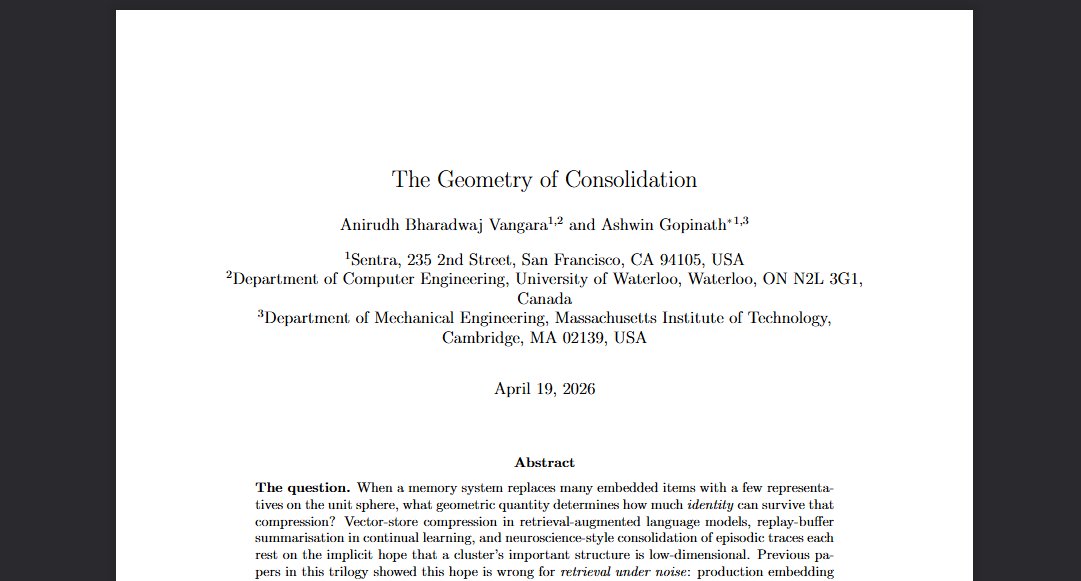
@ashwingop and I present "The Geometry of Consolidation" - a proof that RAG compression has a hard floor no algorithm can beat, set by a single spectral number your embedding model cannot escape.
Every hallucination your RAG pipeline produces? This is why.
Paper + results: https://t.co/zut8pdoPbH
> We’ll also be experimenting with reduced pod sizes, including “one person teams” with engineers, designers, and product managers all in one role.
Truly a new age for us feral generalists.
This is an email I sent earlier today to all employees at Coinbase:
Team,
Today I’ve made the difficult decision to reduce the size of Coinbase by ~14%. I want to walk you through why we're doing this now, what it means for those affected, and how this positions us for the future.
Why now
Two forces are converging at the same time. We need to be front footed to respond to both.
First, the market. Coinbase is well-capitalized, has diversified revenue streams, and is well-positioned to weather any storm. Crypto is also on the verge of the next wave of adoption, with stablecoins, prediction markets, tokenization, and more taking off. However, our business is still volatile from quarter to quarter. While we've managed through that cyclicality many times before and come out stronger on the other side, we’re currently in a down market and need to adjust our cost structure now so that we emerge from this period leaner, faster, and more efficient for our next phase of growth.
Second, AI is changing how we work. Over the past year, I’ve watched engineers use AI to ship in days what used to take a team weeks. Non-technical teams are now shipping production code and many of our workflows are being automated. The pace of what's possible with a small, focused team has changed dramatically, and it's accelerating every day.
All of this has led us to an inflection point, not just for Coinbase, but for every company. The biggest risk now is not taking action. We are adjusting early and deliberately to rebuild Coinbase to be lean, fast, and AI-native. We need to return to the speed and focus of our startup founding, with AI at our core.
What this means
To get there, we are not just reducing headcount and cutting costs, we’re fundamentally changing how we operate: rebuilding Coinbase as an intelligence, with humans around the edge aligning it. What does this mean in practice?
- Fewer layers, faster decisions: We are flattening our org structure to 5 layers max below CEO/COO. Layers slow things down and create coordination tax. The future is small, high context teams that can move quickly. Leaders will own much more, with as many as 15+ direct reports. Fewer layers also means a leaner cost structure that is built to perform through all market cycles.
- No pure managers: Every leader at Coinbase must also be a strong and active individual contributor. Managers should be like player-coaches, getting their hands dirty alongside their teams.
- AI-native pods: We’ll be concentrating around AI-native talent who can manage fleets of agents to drive outsized impact. We’ll also be experimenting with reduced pod sizes, including “one person teams” with engineers, designers, and product managers all in one role.
In short: AI is bringing a profound shift in how companies operate, and we’re reshaping Coinbase to lead in this new era. This is a new way of working, and we need to leverage AI across every facet of our jobs.
To those who are affected
I know there are real people behind these decisions — talented colleagues who have poured themselves into this company and our mission. To those of you who will be leaving: thank you. You’ve helped build Coinbase into what it is today, and I am sincerely grateful for everything you've done.
All impacted team members will receive an email to their personal account in the next hour with more information, and an invitation to meet with an HRBP and a senior leader in your organization. Coinbase system access has been removed today. I know this feels sudden and harsh, but it is the only responsible choice given our duty to protect customer information.
To those affected, we will be providing a comprehensive package to support you through this transition. US employees will receive a minimum of 16 weeks base pay (plus 2 weeks per year worked), their next equity vest, and 6 months of COBRA. Employees on a work visa will get extra transition support. Those outside of the US will receive similar support, based on local factors and subject to any consultation requirements.
Coinbase prides itself on talent density. Our employees are among the most talented people in the world, and I have no doubt that your skills and experience will be highly sought after as you pursue your next chapters.
How we move forward
To the team that is staying, I know this is a difficult day. We’re saying goodbye to colleagues and friends you've been in the trenches with. But here’s what I want you to know as we move forward together:
Over the past 13 years, we have weathered four crypto winters, gone public, and built the most trusted platform in our industry. We’ve made it this far by making hard decisions and by always staying focused on our mission. This time will be no different – nothing has changed about the long term outlook of our company or industry. And most importantly, our mission has never been more important for the world. Increasing economic freedom requires a new financial system, and we’re building it.
The Coinbase that emerges from this will be more capable than ever to achieve our mission.
Brian
Introducing SubQ - a major breakthrough in LLM intelligence.
It is the first model built on a fully sub-quadratic sparse-attention architecture (SSA),
And the first frontier model with a 12 million token context window which is:
- 52x faster than FlashAttention at 1MM tokens
- Less than 5% the cost of Opus
Transformer-based LLMs waste compute by processing every possible relationship between words (standard attention).
Only a small fraction actually matter.
@subquadratic finds and focuses only on the ones that do.
That's nearly 1,000x less compute and a new way for LLMs to scale.
A lot of "Anthropic killed my startup" energy around this, but agent runtime was always going to be a commodity.
The real value is data+context management. The domain knowledge that makes an agent useful to a specific person or org.
Runtimes are generic. Context isn't. For now.
Introducing Claude Managed Agents: everything you need to build and deploy agents at scale.
It pairs an agent harness tuned for performance with production infrastructure, so you can go from prototype to launch in days.
Now in public beta on the Claude Platform.
This is big... Anthropic just announced a model so powerful they won't release it to the public out of fear over the damage it will cause 😨
Claude Mythos Preview found thousands of zero-day exploits in every major operating system and web browser...
The numbers are hard to believe:
> $50 to find a 27-year-old bug in OpenBSD, one of the most security-hardened operating systems ever built
> Under $1,000 to find AND build a fully working remote code execution exploit on FreeBSD that grants unauthenticated root access from anywhere on the internet
> Under $2,000 to chain together multiple Linux kernel vulnerabilities into a complete privilege escalation exploit
For context: these are the kinds of findings that previously required elite security researchers working for weeks.
Anthropic engineers with no formal security training asked Mythos to find exploits overnight. They woke up to working code the next morning.
The results were so impressive Anthropic assembled Apple, Google, Microsoft, Amazon, NVIDIA, and seven other organizations into Project Glasswing:
A $100M defensive coalition. They're not releasing this model publicly. Instead, they're racing to patch the world's infrastructure before models like this proliferate.
Welp, Anthropic's gonna stop the fun with OpenClaw.
Seems like a good excuse to open source what we've been cooking:
https://t.co/9EqgdOOJTS
Goated is an always-on personal AI assistant, built around Claude Code and Codex. It's minimal, performant, and piggybacks on the best harnesses in the world for long-running sessions.
Out of the box, Goated supports:
- Slack and Telegram chat interfaces
- Claude Code and Codex in both headless and TUI modes
- Long-running daemon operation with watchdog recovery
- Cron jobs and headless subagents
- CLI-driven credential management
- Session health checks, restart handling, and queueing
- A seeded private workspace/self repo with bundled note-taking tools and an extensible Cobra-based personal CLI
But it's just Claude Code (or Codex) under the hood, so your agent can really vibe anything you want -- and much better than OpenClaw.
It also doesn't leak memory.
Software horror: litellm PyPI supply chain attack.
Simple `pip install litellm` was enough to exfiltrate SSH keys, AWS/GCP/Azure creds, Kubernetes configs, git credentials, env vars (all your API keys), shell history, crypto wallets, SSL private keys, CI/CD secrets, database passwords.
LiteLLM itself has 97 million downloads per month which is already terrible, but much worse, the contagion spreads to any project that depends on litellm. For example, if you did `pip install dspy` (which depended on litellm>=1.64.0), you'd also be pwnd. Same for any other large project that depended on litellm.
Afaict the poisoned version was up for only less than ~1 hour. The attack had a bug which led to its discovery - Callum McMahon was using an MCP plugin inside Cursor that pulled in litellm as a transitive dependency. When litellm 1.82.8 installed, their machine ran out of RAM and crashed. So if the attacker didn't vibe code this attack it could have been undetected for many days or weeks.
Supply chain attacks like this are basically the scariest thing imaginable in modern software. Every time you install any depedency you could be pulling in a poisoned package anywhere deep inside its entire depedency tree. This is especially risky with large projects that might have lots and lots of dependencies. The credentials that do get stolen in each attack can then be used to take over more accounts and compromise more packages.
Classical software engineering would have you believe that dependencies are good (we're building pyramids from bricks), but imo this has to be re-evaluated, and it's why I've been so growingly averse to them, preferring to use LLMs to "yoink" functionality when it's simple enough and possible.
I'm Boris and I created Claude Code. I wanted to quickly share a few tips for using Claude Code, sourced directly from the Claude Code team. The way the team uses Claude is different than how I use it. Remember: there is no one right way to use Claude Code -- everyones' setup is different. You should experiment to see what works for you!
ICE agents pointed their weapons at a Minnesota police officer who’s an American citizen. She tried to film the encounter and they knocked her phone out of her hand.
🚨 Anthropic CEO Dario Amodei just dropped a massive timeline update at Davos 2026:
“I have engineers within Anthropic who say ‘I don’t write any code anymore. I just let the model write the code, I edit it’... - the creator of Claude code recently also said “100% of his contributions to Claude code were written by Claude code” for the month of December
Dario then goes onto say: “We might be 6 to 12 months away from when the model is doing most, maybe all of what SWEs do end-to-end.”
If the recursive self-improvement loop closes this year, the curve is about to go vertical.
Jon Stewart just hit it out of the park with the Trump’s administration’s blatant hypocrisy… makes you wonder why they want us so heated and fighting… 🤔
Wait so Kristi Noem’s podium at DHS is just a straight up Nazi slogan now?
"One of ours, all of yours" was a Nazi policy made when an SS officer was killed in a Czech Village and then the Nazis killed every single resident of that village in response…..but don’t you dare call them Nazis!
Under the “Big Beautiful Bill,” federal lands like Teton National Forest will be put up for sale to pay for tax cuts for the rich. Enjoy it while it lasts.