This is an incredibly thorough analysis of the GenAI economy. Covers everything from model use to capex to economic demand for GenAI. Congrats to the team. This is a huge public good.
This is a fascinating and important set of data which shows us where things are going, using OpenAI as a canary in the coal mine.
The chatbot era is over, and agentic systems are coming to tasks beyond engineering. And skills show promise as a way to standardize AI use in firms.
Decisions about how to use AI in your organization are increasingly organizational design and strategy decisions, not IT choices: How do you integrate agents into your firm? What intelligence will you outsource? What are the boundaries of the firm? What is the role of people?
This is a new paradigm for interacting with Claude that is significantly more "inline" with all the other human activity org-wide. Once you do all of the under the hood engineering work to make this "just work" (e.g. across tools, integrations, compute environments, memory, security, etc.), Claude basically joins the team in a seamless way - you can talk to it as you would talk to a person and it can help with a very large variety of workloads.
Imo this is the 3rd major redesign of LLM UIUX. The first paradigm was that the LLM is a website you go to, the second was that it is an app you download to your computer. This third one is that it is a self-contained, persistent, asynchronous entity with org-wide tools and context, working alongside teams of humans. It really takes a while to wrap your head around it, but it works and it is awesome.
Satya Nadella reveals why every company may need its own AI model: the model becomes the new company database.
"To me, a model is like the database market."
"A firm should be able to take the tacit knowledge it has and embed it inside weights in a model that they control."
"When somebody asks me how many models should there be, I'll say as many models as firms in the world."
The contrarian part: the value may not sit in one universal frontier model. It sits in each company turning its private operating knowledge into a controlled model.
So many products and services are able to take advantage of information asymmetry (the provider knows more than the customer)
AI eliminates that - or at least drastically reduces it!
As more people start doing this, it may even change how products are structured and sold
Killer but underrated consumer AI use case - what I call “pick a plan”:
- Do I really need all the tuneups the auto shop recommended?
- Should I get the premium insurance plan?
- Does the “free” add-on have strings attached?
I no longer make these decisions without ChatGPT
Noam Brown (@polynoamial) posted something profound this week.
Frontier models can solve most problems if you just let them run long enough. Nobody has ever run Mythos for a full year. We may never know how smart any given generation actually is.
@GavinSBaker's takeaway: however bullish he was on compute before that post, he's more bullish now.
@altcap
Most people don't care whether it's an agent, an assistant, or a chatbot. They just want it to work
@BenBajarin explains why @Apple's AI strategy is less about showing off technology and more about making intelligence disappear into the experience itself.
That's what makes Apple's approach worth paying attention to.
Spicy one from @davidsenra@FoundersPodcast on the pod:
"The problem with the Bay Area and SF is they're all mimetic about being anti-mimetic. Which makes them the most mimetic of all."
Watch the full episode below
This is the best scene in Hell Grind, an entirely AI-made movie, the flashback.
Watch it and read this analysis on where we are with AI movies today: time, cost, quality.
Overall:
Phenomenal technical demo by Higgsfield. Mediocre movie. Good graphics, hints of emotion, but superhero movie level quality in certain scenes at best. Too many cuts. That said, 660x fewer man hours, 50x faster and 36x cheaper than the median US film.
Time:
The 95 min film took 15 people 14 days. The median US theatrical production takes ~200 people ~2yrs. That’s a 660x improvement in man-hours and 50x in calendar time.
Economics:
It took $500k, 80% of which was compute. The final footage was cut from ~100hrs of footage generated from text to video / image to video models like Bytedance’s Seedance: a 64:1 “curation” ratio. The median US movie takes ~$18M, with even indie films costing $1-5M. Thats 36x cheaper than median.
Quality:
Average watch *at best*. Way too many cuts between shots, several characters change accents and have “AI” synthetic voices and characters feel like it’s AI too. Movement, editing and blocking feel artificial too.
On the plus side, we’ve more or less solved character consistency, camera angles and realism. The reason the movie wasn’t amazing was more about poor directorial choices than innately unusable video models. Hard to put a number on it but maybe we’re at ~90% on quality that is technically achievable. If Scorsese made an AI movie, I reckon it would be quite good.
I know the visceral reaction to anything AI is real and well-studied. But I think it’s folly to fight the inevitability of AI film. It’s too cheap and quick to ignore and almost there on quality. Creators with distribution *will* make AI films and shows and just put them on YouTube. This is the worst quality, slowest and most expensive it will ever be. In the end, good content beats “real” content.
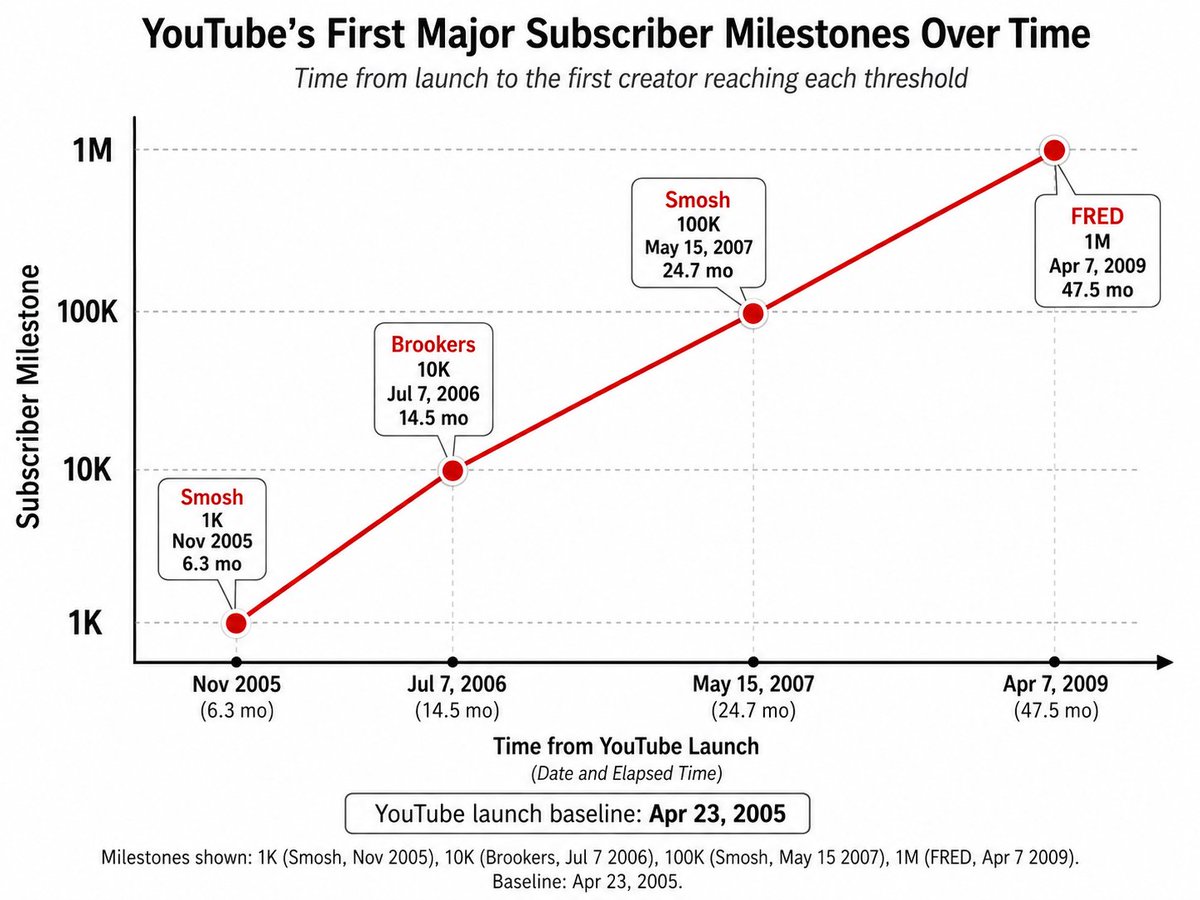
first video ever posted to youtube .. it took 4 years to get to a creator with 1M subscribers
today YT is a 550b business
claude code has been around for 15 months .. software is having its youtube moment and it will happen gradually then suddenly