The Tate group @MRC_LMB is happy to contribute to our collective understanding of arrestin-coupling to #GPCRs. We present a #cryoEM model of the β1AR-βarr1 complex bound to formoterol, an arrestin-biased agonist, in nanodisc. @JGarciaNafria@arshukla
https://t.co/2lxshg8jSM
Excited to share our AI+cryo-EM work! 🧬
🔬 Cryo-IEF: Foundation model trained on 65M particles
🤖 CryoWizard: automated structure pipeline
🎯 Making cryo-EM accessible to more labs
Preprint: https://t.co/MfssWP1zNS
Code: https://t.co/jXaU9KDTEp
#CryoEM#AI#StructuralBiology
@RolandDunbrack Concur! Had to resort to running in viewer mode (-A3) and enabling the internal prompt/overlay in lieu of the external GUI. Used to just be ugly; now ugly and annoying.
@cryomariena@SBGrid The LMB switched to Alma, which proved slightly more performant than SL7 in certain SPA workflows–but guake in EPEL8. 🥺 Current workplace switched to Rocky from CentOS. No complaints.
Delighted to get this out!we describe bitopic binding mode to the dopamine 3 receptor, including a reorganization of TM1 that generates a unique site that could be exploited to develop selective molecules. Tremendous effort from @sandrarrour@angela31398
https://t.co/3CsQKXSFpb
How to sense danger from afar?
Revised and refined, our paper on the insights into smell recognition by a mammalian trace-amine receptor from Cryo-EM, modelling and functional studies is finally out!
https://t.co/wJtnbHUwjT
#cryoEM with energy filter & electron counting significantly increased resolution even for a full size protein like proteinase K. Sub-atomic resolution #MicroED rivals best reported Xray of Proteinase K but by using crystals a billionth the size. A section of the map is shown
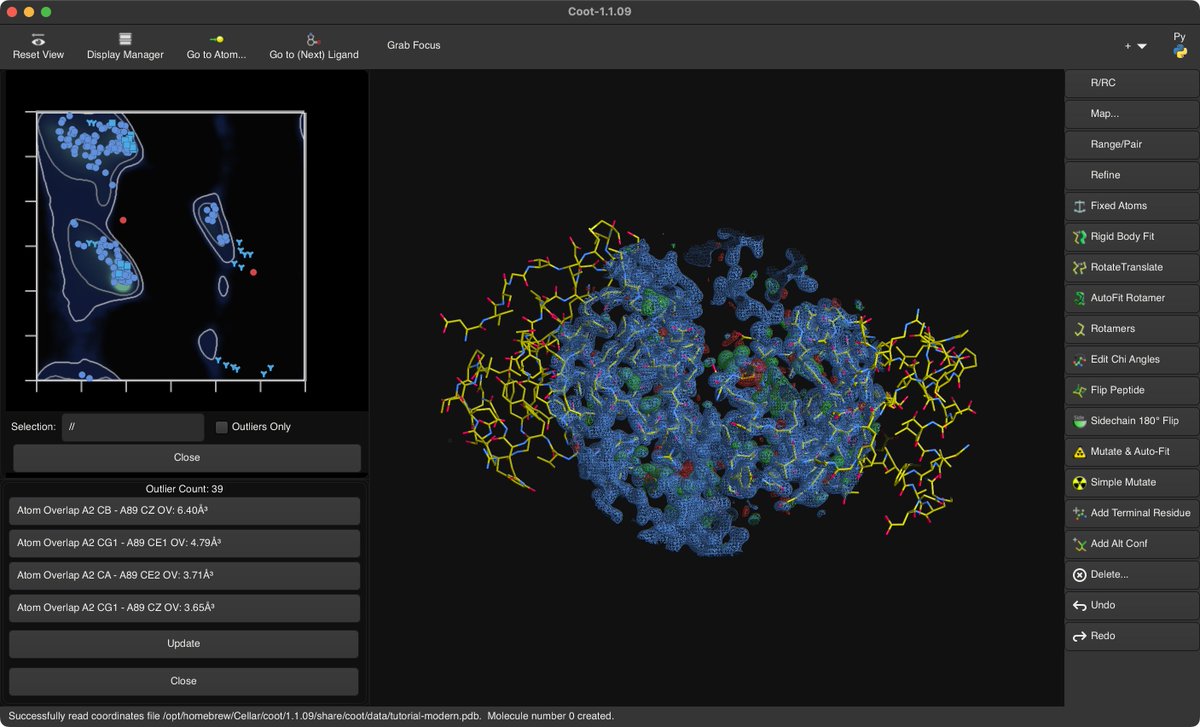
🎉 New formula Coot 1.1.09 in Brewsci/bio for Linux and macOS!
ℹ️ Crystallographic Object-Oriented Toolkit
🍺 brew install brewsci/bio/coot
#Bioinformatics
@biochem_fan Barring limited illustration use cases, I don’t see the point of composite maps. I’m confused why there isn’t more widespread revulsion to the practise in the field.
@biochem_fan @OliBClarke @BJ_Greber I think it may partly be due to the masking—dynamic and auto-tightening procedures can potentiate unexpected feedback loops. @OliBClarke’s advice of disabling dynamic masking leads to more sensible alignment outcomes in such cases.
Obviously Deep Mind/Isomorphic have commercial interests… but they need not seek the faux legitimacy of a Nature paper absent the transparency essential for vetting. And Nature wants to abandon their policies to game their impact factor and steal cheap attention with what will be a clear citation outlier.
While I would have made different choices on both sides, AF3 has a better chance than most things of reuse informing rigor/utility rather than the opinions of editors or reviewers upon first read.
We don’t need journals to tell us what to think, especially for things like this. Let’s stop giving them this power or trying to fix them to get to a slightly less [but still absurd] proxy for quality
Although it is a very exciting development, it is sad to see that no code will be released, which would not be allowed for academic institutions @nature. It was clear that weights will not be released (despite being trained purely on public data) but this I did not expect.
@zenbrainest@KYoojoong@rgumpper@RothLabUNC Great work, beautiful structures, and very nice findings, congrats!
I also invite everybody to check how this orthosteric invasion of a GPCR by cholesterol was already described some years ago, and suggested being feasible in other GPCRs 😉
https://t.co/xpid67D4Yj
@BJ_Greber Enjoyed the review! Thank you. Could you comment about the benefit of EF at 200kV? Wondering what filtering could potentially add in terms of R-H B-factors and resolution limit relative to magnification.