As AI assistants race to become more useful, they’re asking for access to more of your life. And they're not always asking permission. https://t.co/DjtnbYoXnQ via @MorningBrew
Reminder to go touch grass
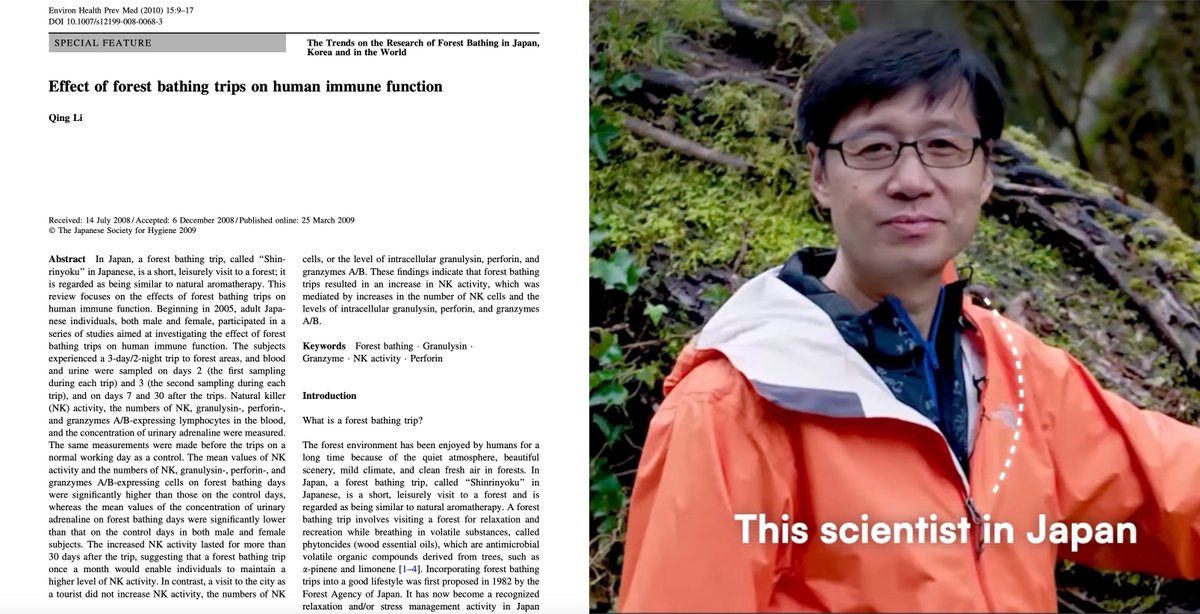
A scientist in Japan demonstrated that the air inside a forest strengthens your immune system for a full month
The study is incredibly fascinating:
Qing Li, an immunologist at Nippon Medical School in Tokyo, took 12 men on a 3-day forest trip. These were slow walks with no breathing exercises and no set route.
Then he tested their blood and found a surge in natural killer cells -- the immune cells your body uses to fight cancer and virus-infected cells.
Remarkably, the effect didn't fade when they went home, it was still measurable 30 days later.
A control group that walked the same distance through a city showed no change at all.
Pine, cedar, and cypress trees release compounds called phytoncides to defend themselves from insects and bacteria. You breathe them in, and Li believes they switch your immune cells into high gear.
He estimates one forest walk a month may be enough to keep those cells elevated all year.
The best medicine might not even need a prescription -- just a walk among the trees.
Ghost Pitùr is an anonymous artist in Brescia, Italy, who prowls the streets at night cleaning vandalized walls.
Armed with paint and brushes, he turns acts of vandalism into acts of restoration.
[📹 ghostpitur]
Scientists have created one of the most detailed 3D reconstructions of a human cell (eukaryotic cell) ever produced.
This groundbreaking model, often termed a "Cellular Landscape Cross-Section Through a Eukaryotic Cell," combines data from X-ray tomography, nuclear magnetic resonance (NMR), and cryo-electron microscopy to map molecular structures in extreme detail.
🇨🇳 In what might be the first such case in world history, a humanoid robot was arrested in China for harassing an old lady on the street.
What a time to be alive.
this is actually insane
> be tech guy in australia
> adopt cancer riddled rescue dog, months to live
> not_going_to_give_you_up.mp4
> pay $3,000 to sequence her tumor DNA
> feed it to ChatGPT and AlphaFold
> zero background in biology
> identify mutated proteins, match them to drug targets
> design a custom mRNA cancer vaccine from scratch
> genomics professor is “gobsmacked” that some puppy lover did this on his own
> need ethics approval to administer it
> red tape takes longer than designing the vaccine
> 3 months, finally approved
> drive 10 hours to get rosie her first injection
> tumor halves
> coat gets glossy again
> dog is alive and happy
> professor: “if we can do this for a dog, why aren’t we rolling this out to humans?”
one man with a chatbot, and $3,000 just outperformed the entire pharmaceutical discovery pipeline.
we are going to cure so many diseases.
I dont think people realize how good things are going to get
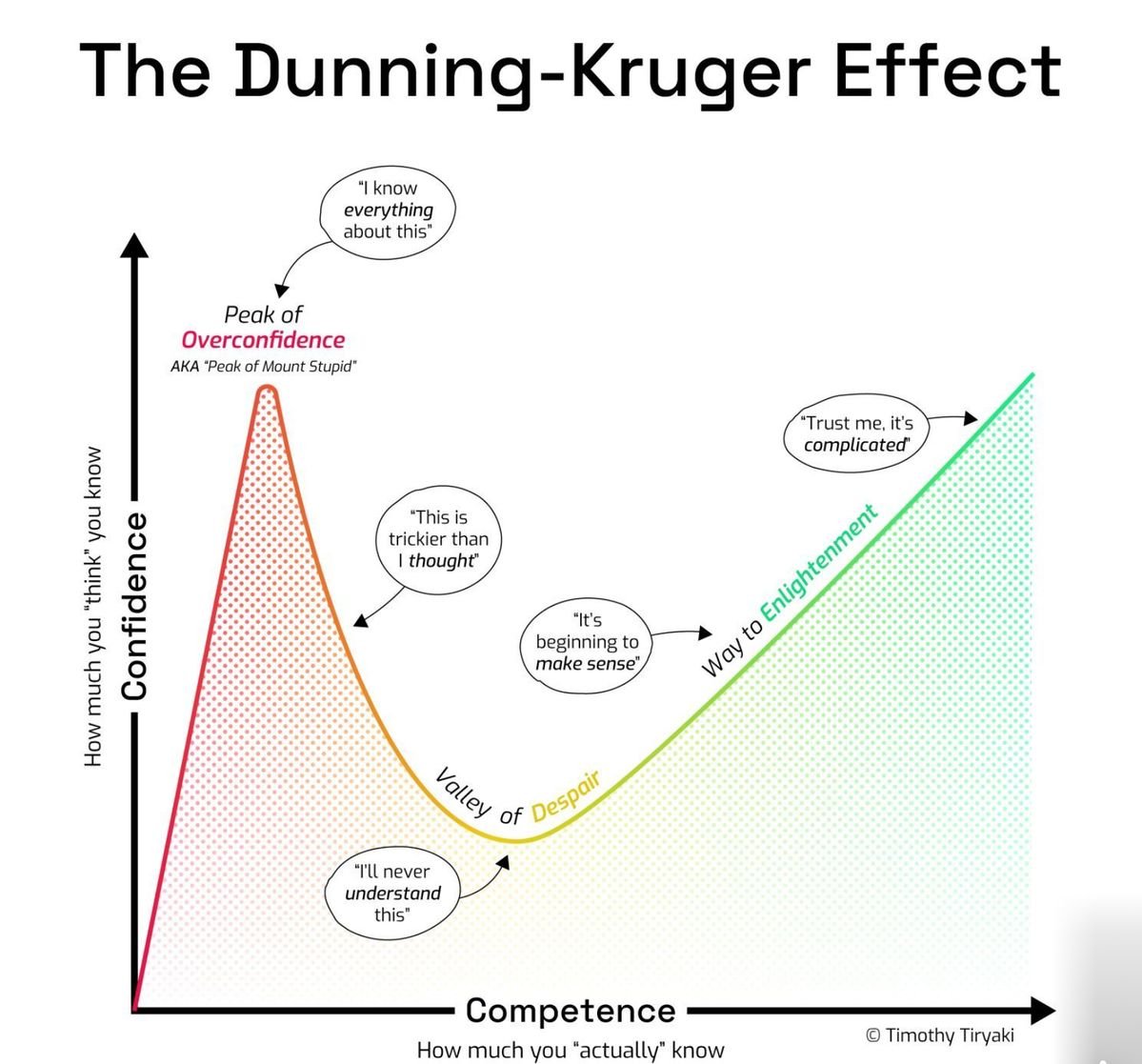
The Dunning-Kruger effect is a cognitive bias in which people with limited knowledge or competence in a specific area greatly overestimate their own abilities. Conversely, highly skilled individuals often underestimate their relative competence, assuming tasks that are easy for them are similarly easy for others.
A Chinese man invented an anti-mosquito device by attaching a net to a fan and placing a UV light behind it. The mosquitoes are drawn to the light and then get sucked into the net
@Rainmaker1973 The thing is you have to cook frozen berries for 2/3 minutes or you risk all sorts of bacteria. Isn’t it written on the package? In the EU it is.
@BowTiedMara OMG in live in Italy and never heard about such thing! There are maybe few crazy people doing weird stuff …. Among 750 million ppl,
but I am pretty sure this happens a lot in your country as well 😉
New research shows clutter dramatically spikes women’s cortisol—while men’s stress barely budges.
Household clutter extends far beyond mere aesthetics—it's deeply intertwined with stress physiology and cognitive burden, impacting women in particular.
Drawing from studies on dual-income married couples, therapist Elizabeth Earnshaw explains that women who view their homes as cluttered often see their cortisol levels rise throughout the day, unlike those who feel at ease, whose levels naturally decline. This heightened effect in women stems largely from bearing the disproportionate invisible mental load—the constant cycle of noticing, recalling, planning, and orchestrating household tasks.
Earnshaw suggests a realistic, three-part approach to reducing the stress–clutter spiral.
First, “shedding” involves intentionally minimizing possessions, including doing the emotional work required to let things go, in order to create more mental and physical space. Second, “preventing” focuses on systems: giving items clear “homes” so that decisions about where things go become automatic rather than mentally taxing. This may start with listing common types of clutter and designing dedicated spots for each (for example, a single, consistent place for receipts). Third, “adapting” asks families to accept that some clutter is inevitable in busy seasons of life and to concentrate on emotional regulation and co-regulation with partners, keeping stress and cortisol lower by adjusting expectations rather than striving for a perpetually picture-perfect home.
[Earnshaw, E., "Clutter, Cortisol, and Mental Load". Psychology Today, 2024]
[Saxbe, D. E., & Repetti, R. , "No place like home: Home tours correlate with daily patterns of mood and cortisol", Personality and Social Psychology Bulletin, 36(1), 71–81, 2010, DOI: 10.1177/0146167209352864]




![Rainmaker1973's tweet photo. New research shows clutter dramatically spikes women’s cortisol—while men’s stress barely budges.
Household clutter extends far beyond mere aesthetics—it's deeply intertwined with stress physiology and cognitive burden, impacting women in particular.
Drawing from studies on dual-income married couples, therapist Elizabeth Earnshaw explains that women who view their homes as cluttered often see their cortisol levels rise throughout the day, unlike those who feel at ease, whose levels naturally decline. This heightened effect in women stems largely from bearing the disproportionate invisible mental load—the constant cycle of noticing, recalling, planning, and orchestrating household tasks.
Earnshaw suggests a realistic, three-part approach to reducing the stress–clutter spiral.
First, “shedding” involves intentionally minimizing possessions, including doing the emotional work required to let things go, in order to create more mental and physical space. Second, “preventing” focuses on systems: giving items clear “homes” so that decisions about where things go become automatic rather than mentally taxing. This may start with listing common types of clutter and designing dedicated spots for each (for example, a single, consistent place for receipts). Third, “adapting” asks families to accept that some clutter is inevitable in busy seasons of life and to concentrate on emotional regulation and co-regulation with partners, keeping stress and cortisol lower by adjusting expectations rather than striving for a perpetually picture-perfect home.
[Earnshaw, E., "Clutter, Cortisol, and Mental Load". Psychology Today, 2024]
[Saxbe, D. E., & Repetti, R. , "No place like home: Home tours correlate with daily patterns of mood and cortisol", Personality and Social Psychology Bulletin, 36(1), 71–81, 2010, DOI: 10.1177/0146167209352864]](https://pbs.twimg.com/media/G8d5WHPWIAI7jKs.png)