SEGMENT, ALWAYS SEGMENT
Most confounding business problems have the same root cause: you haven't segmented your customers.
You look at the top-line number. It's flat, or weird, or inconsistent with what your gut tells you. You poke at it and you can't figure out why. The answer is almost always that you're staring at an average that's hiding two or three very different stories.
A few places this shows up:
1. When your high-level metrics look wonky or divergent, break them out by segment. A flat retention curve often hides one cohort churning out violently and another expanding aggressively. A "meh" NPS usually has one segment of fanatics and one segment of detractors cancelling each other out. The average is a lie. The segments are the truth.
2. When your product is trying to be everything to everyone, you need to tailor it per segment. If your roadmap has SMB founders, mid-market IT buyers, and Fortune 500 procurement all fighting for features in the same backlog, that's three products in a trench coat pretending to be one. Pick the segment you're actually building for, and ship accordingly.
3. When your pricing or positioning feels wrong no matter where you set it, it's because one SKU or pitch is spanning segments with wildly different needs or willingness to pay. Enterprise will pay 10x what a startup will for the exact same thing. A single price point either leaves money on the table at the top or closes the door at the bottom. Segment the packaging. Segment the price.
The pattern holds every time. Whenever a business problem is hard to reason about, break the population into segments and look again. Nine times out of ten, the fog lifts.
Importantly, you don't need to use standard gender or demographic segments. You can build your own! (And AI is a superpower here).
One of the best segmentations in real life was done by @davidweiden at TellMe Networks in the early 2000s. TellMe was selling phone automation software into financial services: a half-billion dollar market, and they had almost no traction. David built a custom segmentation framework called Rifle, which scored every prospect on five weighted criteria. Where the customer was in their buying cycle (engage before the RFP, not after). Whether their long-distance carrier was compatible with TellMe's deployment model. Three more criteria with explicit weightings, including negative scores that disqualified prospects outright. The whole company aligned on the scoring. Sales stopped chasing bad-fit accounts. Product stopped building features for customers who would never close. Marketing stopped spraying the market. Over two years, Rifle drove $20M in ARR inside the qualified segment and took TellMe from a loss to a profit. They literally would have failed without the segmentation. .
Founders: when a metric confuses you, when your product feels scattered, when your sales pitch or pricing won't land, segment. Segment, always segment.
Holy shit, this is some truly expert level analysis
Made me mega bullish on Brazil 🇧🇷
“Brazil is the only large democracy in the world that is simultaneously a food superpower, a water superpower, an energy superpower, a mineral superpower, and a carbon superpower, with export routes that do not depend on any contested strait or chokepoint”
If you're under 53 years old, you have never once been alive while a human was farther than 250 miles from Earth. Tonight, four astronauts are heading 252,000 miles out. That's a thousand times farther than any person has gone in your lifetime.
The 250-mile ceiling is where the International Space Station floats. Every astronaut since December 1972 has been stuck in that zone. Spacewalks, science experiments, cool photos from orbit, sure. But nobody left the neighborhood.
The last crew to go farther was Apollo 17. December 1972. Nixon was president. The internet didn't exist. Cell phones were 11 years away. The youngest member of that crew is now 90 years old.
The farthest any human has ever been from Earth is 248,655 miles. The Apollo 13 crew set that number in 1970, and they didn't mean to. Their oxygen tank blew up, and the emergency route home took them farther out than anyone before or since. Tonight's crew will break that record on purpose.
And the crew itself. Victor Glover becomes the first Black astronaut to leave Earth's neighborhood. Christina Koch becomes the first woman. Jeremy Hansen, a Canadian fighter pilot, becomes the first non-American to do so. When they come home, they'll slam into the atmosphere at 25,000 mph, faster than any human has ever traveled.
The Moon's south pole has ice. Water ice, sitting in craters so deep that sunlight hasn't hit them in billions of years. A 2024 NASA study found way more of it than anyone expected. You can split water into hydrogen and oxygen, which gives you rocket fuel, breathable air, and drinking water, all made on the Moon instead of hauled up from Earth. George Sowers at Colorado School of Mines calculated that Moon-made fuel could shave $12 billion off a single trip to Mars. The Moon is a gas station on the road to Mars.
NASA Administrator Jared Isaacman announced last week a $20 billion plan to build a permanent base at the South Pole over the next seven years, with landings every six months. China is developing its own lunar lander and spacesuit, aiming for a crewed landing by 2030. The Artemis program has burned through $93 billion so far, and the first actual surface landing is penciled in for 2028. There's a real question of who gets there first this time around.
Harrison Schmitt walked on the Moon in December 1972 as part of Apollo 17. He's 90. Asked about it this week, he sounded pretty relaxed. "Mars is attainable," he said. "We're humans. That's what we've always done."
O ouro levou mais de 3.000 anos para ir de ornamento cerimonial a moeda cunhada na Lídia.
O Bitcoin fez o mesmo caminho em 16 anos. De collectible cypherpunk a reserva estratégica dos EUA.
23 nações. 194 empresas públicas. 365 milhões de holders. Adoção corporativa 2.5x em 2025. Stock-to-flow já superior ao do ouro.
Publiquei a versão final do meu paper na SSRN.
🎯🎯“The people who invented refrigeration made some money, but most of the money was made by Coca-Cola, who used refrigeration to build an empire.
LLMs are like as refrigeration & the Coca-Cola has yet to be built”
~Chamath Palihapitiya (@chamath)
Distribution and the human attention premium
That marketing and distribution become the principal challenges of scaling content in an attention landscape awash in it seems like an obvious outcome as production costs collapse.
But it has not yet emerged as a coherent theme from the chaotic scrum of competing effects of AI on social media, technology more broadly, and even society as a whole.
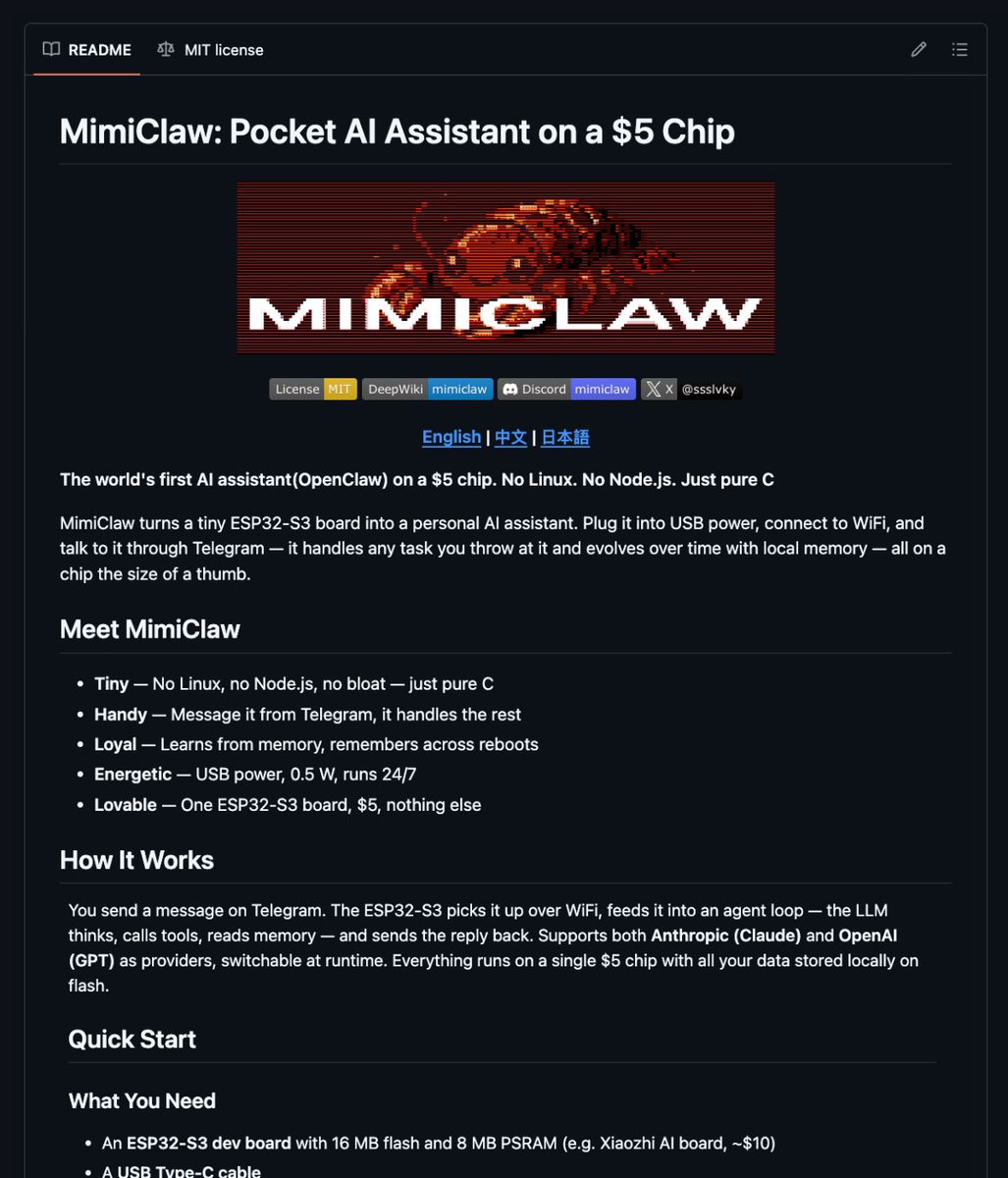
BREAKING: Someone quietly built the first AI assistant that runs on a $5 chip.
It’s called MimiClaw and it's a full @OpenClaw style agent running on an ESP32 microcontroller without @Linux
It’s built with local-first memory and privacy by default.
No Linux. No Mac mini. No Raspberry Pi. No VPS.
100% Opensource. MIT License.