@NPinkoski@Vermeullarmine The new right’s central flaw is that (not unlike like Franco’s coalition) it is united by a common enemy, not a common goal. Post-liberals who decided trans theory was a bridge too far have little in common with small c conservatives.
29 year old New Zealand Green MP Tamatha Paul declares English a “BASTARD LANGUAGE” and mocks conservatives who want to protect their heritage and culture
New Zealand is 5 years ahead of Australia in terms of wokeness, probably the worst for any English speaking country. The left really, really hate white people in New Zealand
This trend where every movie has to feature people of all races—even historical films set in places where only one race existed—is the stupidest thing I’ve ever seen in cinema.
Timon and Pumbaa are TLK's Rosencrantz and Guildenstern. Their function in the story is to turn Simba (Hamlet) into an effeminate wastrel and lead him into spiritual death (or in the case of the source material, physical death).
Simba doesn't self-actualize until he realizes that his purpose is to embody the Father/Warrior-King archetype, and he abandons the duo's philosophy of comfort and degeneration, embracing struggle and hardship for the sake of others.
"Hakuna Matata" isn't the key to happiness, but the chains by which Simba is enslaved to perpetual childhood. It's a blindfold that prevents Simba from confronting and processing the death of his father, which prevents him from ever becoming a ma-... lion.
Holding up Timon and Pumbaa as positive role-models is about the most egregious sin against media literacy you can commit.
The cliche says people get more conservative as they age. The cliche was true. The conditions that made it true are gone.
People used to drift toward inheritance-mode politics as they got older for a reason. They aged into specific material conditions that produced the drift: marriage and partnership, a home of their own, children to raise, a stable job, a community they belonged to. Each of these gave them a stake in continuity. The stake produced long-term thinking, and long-term thinking produced conservative politics. The conditions were at their strongest in the late 1960s and early 1970s. They have weakened since.
The thirty-year-old in 1985 had all five of these things, mostly.
The thirty-year-old in 2025 has thinned versions of all of them at once.
The drift mechanism worked because young adults aged into the same conditions their parents had. The conditions are not arriving on the same schedule. For many, they are not arriving at all.
Five dimensions, then and now.
1) Marriage rates fell sharply across the cohort. In 1985, around 64% of thirty-year-olds had married at least once. The cohort born in 1968 reached a historical peak: 83.7% of men were married by age 30. The cohort born in 1995, who turned 30 in 2025, are at 15%. The Marriage Foundation projects that 58% of women under 30 will ever marry in their lifetime, down from 88% for women now aged 60. Marriage was the threshold at which young adults committed to a household, a partner, and a future. Without the threshold being crossed, the conservatising effect of partnership does not happen on the same timeline.
2) Home ownership at thirty has roughly halved. In 1991, 67% of 25-34 year olds owned their home. By 2011-12, it had fallen to 43%. The cohort born in the late 1980s, who reached 27 in the mid-2010s, had a homeownership rate of 25%. The average first-time buyer in England is now 34 years old. A homeowner has a stake in property values, planning law, local taxation, and neighbourhood quality. A renter sees these as someone else's interests.
3) Parenthood at thirty has become a minority experience. In 1985, around 80% of thirty-year-old women had at least one child. Of women born in 1989, who turned 30 in 2019, 49% remained childless at 30. Of women born in 1990, over 50% were childless at 30. Children produce multi-decade time horizons. Schools matter. Crime matters. The future matters because it is where your children will live. Without children, the long-term stake is theoretical rather than personal.
4) Employment patterns have changed shape. The Standard Employment Relationship was the norm in 1985: a permanent contract, a single main employer, long tenure, a pension, sick pay, the realistic prospect of supporting a household on one income. By 2024, around 10% of the UK workforce was in precarious work, with median job tenure declining and the gig economy expanding. Most households now require two incomes to afford housing. The settled employee had a stake in economic stability and a clear path to acquiring property. The gig worker has a stake in survival.
5) Settled community follows the pattern, in three dimensions at once. Geographic stability has fallen: young university-educated workers move toward London and the major cities at the start of their careers, away from where they grew up. Demographic continuity has changed: in 1985, an estimated 95% of the population of England and Wales identified as White British; by the 2021 census it was 74%. Institutional binding has weakened: church attendance has fallen from 12% of the population in 1980 to around 5% today, with trade union membership, voluntary associations and working men's clubs declining alongside. Each of these produced shared accountability, shared institutions, shared expectations across the neighbourhood. The 1985 thirty-year-old lived inside settled community on all three counts. The 2025 thirty-year-old encounters thinned versions of all three at once.
The absent conditions actively reinforce the worldview the rising cohort already holds. A precarious worker needs collective safety nets, so universal entitlement makes sense to them. A renter pays for someone else's property, so codified renters' rights matter more than property rights. A person without children does not feel the multi-decade stake that family creates, so policy that extends current entitlement at the cost of future generations does not register as a problem. A geographically mobile worker needs portable rights rather than rooted institutions, so universal procedure beats inherited custom every time. A person whose neighbours, colleagues, and peers no longer share a background needs designed rules to mediate between strangers, so codification beats trust. The lived experience confirms the worldview daily.
The political offer presented to this cohort then completes the lock-in. The Greens, and to a large degree Labour and the Liberal Democrats, offer more of what the worldview already accepts: more universal entitlement, more codified rights, more state provision, more designed rules to address the precarity. The offer feels good immediately. It addresses the felt need directly. It also deepens the substrate exhaustion that produced the precarity in the first place, and worsens the trajectory the earlier posts in this series have set out. The framework's analytical position is that this path runs to eventual collapse.
Restore Britain offers the opposite: rebuild the substrate, roll back the constructivist machine, accept short-term cost in service of long-term recovery. The offer feels bad immediately. It asks the rising cohort to bear pain for a future they cannot yet see. The rising cohort is structurally biased toward the offer that feels good now and reinforces what they already think.
The cycle's natural correction mechanism is doubly disabled: the conditions for drift are not arriving, and the political choice presented to those who have not drifted is structured to keep them where they are.
The drift mechanism worked because young adults aged into these conditions on a predictable schedule. The conditions produced stakes. The stakes produced inheritance-mode politics. Each driver has weakened. Several have nearly disappeared.
Saying "they will grow out of it" assumes the next generation will meet the same threshold their parents did. The threshold has been moved. For many in the current cohort, it has been removed entirely.
If you are under thirty-five, look at the five dimensions in this post. Ask which of those conditions you have, and which the political offer you find most appealing would help you reach. The Green and Labour offer makes living without those conditions more bearable. It does not help you reach them. The Restore offer asks you to bear short-term cost for the conditions to become reachable again. Which path you find appealing is a sign of how locked-in the worldview is.
If you are a parent, look at your children's conditions at the age you were when you started settling down. If you are a grandparent, look at your grandchildren's. The drift to conservatism was produced by conditions that the current cohort is unlikely to encounter on the same timeline. That is the diagnostic signature of a mechanism that has broken.
@mactellomckeown Minimum wage growth outpaced normal wage growth. Care work now pays the same as a (much easier) job at Tesco. Public purse indirectly pays care wages therefore lack of interest in these roles is treated as a ‘labour shortage’ rather than a wage issue.
Pick any issue:
marginalised group -> issue is systemic, some aspect of normal life circa 1990 has to be ceded to address it.
Non marginalised group does bad -> issue is their own fault, underserving of pity because it happened in spite of the system.
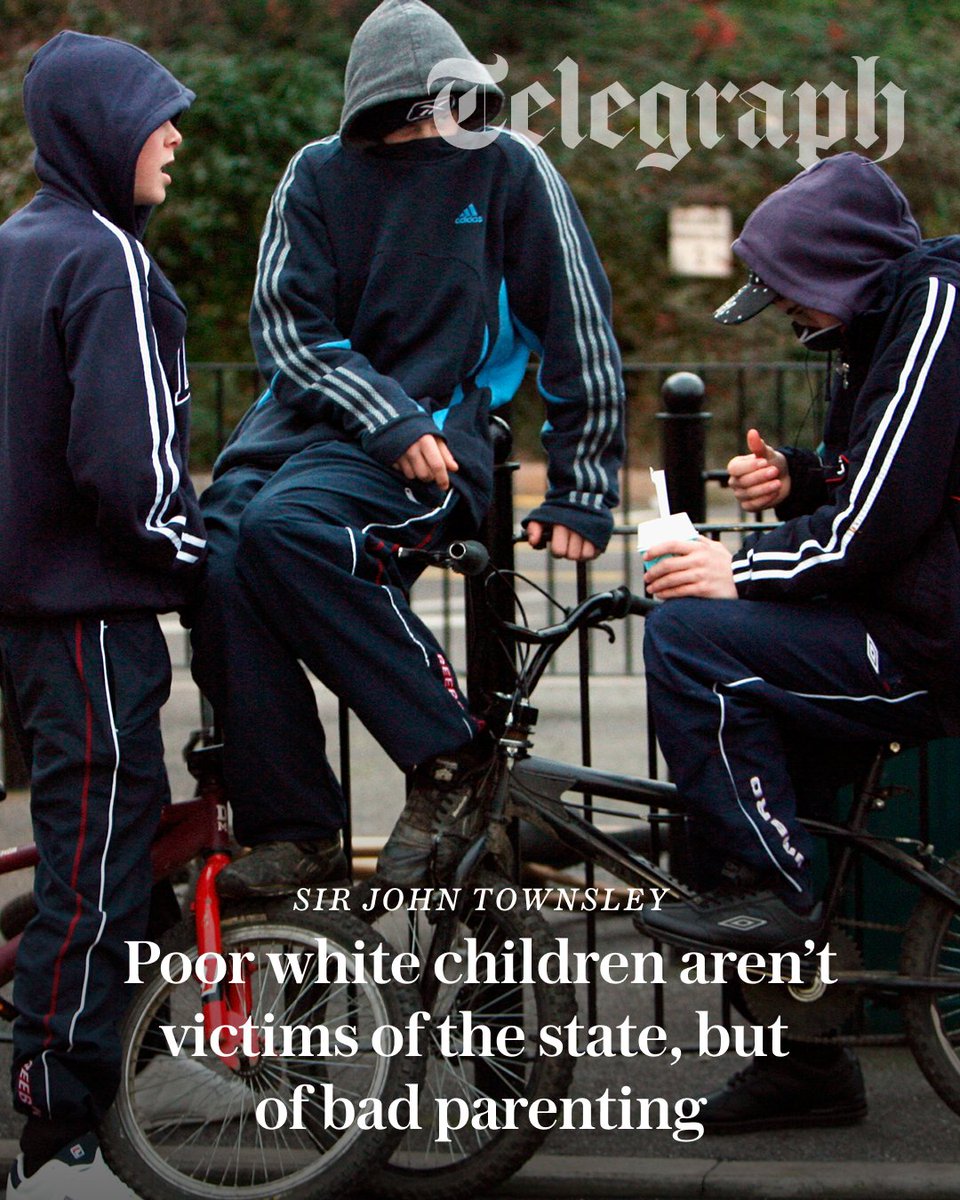
Why are poor white pupils falling so far behind at school?
Sir John Townsley argues the problem is not primarily the education system, but a culture of low expectations that begins at home 👇
https://t.co/JyVcMuVsol