The part worth sitting with: you can have a perfectly aligned agent and still lose this. Your act of verifying was producing the verification, as a byproduct. Outsource the act, lose the byproduct - even when your agent serves you flawlessly.
Y’day, I wanted to know what Dr. Seuss looked like. So, I Googled it. The images I was looking at seemed reasonable, so accepted the results.
When content is majorly created/consumed by agents, can we still trust crowd-verified data? Kicked off an interesting Claude convo
Most framings call this an alignment problem - is the AI doing what we want. But alignment is two-party: agent faithful to principal. What’s actually at risk is system-level: the correction layer that only existed because humans were doing the looking.
When agents both produce and consume content, that substrate thins. Stuff gets generated on-the-fly for me (no public artifact to object to). And the audience for published content shifts from humans to other agents - which quietly changes what gets written.
What’s actually verifying those images isn’t Google. It’s the assumption that if the top results were wrong, independent fans, Wiki editors, news sites, etc. would’ve objected by now. SEO is just the ranking layer - the “many eyes” substrate underneath is doing the work.
We are living through a moment where a group of people do not just disagree, they do not even acknowledge a shared fundamental reality.
There is no common frame of reference, no mutual set of facts from which discourse can even begin. They can watch the same video, from multiple angles, and walk away convinced they saw a completely different event.
They exist inside a narrative so deeply entrenched that to question it, to even acknowledge a contradiction, is to commit some sort of ideological treason.
This is a deliberate, conditioned immunity to contradiction. It is a cultivated resistance to evidence. They have developed a mind so thoroughly welded to its chosen reality that it will alter, discard, or fabricate whatever it must to maintain coherence.
They can be shown, in real time, the unraveling of their worldview, and they will patch over the holes with fantasy rather than face any doubt whatsoever.
Politics has turned knowledge itself into a partisan weapon. The expectation is no longer to seek truth, but to defend your team at all costs.
There is a lingering obligation to have an opinion on everything, to be informed at all times, to adopt the correct stance. And so, they improvise. They adopt prefabricated opinions handed down by their faction. They fill in the gaps with instinctive loyalty rather than demonstrating any semblance of independent thought.
The game is rigged, and they know it. Two parties, two choices, two sides that everyone is herded into, and neither is worth the loyalty demanded of them.
But to acknowledge this would be to admit powerlessness, to admit that they are trapped in an illusion of choice. So they cope. They retroactively justify their allegiance by turning their side into something righteous, infallible, and necessary. The alternative is too terrifying.
It is a coping mechanism turned mass psychosis. And it is escalating. When reality itself is dictated by allegiance, when loyalty outranks reason, when every fact must be bent into submission to fit the tribe’s chosen narrative, the outcome is inevitable: war.
When factions exist in separate realities, they cannot coexist. They cannot negotiate, they cannot reason, they cannot even comprehend the other side as anything but a threat.
This is irreconcilable. We cannot function like this. A society cannot sustain itself when its people are no longer individuals but ideological husks, possessed by abstractions, fighting battles for masters who do not even know their names.
You are not your faction. You are not your party. You are not an extension of a collective mind.
The moment you outsource your thinking, the moment you allow yourself to believe that your side must be right because the alternative is unbearable, you have ceased to be an individual. You have become another interchangeable pawn in a game that does not need you to think, only to obey.
Wake up. This war for reality is not one you want to be drafted into.
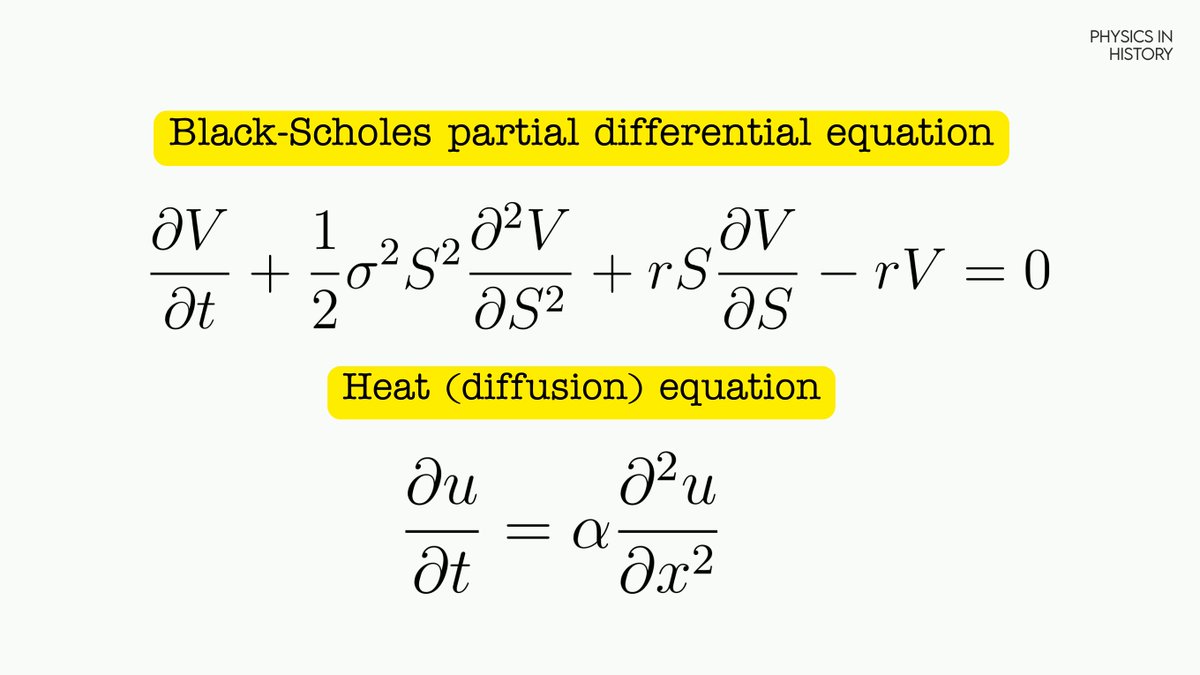
The Black-Scholes equation, used to price financial options since 1973, is secretly a sibling of the heat equation from physics. Economists Fischer Black and Myron Scholes borrowed the math of heat diffusion—how temperature spreads—to model stock price volatility. It’s a rare case where physics directly bankrolled Wall Street.
@quantian1 Buying accelerating top line is one thing, but buying accelerating un-billed backlog with a pretty clear need for additional debt/equity in the meantime seems like a different thing.
@alexsheppert@NTFabiano@darrencandow@grok any comment on what the broader body of research says about long-term effects of creatine at dosages mentioned in the OP research?
@InvestingVisual These are two companies with completely different business models and value propositions. Data is at the core of many different businesses. What else makes a head to head comparison appropriate?
@dieworkwear The lines on the suit to the right also do not appear to run true. Is this a result of poor tailoring or would both this and the earlier suit run more true if the top button was buttoned?
@DaveShapi After trying it, it would be really neat for there to be a backfill option available where the main topic could be put into a group of contextual nodes
Are tech newsletters, blogs, and unbiased news in jeopardy, @benthompson? Or is this just an opportunity for some companies to build a method for content monetization when used by AI models/agents?