Everyone thinks AI coding tools set founders free.
Watch what people actually build with them: rules, approvals, process, layers. The same cage, assembled faster.
The tool that can scaffold anything in an afternoon will scaffold your bureaucracy in an afternoon too.
Speed of construction is speed of calcification. Build the thing that lets you create new things: experiences that didn’t happen before.
Well said. This has been the case for many years, but the speed at which we’re able to deliver now is making it impossible to ignore. (Boy are we still trying though!)
I’ve rarely seen code throughput or work throughput overall be the “limiting reagent” on software projects, despite many arguments to the contrary.
Bob McGrew has a framework I keep thinking about: in the AI future there are only two jobs. The Lone Genius and the Manager.
That's it. Everything else gets absorbed.
The Lone Genius is the person sitting alone at a computer, amplified 1000x by AI. One person with taste, vision, and relentless focus who can now do what used to take a team of 50.
The Manager is the person who becomes CEO of their own "firm" where most of the employees are AI agents. They define the goals. They decide what matters. They coordinate. The AI does the execution.
The Marxists will hear "two jobs" and panic. "What about everyone else?!" But here's what they're missing: AI doesn't shrink these two categories. It explodes them open. More people get to be geniuses. More people get to be managers. The barrier to entry for both just collapsed.
What actually gets eliminated? David Graeber called them "bullshit jobs." Graeber was no libertarian! He inspired Occupy Wall Street.
His words: "Huge swaths of people spend their entire working lives performing tasks they secretly believe don't really need to be performed. The moral and spiritual damage that comes from this situation is profound. It is a scar across our collective soul."
Graeber said bullshit jobs are "a form of spiritual violence directed at the essence of what it means to be a human being." They induce "hopelessness, depression, and self-loathing."
This is who the left should be fighting for. Not to preserve those jobs. To liberate people from them and give them better ones.
The dirty secret of the modern economy: millions of people sit in roles so pointless that even they can't justify their existence. Compliance layers. Reporting layers. Coordination layers. Meeting-about-the-meeting layers. They know it's meaningless. It eats them alive.
AI eats those layers. Good. That's a jailbreak.
What I love about Bob's framework is where it points. The Lone Genius used to require a PhD, a lab, institutional backing. Now a 19-year-old with taste and Codex can ship what took a research team a year. The genius bottleneck was never talent. It was access.
The Manager used to mean you needed to hire 50 people, raise money, build an org chart. Now you can orchestrate a fleet of AI agents from your laptop. The management bottleneck was never skill. It was capital.
AI doesn't concentrate genius and management into fewer hands. It distributes them into more hands. The working class kid in West Virginia. The single mom in Ohio. The 55-year-old who got laid off and now builds software for the first time. Those are some of Bob's future geniuses and managers.
The best founders I see at YC are already living this. They toggle between both modes in the same day. Morning: lone genius, creative insight, the thing nobody else sees. Afternoon: manager, spinning up agents, steering, shipping.
The cycle time between genius and manager IS the new productivity metric.
So when someone tells you AI means "only two jobs and everyone else starves," quote Graeber to them, they’ll get it.
Graeber knew the real violence was making people do meaningless work and pretending it was dignity. AI ends that. More genius. More agency. Fewer spiritual prisons.
@ashwingop This is really great stuff man. It’s dense but it does such. Great job of focusing the conversation on the practical limitations and goals of context engineering. Super exciting and thanks for sharing.
> be Riot
> 2014 anti-cheat team is 3 guys
> legacy system Packman barely works
> 2020 ship Vanguard, kernel-level, on boot
> internet calls it a Chinese rootkit
> ship it anyway
> ban 3.6M Valorant cheaters in 4 years
> one ban every 37 seconds
> 2024 force it onto League, 175K bans in months
> scripting drops below 1% for the first time in 4 years
> Elysium, Oasys, Zeitgeist all shut down
> May 22 2026 flip IOMMU on DMA rigs, they blue-screen mid-match
> tweet "congrats on your $6k paperweight"
a Tencent rootkit just bricked a $6,000 wallhack rig and the only people mad are the guys who bought one
Every generation thinks the next machine will replace humanity.
The tractor.
Electricity.
The computer.
The internet.
Now AI.
But history says something different.
When the cost of intelligence drops, human ambition expands.
That’s the part most people miss.
The recent a16z article on the “AI Job Apocalypse” made one thing very clear:
AI is not deleting work.
It’s reallocating work. (https://t.co/1LseIZltyh)
Routine tasks shrink.
Higher leverage work grows.
The spreadsheet didn’t eliminate finance.
The internet didn’t eliminate business.
The smartphone didn’t eliminate communication.
They created entirely new industries.
AI will do the same.
The winners in this era will not be the people fighting AI.
It will be the people using AI to amplify judgment, creativity, speed, and execution.
One person with AI can now:
- build a company faster
- launch products faster
- learn faster
- create content faster
- solve problems faster
We are entering an age where intelligence becomes abundant.
And when intelligence becomes abundant, execution becomes the new scarcity.
That changes everything.
The most optimistic part?
A teenager with a laptop now has capabilities that once required entire corporations.
That is not dystopian.
That is empowering.
Yes, some jobs will disappear.
Every technological revolution reshapes labor.
But new industries are already emerging:
AI operators.
AI strategists.
AI workflow architects.
Human-AI collaboration designers.
Autonomous business builders.
The future belongs to people who adapt early.
Not people who panic early.
AI is not the end of human value.
It’s the beginning of a new operating system for civilization.
And the people who learn to work with intelligence instead of competing against it will build the next generation of companies, wealth, and breakthroughs.
The industrial revolution multiplied physical power.
AI multiplies cognitive power.
That’s a far bigger shift.
Source : @a16z https://t.co/wLYnXTrx7L
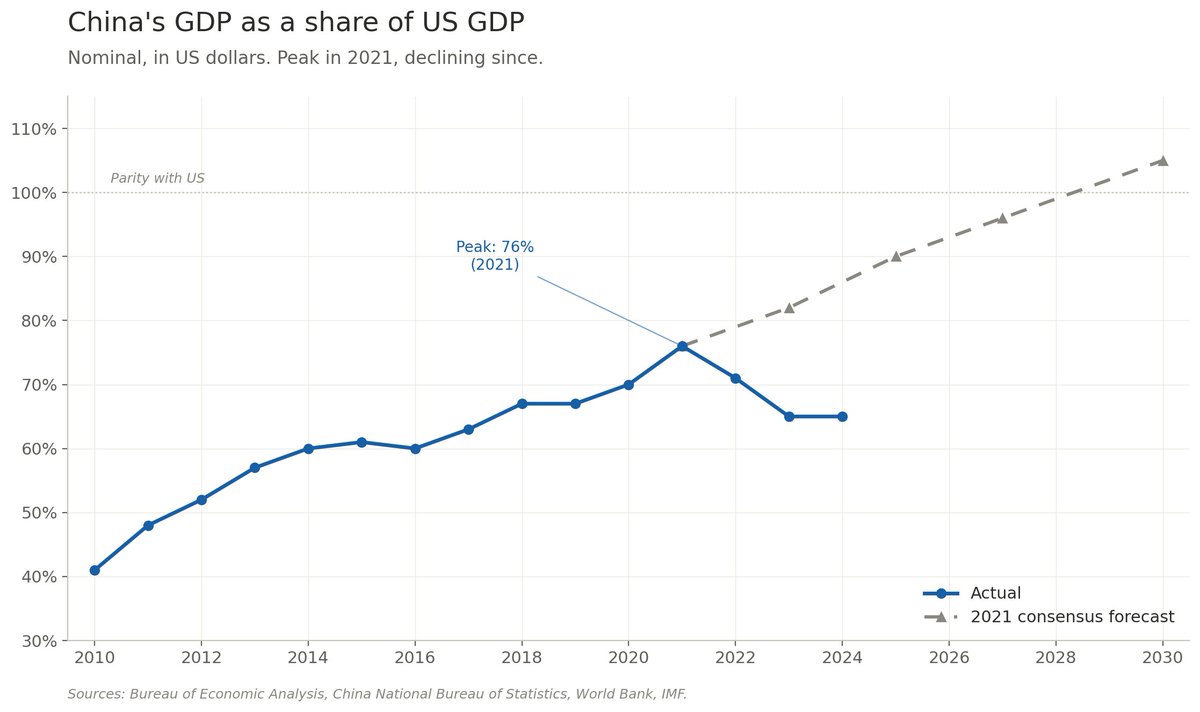
The United States has a habit of watching its rivals shrink. The Soviet Union collapsed. Japan, which was supposed to own America in the 1980s, is now a far smaller economy. China looks set to follow.
In 2021 China's GDP reached 76 percent of American GDP, and the consensus was that it would pass the US before 2030. That consensus has collapsed. By 2024 the US economy was 29.2 trillion dollars against China's 18.9 trillion, a gap that has widened for three straight years. China's working-age population is shrinking. Its fertility rate has fallen to roughly 1.0, half of replacement. There is no immigration to compensate.
Yet America benefits from believing it faces a formidable rival. The belief is what keeps it competing.
We dramatically underestimate how much change management it is going to take to automate most knowledge worker tasks.
Between data being in legacy environments or systems or without good APIs, context missing for doing the task, teams that are less technical, and other factors, there’s still a lot of work to drive real AI transformation in an enterprise.
This is actually great news if you’re building right now because the opportunity is to build the software bridges to make this easier, or to build new services firms to help with this change management. Opportunity is all around for those looking.
@jnnfir So cool to see what a lot of the parents at home are doing with agents+ 3D printers, etc. I’m jealous I think school is about to get a hell of a lot more fun.
The best thing you can do in today's world is practice thinking. Very few people, especially smart people, do this. Snap yourself out of your automatic patterns and stretch your mind for once. This will only become more important as AI and social media distort reality.