What design pattern would you use here?
User user = new User(
"Sumit",
"[email protected]",
null,
null,
true,
false,
"Bangalore",
null
);
The object has 15+ optional parameters.
How would you redesign this?
Alright, this is going to be a bit of a long one, but at its very core, Control Systems and Artificial Intelligence are 2 routes for achieving the same thing: reducing the gap between what is and what should be.
A thermostat wants the room to be 22°C. A cruise controller wants the car to be at 80 km/h. A robot arm wants its end effector to be at a specific coordinate. A large language model wants its generated output to match the statistical patterns of human language. In every case, there is some notion of a desired state, a current state, an error between the two, and a mechanism for reducing that error.
This is why the philosophical foundations of both fields are staggeringly similar. They are fundamentally about decision-making under uncertainty. The system studies the input, observes the environment, processes information, takes a controlling action, observes the consequences of that action, and then adjusts its future behavior accordingly, while remembering the behavior of it's past actions. Whether the adjustment happens through PID gains, adaptive control laws, gradient descent, or reinforcement learning is merely an implementation detail.
In fact, if you strip away the terminology, many AI concepts sound suspiciously familiar to anyone with a controls background. A loss function is just a generalized error signal. Gradient descent is a tuning mechanism. Training is a tuning and optimization process. Reinforcement learning agents continuously interact with a plant-the environment-and attempt to maximize a reward signal that is effectively another form of performance metric. The language changes, but the underlying feedback loop remains.
What's interesting is that the two disciplines diverged historically because they evolved to solve different classes of problems.
Control theory grew up around physical systems. Engineers already knew a lot about the systems they were controlling. They could derive equations for motors, aircraft, power converters, and industrial processes. The challenge was designing a controller that could guarantee stability, robustness, and performance.
AI emerged from a different problem space. Here, the system itself was often unknown or too complex to model explicitly. Nobody can write down differential equations describing every nuance of human language, image recognition, or strategic reasoning. Instead of deriving a model, AI attempts to learn one from data.
You could almost describe the distinction as:
> Control Theory assumes knowledge and optimizes behavior.
> AI assumes data and learns knowledge.
Yet even that boundary is becoming blurry.
Modern robotics routinely combines both. A drone might use classical PID loops running at kilohertz frequencies to stabilize its attitude, while a neural network performs object detection, path planning, or adaptive navigation.
Autonomous vehicles fuse model-based control, optimization, estimation theory, machine learning, and sensor fusion into a single system. The wall between "AI" and "Control Systems" becomes harder to see the deeper you go.
Some researchers even argue that intelligence itself is simply an extraordinarily sophisticated control problem. Biological organisms continuously sense their environment, predict future states, take actions to achieve goals, and update internal models based on feedback. From that perspective, the human brain can be viewed as perhaps the most advanced adaptive control system ever observed.
The irony is that many newcomers see AI as the futuristic field and control systems as the old-fashioned one. But beneath the surface, much of modern AI stands on foundations built by decades of work in control theory, optimization, estimation, information theory, and signal processing. The mathematical DNA is shared, and the electronics nerds (I try to be one) who happen to be in the know simply stand steadfast, smiling, albeit menacingly.
So while it isn't technically correct to say that a PID controller and a neural network are the same thing, it is fair to say that they are descendants of the same idea:
-> Observe reality. Compare it to a goal. Measure the error. Adapt. Repeat.
Everything else is just a matter of how sophisticated the adaptation mechanism becomes.
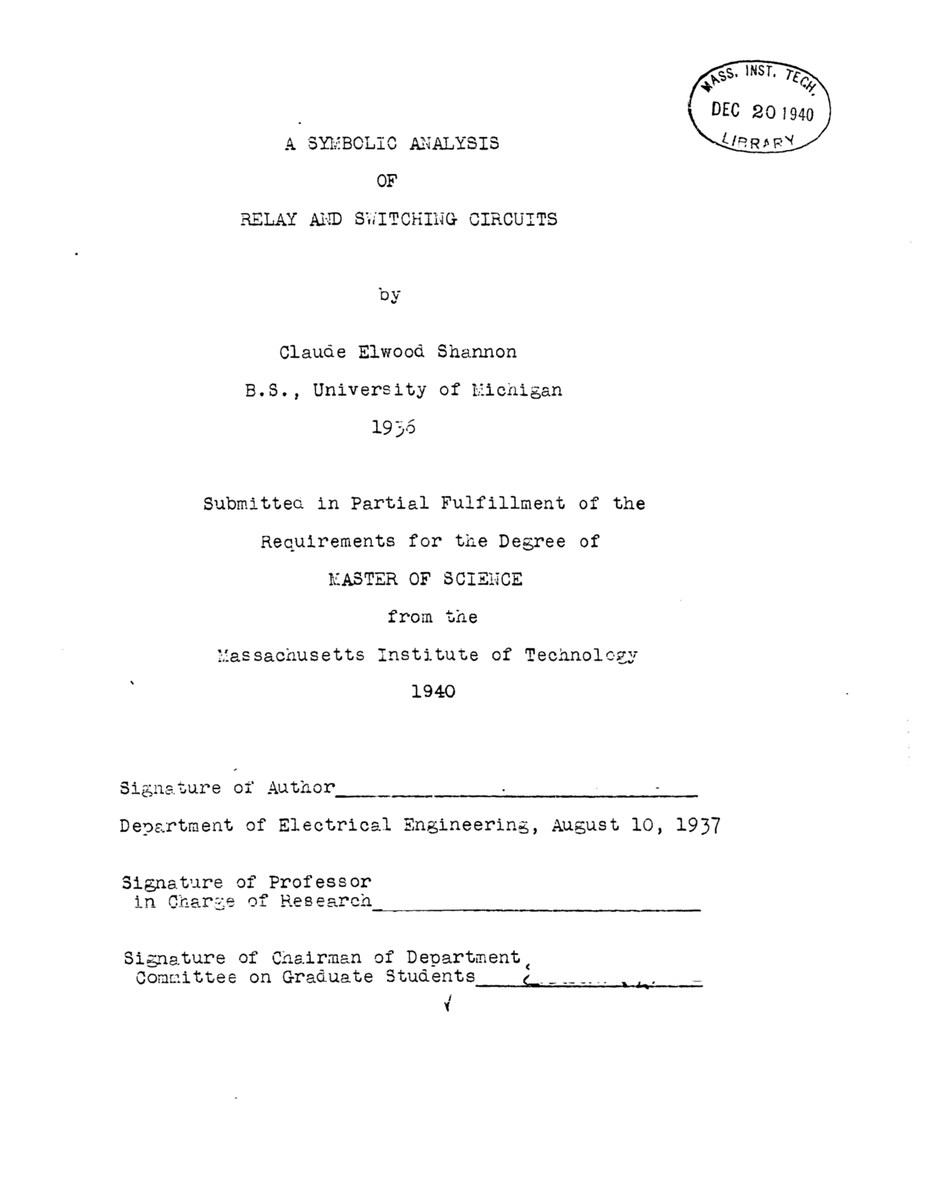
There are a few well known PhD theses, but these are the two most impactful Master's Theses in the history of humankind:
1. Claude Shannon - "A Symbolic Analysis of Relay and Switching Circuits" (1937): Demonstrated that electrical switches could perform logical operations, laying the theoretical foundation for digital circuit design and modern computing.
2. Seppo Linnainmaa - "Algoritmin kumulatiivinen pyöristysvirhe yksittäisten pyöristysvirheiden Taylor-kehitelmänä" (1970, in Finnish): Introduced the modern backpropagation algorithm, now enabling the current AI revolution.
Google's "Attention is All You Need" paper came from trying to get a 3% gain in Google Translate.
Innovation is a consequence of production. "If you don't make the thing, you cede your opportunity to innovate on the thing."
~ Palantir's CTO @ssankar
pro tip: get good at sounding confident even when you know nothing. ask questions when essential, and trust yourself to figure the rest out.
because everything is figureoutable.
Jane Street AI Engineer revealed how they trained their own LLM for trading to make $22.5B/year
16 minutes. free. straight from tier-1 quants.
bookmark & watch - this is the most honest "AI inside a hedge fund" talk ever published.
forget the "AI trading bot" YouTube grifters. This is the real inside view: data, training, evals, integration.
then start building your own bot using post below.
@CaptainInsightX one of my favorite Chris quotes is something along the lines of:
<< the beauty of software is that 10 people can create abstractions which 100 people can use to create abstractions for 1000 people, which can create abstractions for 100,000 people, etc>>
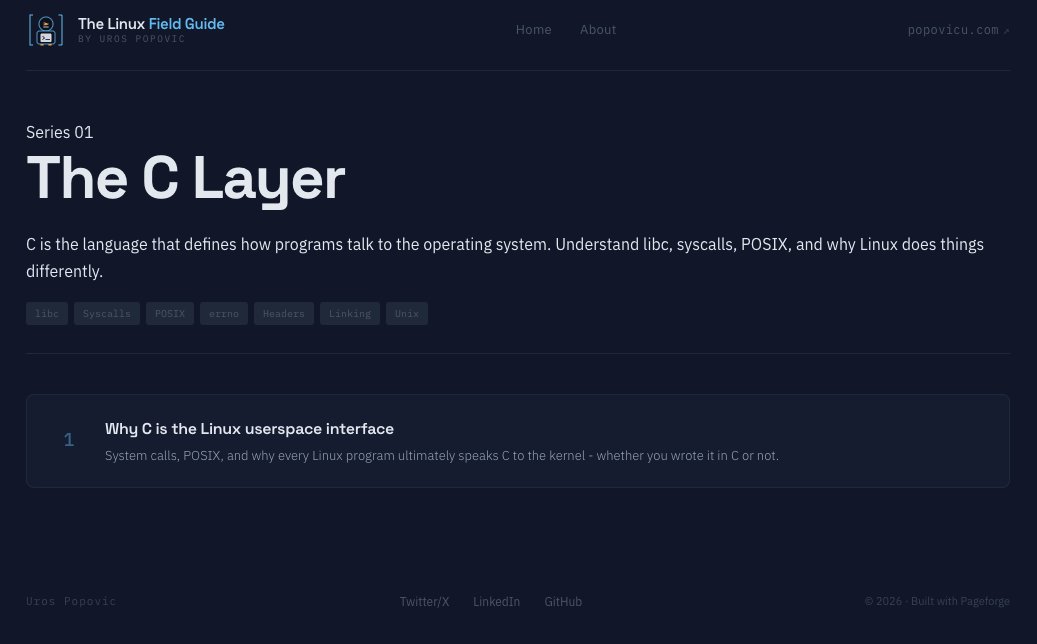
The C Layer, Series 01 of The Linux Field Guide.
First article ships this week.
Most writing about C defends it the same way. "It's fast." "It's close to the metal." "There's too much legacy code to replace it." These arguments treat C as a tool you happen to be stuck with.
I wanted to write the article I wish I'd had years ago - one that makes a different argument.
C isn't just a language on Linux. It is literally the operating system interface, as POSIX defines it. Read the spec yourself: POSIX doesn't describe syscall numbers or register conventions. It describes C function signatures and C header files. To be a "POSIX-compliant" OS means, fundamentally, to host a C library. The interface is written in C because C is the interface.
This is why other languages - Python, Java, etc. - eventually route through C to talk to the system. It's why Linux and macOS quietly disagree about where the real kernel boundary even lives. It's why "just replace C" isn't a language choice, it's a proposal to redefine what an OS interface looks like.
Once you see this, a lot of decisions in the Linux ecosystem stop looking arbitrary: why glibc matters, why statically linked Go binaries work on Linux but not macOS, why Apple and Huawei bother certifying their systems as Unix.
C isn't sticking around because it's fast. It's sticking around because it's the Latin of computing, and the whole ecosystem is written in that Latin.
More entries will be in the series. The first one sets up the frame. Dropping this week.
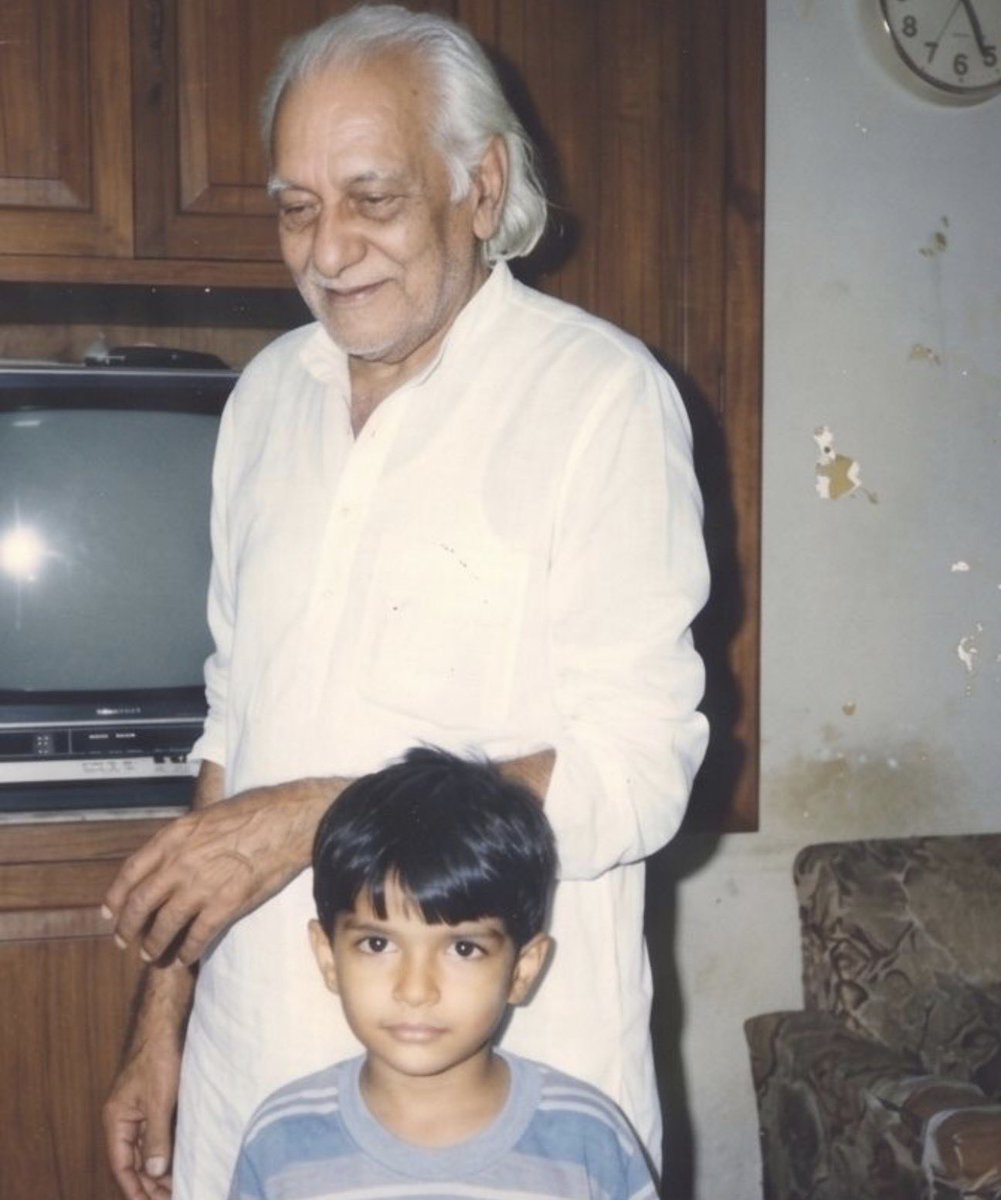
My grandfather lost everything in a bad business cycle.
His advice to me: "Never bet on hype. Bet on fundamentals."
I didn't fully understand what he meant until I started studying the history of AI.
We've been here before. Twice.
At the peak of an AI hype cycle - where the belief outruns the capability, and the entire field becomes fragile to any honest correction.
The first time was the 1970s. Governments funded AI expecting machine translation and reasoning within years. When it didn't arrive, they didn't just cut funding for bad projects. They cut funding for everything, including neural networks that actually had promise.
One book (Perceptrons by Minsky and Papert) showed real limits of single-layer networks. Fair critique. But the takeaway that spread wasn't "this version has limits." It became "this entire approach is a dead end."
That distinction set the field back by a generation.
The second time was the late 1980s. Expert systems were supposed to replace human judgment. They couldn't handle the real world. The boom collapsed.
Neither winter killed the underlying technology. But both starved promising research and concentrated what survived in fewer hands.
Now look at the current cycle.
A new model drops every few months. Benchmarks improve. Claims get bolder. Then the limitations surface, use cases narrow, and the conversation quietly resets - until the next drop.
Harvard researchers noted recently that generative AI has been positioned as "unstoppable" not as a factual assessment, but as a rhetorical strategy to create market inevitability.
The deeper structural risk, per Allianz Trade's 2026 analysis, isn't even reputational. It's financial: companies borrowing against future demand that hasn't materialized. Smaller researchers getting defunded. Power concentrating among the giants who survive.
This is the pattern my grandfather would have recognized immediately.
The enterprises building durable AI right now aren't the loudest ones. They're the ones asking harder questions before they deploy.
At Fast Code AI (@FastCodeAI), that's the only kind of work we take on.
One question for you: do you think we're heading into a correction, or has something structurally changed this time.