Warren Buffett: “Interest rates are to asset prices what gravity is to the apple. When there are low interest rates, there is a very low gravitational pull on asset prices.”
For higher rates, the opposite is true. Buffett’s primer on their relationship to investments & “The Yardstick Effect”:
Peter Lynch on one of the most dangerous thoughts in investing: "It's $3 [per share]. How much can I lose?"
"If you put a billion in at $3, you can lose a billion."
"They blow taps on lots of companies every year. They can go to zero."
Warren Buffett was just asked if stocks look cheaper after the worst quarterly performance in 4 years.
His answer: "No."
"3 times since I've taken over Berkshire, it's gone down more than 50%. This is nothing."
"This is nothing to make you get excited and think there's huge value if they're 5 or 6% cheaper. We aren't in it to make 5 or 6%."
Thank you to @github for having my back. GitHub Copilot Pro+ is THE best value on the market. https://t.co/am55JSiA7w
I have been able to review, test and comment on eight (and counting) Microsoft related PRs for OpenClaw tonight thanks to @ashleywolf!
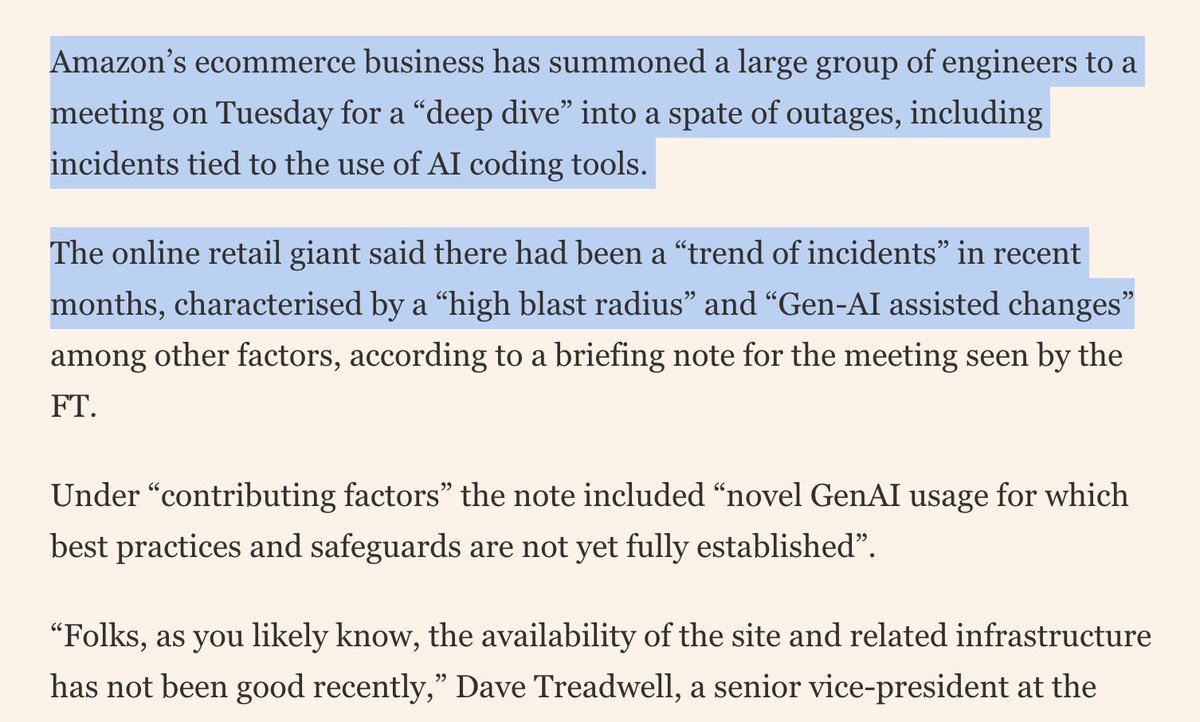
Amazon is holding a mandatory meeting about AI breaking its systems. The official framing is "part of normal business." The briefing note describes a trend of incidents with "high blast radius" caused by "Gen-AI assisted changes" for which "best practices and safeguards are not yet fully established." Translation to human language: we gave AI to engineers and things keep breaking?
The response for now? Junior and mid-level engineers can no longer push AI-assisted code without a senior signing off. AWS spent 13 hours recovering after its own AI coding tool, asked to make some changes, decided instead to delete and recreate the environment (the software equivalent of fixing a leaky tap by knocking down the wall). Amazon called that an "extremely limited event" (the affected tool served customers in mainland China).
"In the stock market, you have the luxury of being able to stay on the sidelines, free of charge, observing and waiting for the most opportune moment to wager. You get to see the market's 'cards' before you bet, free of charge."
Charlie Munger’s simple formula for success:
-Spend less than you earn
-Invest shrewdly
-Avoid toxic people and toxic activities
-Defer gratification
-Try to keep learning all your life
Asked Jeff Van Gundy what it's like to be a "defensive coordinator" in basketball, when in reality JVG contributes more than that
Some gems in there, like his perspective on how 38% 3-point shooters miss 62 out of 100 3s.
And an easter egg at the end of the clip on tanking lol
@finn_dan blocked your replies? Why do I see this? I almost ALWAYS mention a stop. I expect to be wrong quite often and the market does not deny me that. But I hold my winners longer.
This is my last conversation with you as you are NOW blocked
People should not be judging AI-augmented coding by “1 shots.”
If someone told you that their model did a “one shot of Minecraft” and they’re impressed by that, you need to consider how much semantic heavy lifting the word “Minecraft” is doing in that prompt.
Ask them to one shot Minecraft without using the word Minecraft.
It’s not trivial to one shot something unique, because programming is the art of making the ambiguous incredibly specific through sculpting. AI sculpting is less about vibes and more about finding the specificity you want and keeping the system stable through changes. Good SDLC practices still matter, historical context still matters, and knowing how things work matters, shout out to @Grady_Booch.
It’s a cool party trick to one shot Mario Brothers or space invaders, but then you’ll end up with the most mid version of both. Literally mid. You’ll get the statistical fat part of the Bell curve version of these mythical games. You’re telling the model to close its eyes and draw the face of these games from memory.
As high-level programming cedes way to the prose compiler, making your goals and specs well understood to the ambiguity loop and showing good judgment is going to matter more than ever. Consider all of your words and make sure that certain words aren’t carrying all the semantic load, hidden or otherwise.
Jensen Huang: "People with really high expectations have very low resilience."
"I think one of my great advantages is that I have very low expectations. And I mean that.
Most of the Stanford graduates have very high expectations. And you deserve to have high expectations because you came from a great school.
You were very successful. You're top of your class.
Obviously, you were able to pay for tuition. And then you're graduating from one of the finest institutions on the planet.
You're surrounded by other kids that are just incredible. You naturally have very high expectations.
People with very high expectations have very low resilience. And unfortunately, resilience matters in success.
I don't know how to teach it to you except for I hope suffering happens to you. And I was fortunate that I grew up with my parents providing a condition for us to be successful on the one hand, but there were plenty of opportunities for setbacks and suffering.
And to this day, I use the phrase pain and suffering inside our company with great glee. And I mean that. Boy, this is going to cause a lot of pain and suffering.
And I mean that in a happy way, because you want to train, you want to refine the character of your company.
You want greatness out of them. And greatness is not intelligence.
Greatness comes from character, and character isn't formed out of smart people.
It's formed out of people who suffered.
And so if I could wish upon you, I don't know how to do it. For all of you Stanford students, I wish upon you ample doses of pain and suffering."