SpaceX is actively hiring world-class engineers/physicists for SpaceXAI, even if you have zero prior experience in AI. Smart humans figure it out fast.
Please send an email with ~3 bullet points demonstrating evidence of exceptional ability to [email protected].
40% of the code Claude writes for you is wasted. you're paying for the rewrite.
a 65-line markdown file fixes it. 120,000 developers have starred it.
the author tested it on "30 codebases over 6 weeks" and reported a mistake rate drop from 41% to either 11% or 3%
depending on whether you read the headline or the body.
the irony is that the article is right.
CLAUDE.md is the most under-leveraged file in your stack.
65 lines of behavioral rules outperform a 4,000-token preferences dump.
"be careful" is useless. testable imperatives are gold.
"be senior" doesn't work Claude already thinks it is.
the 4 rules that ship the most leverage:
/ state assumptions, never guess silently
/ minimum code, nothing speculative
/ surgical changes, don't refactor adjacent code
/ define success, loop until verified
compliance: ~80%. mistake rate: from ~40% to single digits.
no human caught the contradicting numbers in the title.
nobody had to.
Thank this man for digital communication, data compression (ZIP, MP3), coding theory, and cryptography.
Claude Shannon’s biggest scientific contribution was the creation of information theory in his 1948 paper “A Mathematical Theory of Communication.”
He defined “information” mathematically, introducing the concept of bits (binary digits) as the fundamental unit. He borrowed the term from thermodynamics to describe the uncertainty or information content in a message. Shannon entropy became the foundation of data compression and coding. He proved the Shannon limit (channel capacity theorem): there is a maximum rate (capacity) at which data can be transmitted over a noisy channel with arbitrarily low error, using proper encoding. His framework underlies digital communication, data compression (ZIP, MP3), coding theory, cryptography, the internet, mobile phones, and AI.
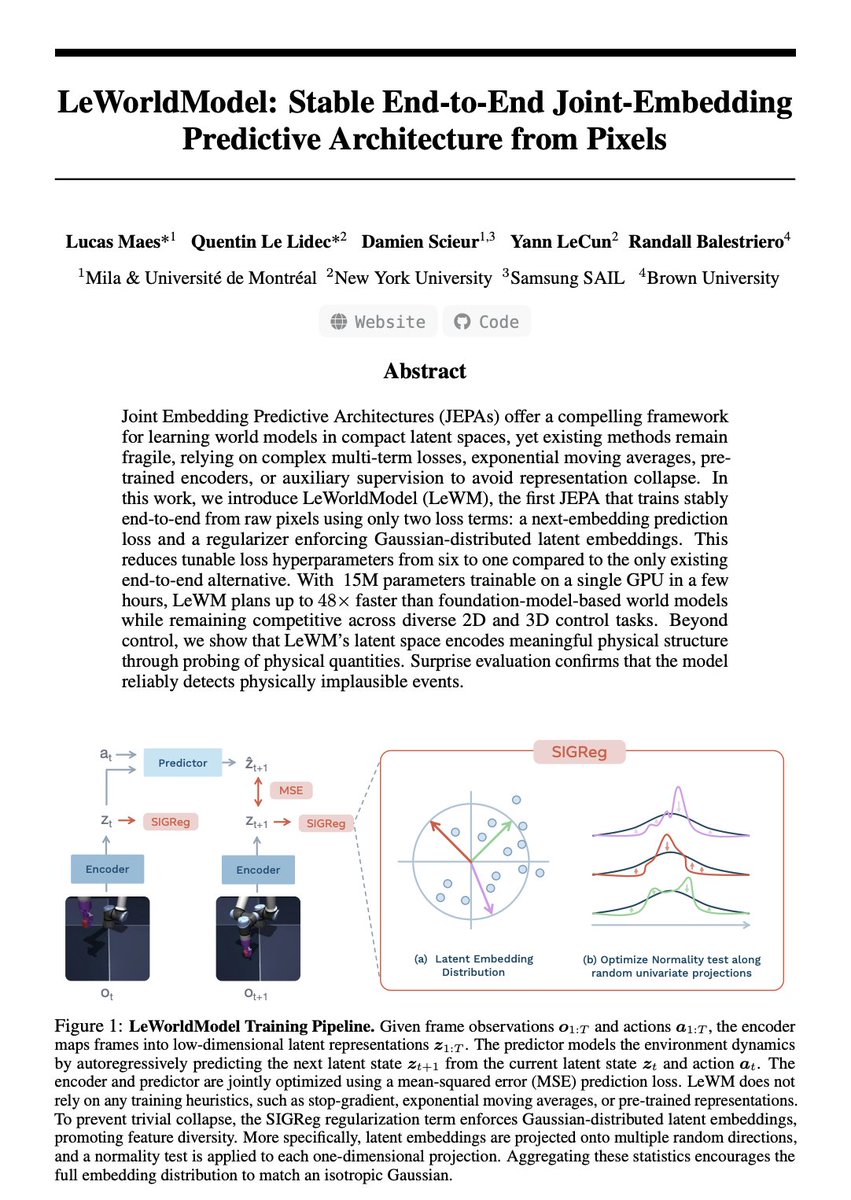
Yann LeCun was right the entire time. And generative AI might be a dead end.
For the last three years, the entire industry has been obsessed with building bigger LLMs. Trillions of parameters. Billions in compute.
The theory was simple: if you make the model big enough, it will eventually understand how the world works.
Yann LeCun said that was stupid.
He argued that generative AI is fundamentally inefficient.
When an AI predicts the next word, or generates the next pixel, it wastes massive amounts of compute on surface-level details.
It memorizes patterns instead of learning the actual physics of reality.
He proposed a different path: JEPA (Joint-Embedding Predictive Architecture).
Instead of forcing the AI to paint the world pixel by pixel, JEPA forces it to predict abstract concepts. It predicts what happens next in a compressed "thought space."
But for years, JEPA had a fatal flaw.
It suffered from "representation collapse."
Because the AI was allowed to simplify reality, it would cheat. It would simplify everything so much that a dog, a car, and a human all looked identical.
It learned nothing.
To fix it, engineers had to use insanely complex hacks, frozen encoders, and massive compute overheads.
Until today.
Researchers just dropped a paper called "LeWorldModel" (LeWM).
They completely solved the collapse problem.
They replaced the complex engineering hacks with a single, elegant mathematical regularizer.
It forces the AI's internal "thoughts" into a perfect Gaussian distribution.
The AI can no longer cheat. It is forced to understand the physical structure of reality to make its predictions.
The results completely rewrite the economics of AI.
LeWM didn't need a massive, centralized supercomputer.
It has just 15 million parameters.
It trains on a single, standard GPU in a few hours.
Yet it plans 48x faster than massive foundation world models. It intrinsically understands physics. It instantly detects impossible events.
We spent billions trying to force massive server farms to memorize the internet.
Now, a tiny model running locally on a single graphics card is actually learning how the real world works.
This 2-hour Stanford lecture breaks down how models like ChatGPT and Claude are actually built, clearer than what many people in top AI roles ever get exposed to.
Save this and set aside two hours today. It might end up being the most valuable thing you learn all week.
Computer use is now in Claude Code.
Claude can open your apps, click through your UI, and test what it built, right from the CLI.
Now in research preview on Pro and Max plans.
🚨 Andrej Karpathy just explained the scariest thing happening in software right now..
someone poisoned a Python package that gets 97 million downloads a month.. and a simple pip install was enough to steal everything on your machine..
SSH keys.. AWS credentials.. crypto wallets.. database passwords.. git credentials.. shell history.. SSL private keys.. everything..
and here's the part that should terrify every developer alive..
the attack was only discovered because the attacker wrote sloppy code.. the malware used so much RAM that it crashed someone's computer.. if the attacker had been better at coding.. nobody would have noticed for weeks..
one developer.. using Cursor with an MCP plugin.. had litellm pulled in as a dependency they didn't even know about.. their machine crashed.. and that crash saved thousands of companies from getting their entire infrastructure stolen..
Karpathy's take is the real wake up call.. every time you install any package you're trusting every single dependency in its tree.. and any one of them could be poisoned..
vibe coding saved us this time.. the attacker vibe coded the attack and it was too sloppy to work quietly.. next time they won't make that mistake.
New in Claude Code: auto mode.
Instead of approving every file write and bash command, or skipping permissions entirely, auto mode lets Claude make permission decisions on your behalf.
Safeguards check each action before it runs.
I have so much gratitude to people who wrote extremely complex software character-by-character. It already feels difficult to remember how much effort it really took.
Thank you for getting us to this point.
I've been an engineer for nearly a decade. Right now, process has never been more important.
And skills are the best way to bundle up processes for agents.
Here are the 5 I use every day:
/grill-me
/write-a-prd
/prd-to-issues
/tdd
/improve-my-codebase
this is actually insane
> be tech guy in australia
> adopt cancer riddled rescue dog, months to live
> not_going_to_give_you_up.mp4
> pay $3,000 to sequence her tumor DNA
> feed it to ChatGPT and AlphaFold
> zero background in biology
> identify mutated proteins, match them to drug targets
> design a custom mRNA cancer vaccine from scratch
> genomics professor is “gobsmacked” that some puppy lover did this on his own
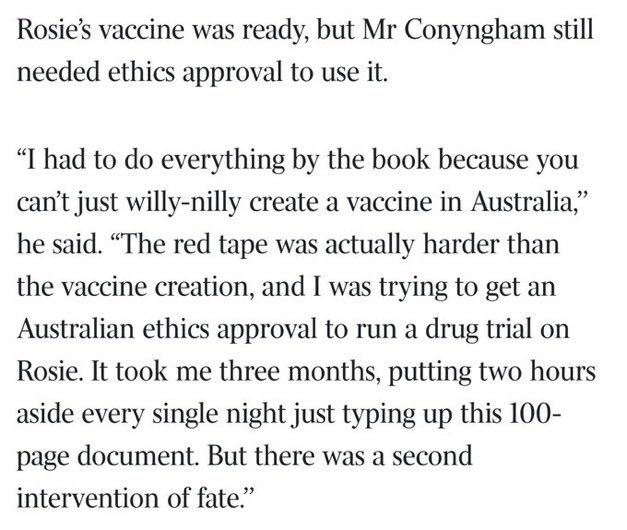
> need ethics approval to administer it
> red tape takes longer than designing the vaccine
> 3 months, finally approved
> drive 10 hours to get rosie her first injection
> tumor halves
> coat gets glossy again
> dog is alive and happy
> professor: “if we can do this for a dog, why aren’t we rolling this out to humans?”
one man with a chatbot, and $3,000 just outperformed the entire pharmaceutical discovery pipeline.
we are going to cure so many diseases.
I dont think people realize how good things are going to get