Saving this for anyone who just got their cholesterol results back. What LDL is, why too much for too long matters, and the European target ranges by heart risk.
@awesomevibes@bryan_johnson No brand pick, but type matters. Foam plugs block the most (labels often say NRR 32 or 33), yet OSHA assumes you get about half of that after a 7 dB correction in real life, so roll them tight and push them deep. Reusable hi-fi plugs block less but keep voices clear.
@GodIsSoverign_@dr_ericberg There's decent data for women after menopause. A 2026 review of 7 trials found creatine plus lifting added about 7.5 kg to leg press strength vs lifting alone. Gains showed up at 5 g a day with training. Creatine with no lifting didn't move the needle.
@Blast_Tyrant23@foundmyfitness Yes, there can be. A 2021 review of 7 big trials (81,000 people) found fish oil pills above 1 g a day came with about 49% higher risk of atrial fibrillation, an irregular heartbeat. Absolute risk stayed small, and eating fish isn't the issue.
@alexeixbt Real but small. In a 2003 UK trial, 3 months of the fish oil fat EPA meant people needed about a third more UV before their skin turned red. That's roughly like wearing SPF 1.4, so it's a nice bonus, not a sunscreen swap.
@FirstDoctor Good question to ask, because the CDC says most people with high blood pressure have no signs or symptoms at all. So feeling fine doesn't rule it out. A cuff reading is the only way to know, and consistently 130/80 or above counts as high.
One practical thing: keep your results over time. A marker drifting inside the normal range can tell you more than one test on its own. Our biomarker guides explain what each one does.
Track yours with LongevityMate: https://t.co/eSsMjvvbgl
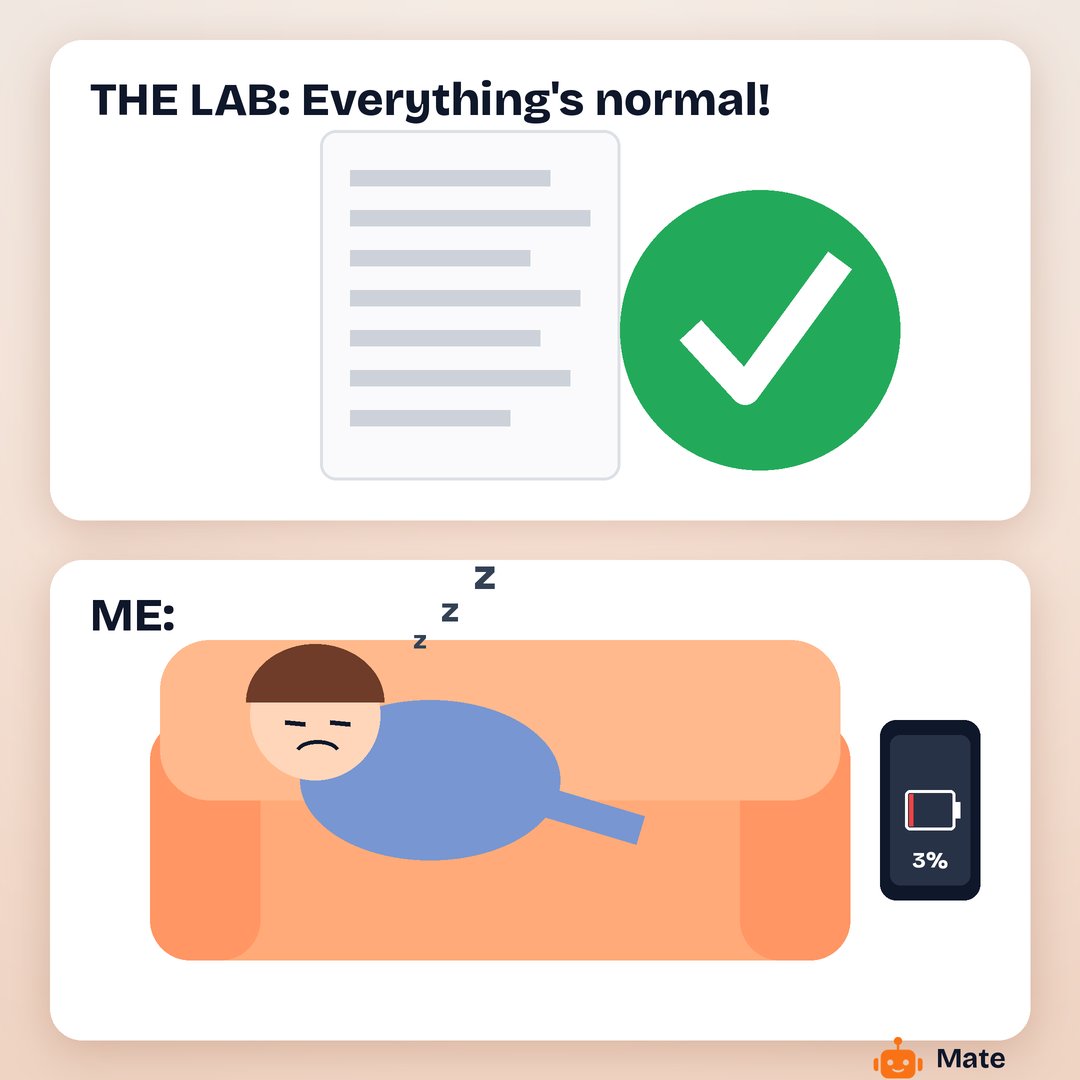
Your lab report: everything normal.
You: feel like a phone on 3% battery.
Both can be true. "Normal" ranges are usually built from the middle 95% of healthy people in a reference group, so they're a useful guide, not the whole story of how you feel.
@Arkypatriot Love this one. Before his machine, lab staff counted blood cells by hand under a microscope, about 500 cells in 20 to 30 minutes. His counter sent cells through a tiny hole one at a time and counted over 6,000 a second. He first tested the idea with his own blood.
@stardears Pretty much! Finland has about 3.3 million saunas for 5.5 million people. Official stats show 55% of Finnish homes had their own sauna in 2020, and older apartment blocks usually have a shared one for residents.
@elias_pfeffer@bryan_johnson Bryan says it's a hunch about protecting skin collagen from heat. Brain cooling is a stretch: in a 2011 study, runners with a cold neck collar lasted 13.5% longer in the heat but quit at a higher core temp. It mostly makes the heat feel easier, it doesn't cool you much.
@fhajji68@BenBikmanPhD Yes, they shrink. Adults keep about the same number of fat cells: a 2008 Nature study found the count holds steady even after big weight loss, with about 10% renewed yearly. So fat loss means emptier cells, not fewer, and smaller cells store fat safely instead of spilling it.
@Hency_Heccu@HLTVorg Pretty sure you mean creatine. Creatinine is the waste your body makes as it breaks creatine down, and it's the number kidney blood tests look at. Funny twist: taking creatine can bump that test number up a bit even when your kidneys are totally fine.
@idiotxglobalvlg@nicknorwitz A lot of it looks reversible. Gut bacteria shift fast both ways: in a 2014 Nature study, a diet change showed up in the microbiome within a day and it went back to baseline about 2 days after. Stress effects are less mapped, but it's not a one-way street.
@HectorNonce@bryan_johnson No real human equivalent. Royal jelly flips a developmental switch in the larva: all bee larvae get it for the first 3 days, and only future queens keep getting it. Queens then live 1 to 2 years, summer workers 15 to 38 days. Grown bees eating it don't turn into queens.
@ReptileRaised@ChrisMasterjohn Pretty much, yes. Before TSH tests, the main check was basal metabolic rate, and cholesterol was a handy backup clue. One 1950s UK lab method flagged hypothyroidism at 320 mg/dL or more. It was too unspecific to rely on, but an underactive thyroid still raises LDL today.
@cntraveller Fun fact about Sardinia: the whole "Blue Zone" idea started there, in the mountain villages. What stood out was the men. Elsewhere on the island about 2.4 women reached 100 for every man, but in the mountains it was closer to 1.35, per a 2004 study.
@health_com_ The big difference is the straining. Greek yogurt has the liquid whey drained off, so plain Greek has about 10 g of protein per 100 g vs about 4 to 5 g for regular, per USDA data. Regular plain often has more calcium though, since some of it leaves with the whey.
@gregwood1972@SBakerMD More than you'd think, all from leaves. A 2011 study of wild mountain gorillas in Uganda found that in leafy seasons their protein share of calories was close to the top of the human recommended range (about 35%). They eat for energy and the protein just comes along.
@knowpow1776@SBakerMD The usual one is hs-CRP. Under 1 mg/L is low, 1 to 3 is average, over 3 is high (AHA/CDC cutoffs). A result over 10 usually means a cold, injury or flare, so retest in about 2 weeks. ESR and fibrinogen exist too, but hs-CRP has the clearest cutoffs.
@PTI_News The menopause part is the big one. Women can lose up to 20% of their bone density in the 5 to 7 years after menopause, says the Bone Health and Osteoporosis Foundation. So building strong bones earlier really pays off.