MolmoAct2 by AllenAI
A fully open action reasoning model for real-world robot deployment, featuring the largest open bimanual dataset (720 hours), a specialized spatial reasoning backbone, and adaptive-depth reasoning that cuts latency while outperforming GPT-5 and Gemini Robotics.
What's different between these two BC policies? It's the same architecture, training budget, and data collection setup — the only difference is the controller gains!
Controller gains are an understudied design parameter in robot learning. In our new work (w/ @BronarsToni*, @pulkitology), we show how they act as an inductive bias across BC, RL, and Sim2Real transfer, with real consequences on performance. Here's what we found 🧵
* Equal Contribution
📄arxiv: https://t.co/SMYgh7i8cA
🔗website: https://t.co/cLCd1FYCdJ
We developed an RL method for fine-tuning our models for precise tasks in just a few hours or even minutes. Instead of training the whole model, we add an “RL token” output to π-0.6, our latest model, which is used by a tiny actor and critic to learn quickly with RL.
ACG: Action Coherence Guidance for Flow-based Vision-Language-Action Models (ICRA 2026)
https://t.co/JVzPkA0X3R
Action Coherence Guidance (ACG) is a training-free, test-time guidance algorithm that improves temporal and spatial action consistency in Vision-Language-Action (VLA) models. It mitigates motion jitter, unintended pauses, and trajectory drift caused by noisy demonstrations, resulting in stable and precise robotic manipulation.
We find that RL post-training can substantially improve BC policies without teaching them anything fundamentally new.
So what is RL doing? In DICE-RL, it contracts a broad behavior prior toward high-value modes. (1/n)
https://t.co/5WbSgSQ5Ok
Our work, "A Primer on SO(3) Action Representations in Deep Reinforcement Learning," was accepted to #ICLR2026! We provide a systematic study of action representation choices in RL, showing that they fundamentally impact training stability and performance.
#Robotics#AI#RL
We wrapped up #TRBAM this afternoon with three poster sessions by @cal_engineer @berkeley_cee students Jingchun Wang and Yi Ju; @berkeleymechanicalengineering recent MEng grad Luai Abuelsamen; and PATH's Hao Liu; and a lectern session by TE PhD student Tyler Truksa
TRB is almost here! UC Berkeley ITS and Berkeley Lab researchers head to Washington, D.C. for the Transportation Research Board Annual Meeting #TRBAM (Jan. 11–15, 2026).
Check out the ITS TRB Schedule: https://t.co/Pt6mENgraY
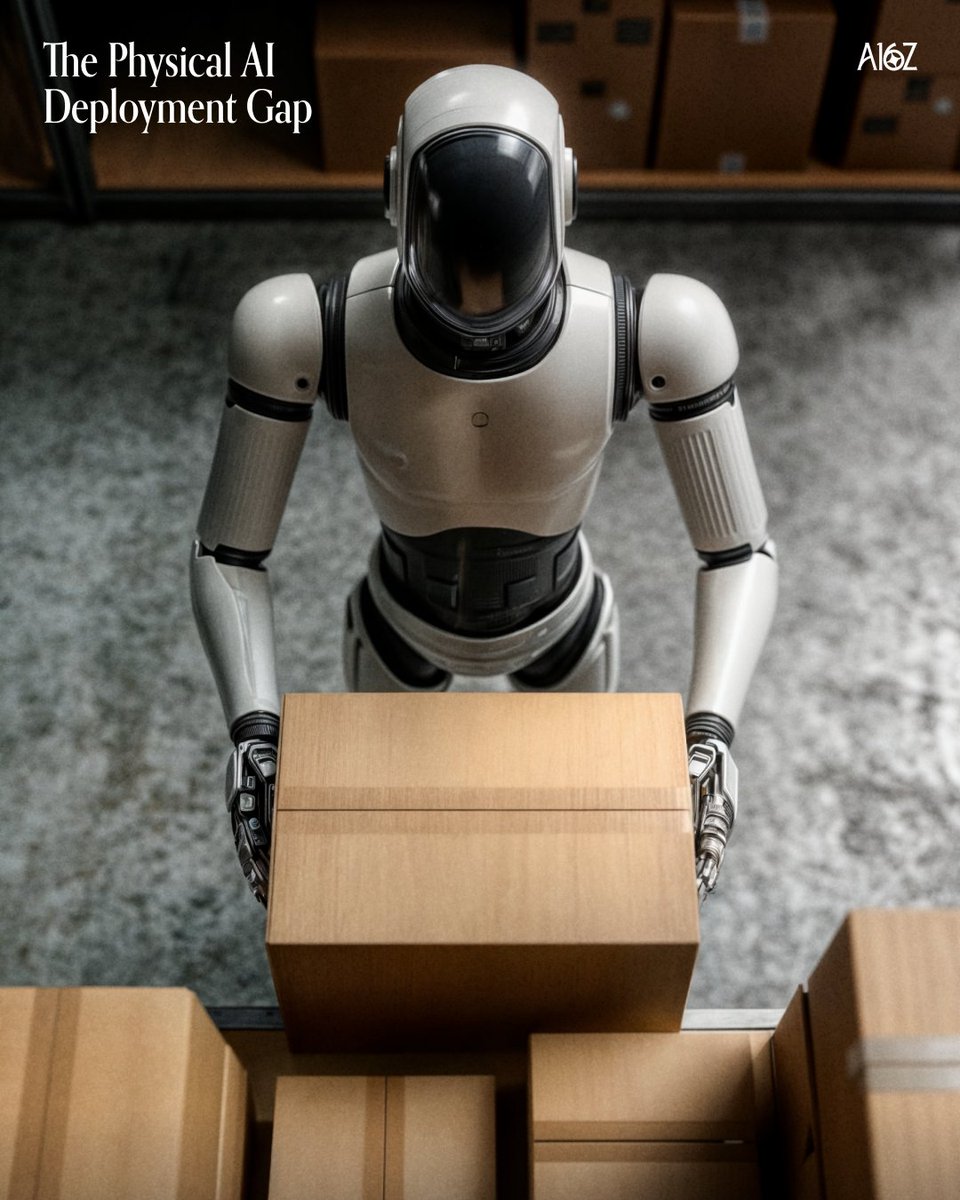
The physical AI deployment gap
a16z's Oliver Hsu on the gap between the frontier of robotics research and the deployment of robots in production settings, and why it matters: https://t.co/7aSVPIQ5zb
Robots assembling real products without scripts or human demos just became real.
Fabrica is a dual-arm system from MIT that can plan and execute multi-part assembly tasks end-to-end.
• Plans the full assembly hierarchy
precedence, sequence, grasp, motion, even fixture generation
• Combines planning with lightweight reinforcement learning for contact-rich steps
• Trains generalist policies that transfer zero-shot to real robots
• Achieves 80% success on complex multi-part assemblies ❗️
• Works across object shapes, grasp poses, and assembly directions
Most assembly systems break once geometry changes.
This shows that general multi-part assembly can be solved without handcrafted rules or human demonstrations.
Robots building unfamiliar objects in the real world.
Thanks for sharing, @YungshengTian!
📍Paper
https://t.co/IvtXqDZeuH
📍Project
https://t.co/Xxkze1oxW8
——
Weekly robotics and AI insights.
Subscribe free: https://t.co/dsa6wcvq6n
After 18 months in stealth, dozens of prototypes, millions of real-home demonstrations, and one final all-nighter, we’re thrilled for you to say hello to Memo