When Crypto sentiment recovers, ETH will be the main beneficiary.
If you ask any semi-informed person about Bitcoin, the convo will immediately steer towards Saylor/MSTR. And that conversation isn’t particularly bullish BTC anymore.
If you ask that same person about Ethereum, the convo can go any number directions covering a range of topics from Robinhood, to Coinbase, to stablecoins, to decentralized finance, to privacy, to tokenization, to prediction markets, to agentic finance, to digital and real world collectibles, and on and on.
The rabbit hole goes deep.
The same rabbit hole that each and every person reading this post fell into at one point.
What we log into this app to check on every single day.
It’s all about ETH.
Ethereum = Crypto.
@ExSoldier762@Addi56640@SteveInmanClips It's called conservation of momentum my friend. Tldr: big mass from car makes small mass of pedestrian go faster than car... Look it up!
I know you guys just adore the lush and exotic bougainvillea, so I went on a hunt to find the biggest.
This is what I came up so far , somewhere in a small village in Mexico , this giant resides .
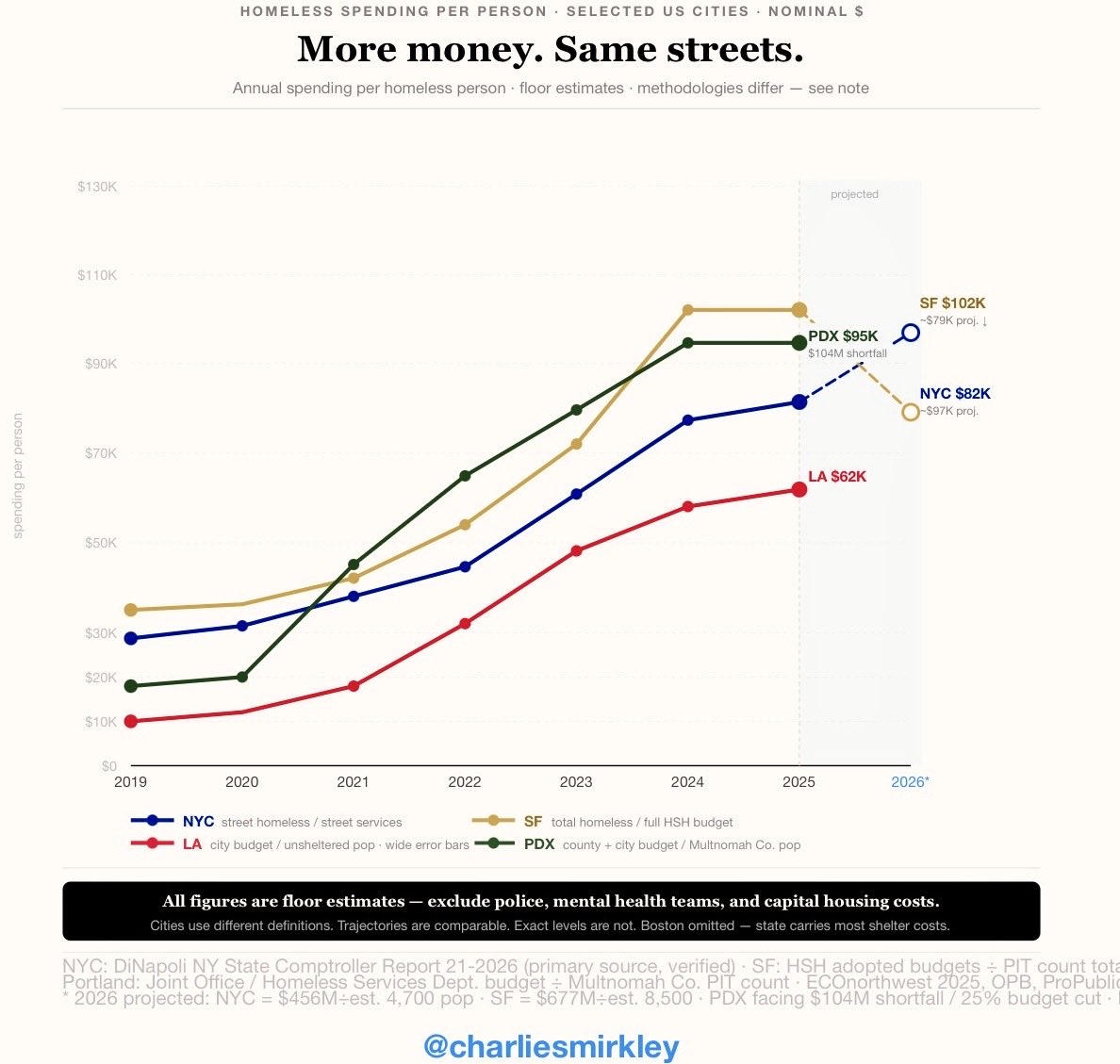
Spending per homeless person since 2019:
NYC +187%, SF +190%, PDX +430%, LA +480%. Average: +320
Floor estimates.
Homeless pop over same period: +13%
Spending up ~320%. Problem up ~13%.
Users do not use blockchains. They use products.
The EF is not building a product.
They are building a blockchain. A platform. That allows anyone to permissionlessly build whatever the fuck they want.
I know it's confusing bc there are a lot of shallow, single-purpose blockchains out there.
Shallow, single-purpose blockchains are products.
The EF is not building a product.
@dankrad Bro has the audacity to attack the EF for prioritizing cypherpunk values after literally selling his soul to a corpo centralized database chain.
It's wild how these giga-brains miss the entire point and importance of cypherpunk values.
Go get your paycheck and STFU, sellout.
@Mudassir_Taj141 US Consulate is not your soil. It is US jurisdiction. Everyone knows this. It is basic diplomacy laws that apply in all civilized countries.
I did a 40 hr and then a 70 hr social media fast.
I’ve come to believe that social media is pollution.
Not a vice or guilty pleasure.
It’s closer to water toxins, air pollution and microplastics.
Social media has been on my mind because I can feel how bad it is for me. For my health and agency. I am a professional rejuvenation athlete. For five years, I’ve engineered my life around biological renewal and the elimination of decay. After hundreds of experiments across food, sleep, exercise, therapies, and toxins, I’ve developed both data and intuition about what strengthens or degrades my system.
I can viscerally feel that social media is bad for me. It erodes my autonomy and increases cognitive entropy.
Like other toxins, it accumulates. You can’t unsee or unfeel what you’ve consumed. It settles into mental tissue like heavy metals, producing chronic low-grade inflammation. Evidence suggests even after you stop scrolling, attentional fragmentation and emotional priming persist. Your thoughts begin to mirror the algorithm’s incentives. Independent cognition quietly erodes and you don’t notice the loss.
Time away and getting lost in deep focus is the only remedy.
When something erodes your agency, the rational response is elimination. The problem is, elimination isn’t realistic. “Just put the phone down” is as practical as telling someone in 19th century London to stop breathing coal smoke.
You need to know what’s happening in the world, be in touch with your friends and be part of the tribe.
That necessity is what allows companies to harvest your emotions, intellect and time for their profit. You are their raw material they exploit. Then in an ironic twist, the system gets you to exploit yourself by engineering an environment where it takes more effort to stop than to continue scrolling. Pollution exposure by default.
What specifically makes social media toxic is that value and poison are inseparable by design. You go to hear from friends and you leave an hour later absorbed in outrage that serves no biological interest of yours. The water is real. The lead is in the pipes.
The performance metrics (likes, views, etc.) bleed you of independent thought. They create quantified social proof, triggering ancient hierarchy reflexes. You no longer evaluate signal from noise; the engagement metrics do it for you.
Like all toxins, the damage is cumulative. We live inside the exposure long enough that it feels normal. The 40 and 70 hour social media fasts did that for me. Gave me just enough separation to feel and diagnose the poison. The obviousness of it feels like when I went to India and saw their humanitarian crisis of air pollution which no one sees anymore.
So what do we do?
Neither platforms nor individuals are likely to change on their own. AI may be the countermeasure. An AI layer between you and the feed. Filtering rage, removing vanity metrics and translating sensationalism into calm, factual language. Preserving signal and eliminating noise.
I want social media to become a longevity intervention, not a longevity threat. I never want to see the raw feed. I want an AI agent to read it for me, strip the engagement metrics that hijack my judgment, filter the rage, and return only what I actually came for.
Every generation faces its pollutants. When cholera spread through London's water, the answer wasn't telling people to drink less. It was building filtration. The same logic applies here. Best next move is to design the filter to avoid being the raw material.
@DrewIsSharing Cannabis doesn't cause schizophrenia, it simply accelerates its onset. I bet if you narrow your population to 18-30 year olds you will a see much more dramatic impact
elon is the man of the millennium and most people still don't understand why
it's not the money. bezos has money. it's not the companies. plenty of founders have companies.
it's that he's the only one treating civilizational survival as an engineering problem instead of a talking point
Ethereum itself must pass the walkaway test.
Ethereum is meant to be a home for trustless and trust-minimized applications, whether in finance, governance or elsewhere. It must support applications that are more like tools - the hammer that once you buy it's yours - than like services that lose all functionality once the vendor loses interest in maintaining them (or worse, gets hacked or becomes value-extractive). Even when applications do have functionality that depends on a vendor, Ethereum can help reduce those dependencies as much as possible, and protect the user as much as possible in those cases where the dependencies fail.
But building such applications is not possible on a base layer which itself depends on ongoing updates from a vendor in order to continue being usable - even if that "vendor" is the all core devs process. Ethereum the blockchain must have the traits that we strive for in Ethereum's applications. Hence, Ethereum itself must pass the walkaway test.
This means that Ethereum must get to a place where we _can ossify if we want to_. We do not have to stop making changes to the protocol, but we must get to a place where Ethereum's value proposition does not strictly depend on any features that are not in the protocol already.
This includes the following:
* Full quantum-resistance. We should resist the trap of saying "let's delay quantum-resistance until the last possible moment in the name of ekeing out more efficiencies for a while longer". Individual users have that right, but the protocol should not. Being able to say "Ethereum's protocol, as it stands today, is cryptographically safe for a hundred years" is something we should strive to get to as soon as possible, and insist on as a point of pride.
* An architecture that can expand to sufficient scalability. The protocol needs to have the properties that allow it to expand to many thousands of TPS over time, most notably ZK-EVM validation and data sampling through PeerDAS. Ideally, we get to a point where further scaling is done through "parameter only" changes - and ideally _those_ changes are not BPO-style forks, but rather are made with the same validator voting mechanism we use for the gas limit.
* A state architecture that can last decades. This means deciding, and implementing, whatever form of partial statelessness and state expiry will let us feel comfortable letting Ethereum run with thousands of TPS for decades, without breaking sync or hard disk or I/O requirements. It also means future-proofing the tree and storage types to work well with this long-term environment.
* An account model that is general-purpose (this is "full account abstraction": move away from enshrined ECDSA for signature validation)
* A gas schedule that we are confident is free of DoS vulnerabilities, both for execution and for ZK-proving
* A PoS economic model that, with all we have learned over the past half decade of proof of stake in Ethereum and full decade beyond, we are confident can last and remain decentralized for decades, and supports the usefulness of ETH as trustless collateral (eg. in governance-minimized ETH-backed stablecoins)
* A block building model that we are confident will resist centralization pressure and guarantee censorship resistance even in unknown future environments
Ideally, we do the hard work over the next few years, to get to a point where in the future almost all future innovation can happen through client optimization, and get reflected in the protocol through parameter changes. Every year, we should tick off at least one of these boxes, and ideally multiple. Do the right thing once, based on knowledge of what is truly the right thing (and not compromise halfway fixes), and maximize Ethereum's technological and social robustness for the long term.
Ethereum goes hard.
This is the gwei.