Hormuz is being modeled by consensus as an oil shock. It is not. It is an input layer reset of the global manufacturing economy. The crude price move is the loudest signal but not the most consequential.
The most consequential transmission is the slow repricing of the chemical, metal, and specialty input layer that sits underneath every physical product made on Earth.
Each cascade has its own time signature. Oil moves in days. Fertilizer in weeks. Specialty chemicals in months. Capital goods and consumer durables in quarters. Sovereign wealth flows and reinsurance capital in years.
So the impact rolls through markets in waves rather than a single shock. This is what makes it harder to model than a typical commodity event.
the strait of hormuz is in a quantum superposition of open and closed that only collapses when you try to take a tanker through yourself and see if you get shot at
How does the reopening of Straits of Hormuz look like?
I presented this to my clients last week. Logistics will be messy. Confidence needs to be rebuild. Unconditional is the word.
It's going to take time, guys. Don't hold your breath.
#oott
@aeberman12 Another difference is, 2022 shock affected Europe most, which is pricing center for brent gasoil etc. Rich world bids to get other resources at higher prices. This time Asia is more affected, and poorer world (not just in asia) has to live by rationing / demand destruction.
Providing an update on the damage from the missile attacks on Ras Laffan Industrial City
H.E. Minister Saad Sherida Al-Kaabi: The missile attacks reduced Qatar’s LNG export capacity by 17% and caused an estimated loss of $20 billion in annual revenue
- Extensive damage to our production facilities will take up to five years to repair and will compel us to declare long-term force majeure
QatarEnergy expects the damage to its Ras Laffan Industrial City caused by missile strikes, which occurred on Wednesday 18 March 2026, and in the early hours of Thursday 19 March 2026, to cost about $20 billion a year in lost revenue and to take up to five years to repair, impacting supply to markets in Europe and Asia.
Providing an update on the damage to the facilities at Ras Laffan Industrial City, His Excellency Mr. Saad Sherida Al-Kaabi, the Minister of State for Energy Affairs, the President and CEO of QatarEnergy, said “I am relieved to confirm that no one was injured by these unjustified and senseless attacks, which weren’t just an attack on the State of Qatar but attacks on global energy security and stability. This was an attack on all of us who stand for development and human progress that is sustained by a fair, reliable, and secure access to energy.”
The attacks damaged two liquefied natural gas (LNG) producing Trains 4 and 6 totaling 12.8 million tons per annum (MTPA) of production, representing approximately 17% of Qatar’s exports. Train 4 is a joint venture between QatarEnergy (66%) and ExxonMobil (34%), and Train 6 is a joint venture between QatarEnergy (70%) and ExxonMobil (30%).
His Excellency Minister Al-Kaabi said: “The damage sustained by the LNG facilities will take between three to five years to repair. The impact is on China, South Korea, Italy and Belgium. This means that we will be compelled to declare force majeure for up to five years on some long-term LNG contracts.”
The attacks also targeted the Pearl GTL (Gas-to-Liquids) facility, a production sharing agreement operated by Shell, that converts natural gas into high-quality cleaner burning drop-in fuels and produces base oils used to make premium engine oils and lubricants, and paraffins and waxes.
“The damage caused to one of the two trains at Pearl GTL is being assessed and is expected to be offline for a minimum of one year” His Excellency Minister Al-Kaabi added.
It should be noted that there will be a loss of associated product production due to this outage as follows:
· Condensates: 18.6 million barrels which is around 24% of Qatar’s exports
· LPG: 1.281 MT which is around 13% of Qatar’s exports
· Naphtha: 0.594 MT which is around 6% of Qatar’s exports
· Sulfur: 0.18 MT which is around 6% of Qatar’s exports
· Helium: 309.54 MCFA which is around 14% of Qatar’s exports
His Excellency the Minister of State for Energy Affairs, the President and CEO of QatarEnergy paid tribute to the Qatari military and security forces and to the energy sector emergency response teams whose courage and extraordinary professionalism ensured the situation was contained quickly and safely.
#Qatar
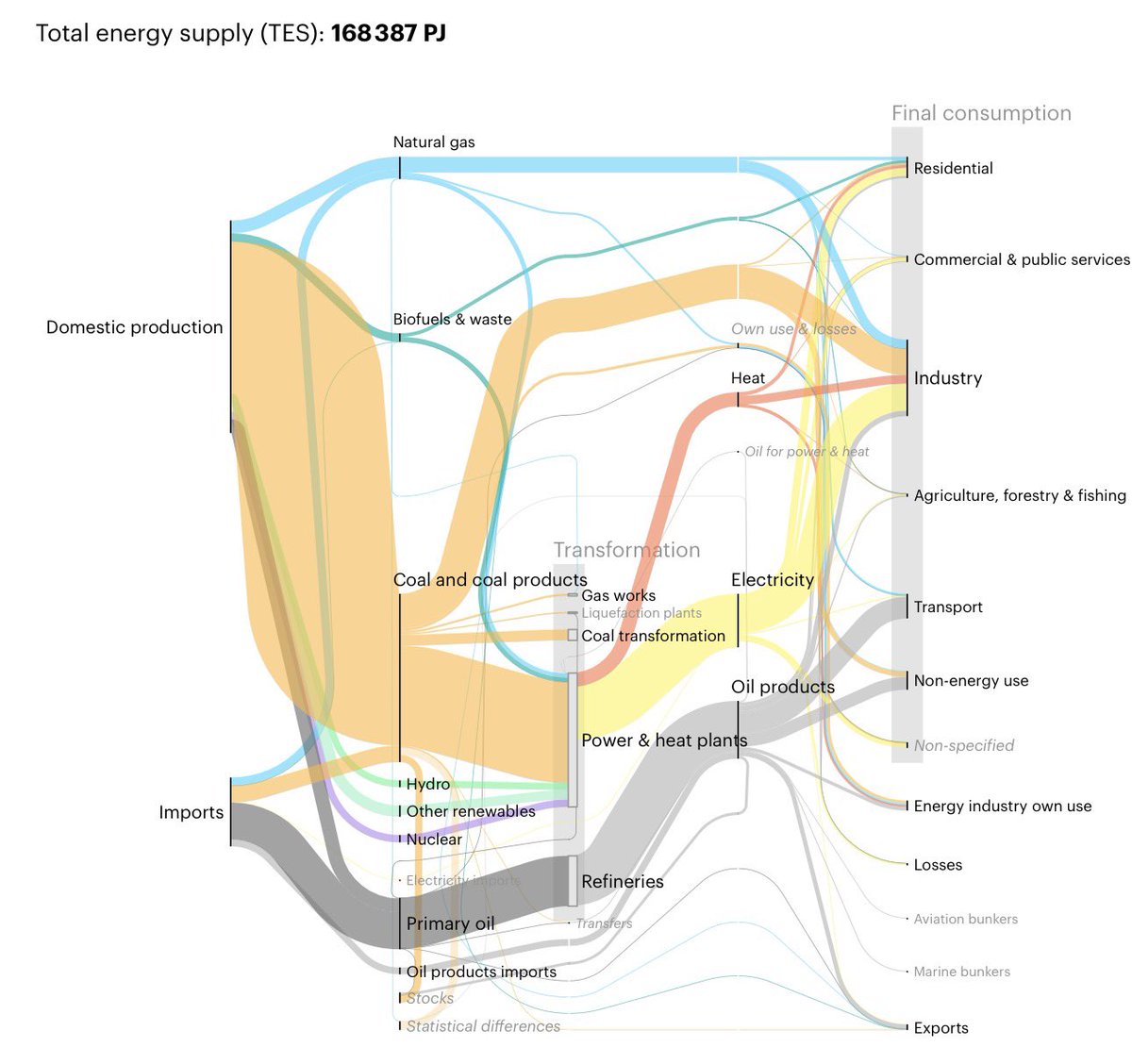
The two Superpower Energy Systems
On the left is the US energy system and on the right is the Chinese energy system.
What is immediately obvious is how very different they are. US is dominated by nat gas and primary crude, China is dominated by coal.
There are some more subtle differences too:
• US is 90 EJ, China is 170 EJ (charts not to scale)
• In both systems, residential use is small
• US system has higher commercial use
• Chinese system has much higher industrial use
• US system has much higher transport use
• US system has much higher energy exports
A lot of prevailing narratives and emergent trends are just minuscule rounding errors in this 2023 data from EIA.
Electrification of transport is barely visible in either system. Tesla moving EV production to Optimus production probably acknowledges the bifurcation of the US energy system, where electrification will increasingly serve residential, commercial and industrial uses and petroleum will continue to serve the US high transport demands.
Americans are vastly more mobile inside America than the Chinese are inside China. Orders of magnitude difference here.
China is essentially one giant factory process of…
coal -> steam -> electricity -> manufacturing
It might be a surprise just how much of China’s energy is sourced from domestic primary energy. It’s a lot. This gives China a strategic robustness, their main import vulnerability is crude which they need for transportation however they have built a transport light society.
Chinese industries are all clustered in a single specialist city, people don’t move around the country much.
China’s domestic coal production is their strategic resilience and therefore they’re unlikely to ever move off coal.
I’ll post the link below and you can have a look at various countries, as these energy systems tell you an lot about how each country is structured as a machine and where it’s strategic weaknesses are.
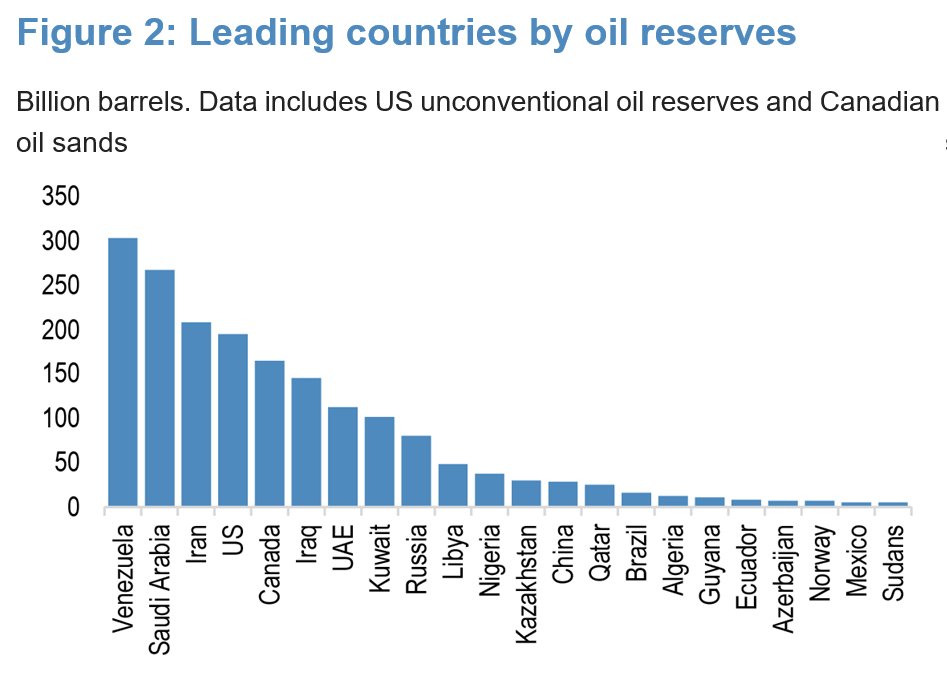
Investors: JPMorgan says Venezuela has largest oil reserves
JPM: That comes from an OPEC report
OPEC: Our members self-report. Ask Venezuela
Venezuela: We get that from PDVSA
PDVSA: Hugo Chavez told us years ago to report that for prestige & now we'd look bad if we lowered it
Last quarter I rolled out Microsoft Copilot to 4,000 employees.
$30 per seat per month.
$1.4 million annually.
I called it "digital transformation."
The board loved that phrase.
They approved it in eleven minutes.
No one asked what it would actually do.
Including me.
I told everyone it would "10x productivity."
That's not a real number.
But it sounds like one.
HR asked how we'd measure the 10x.
I said we'd "leverage analytics dashboards."
They stopped asking.
Three months later I checked the usage reports.
47 people had opened it.
12 had used it more than once.
One of them was me.
I used it to summarize an email I could have read in 30 seconds.
It took 45 seconds.
Plus the time it took to fix the hallucinations.
But I called it a "pilot success."
Success means the pilot didn't visibly fail.
The CFO asked about ROI.
I showed him a graph.
The graph went up and to the right.
It measured "AI enablement."
I made that metric up.
He nodded approvingly.
We're "AI-enabled" now.
I don't know what that means.
But it's in our investor deck.
A senior developer asked why we didn't use Claude or ChatGPT.
I said we needed "enterprise-grade security."
He asked what that meant.
I said "compliance."
He asked which compliance.
I said "all of them."
He looked skeptical.
I scheduled him for a "career development conversation."
He stopped asking questions.
Microsoft sent a case study team.
They wanted to feature us as a success story.
I told them we "saved 40,000 hours."
I calculated that number by multiplying employees by a number I made up.
They didn't verify it.
They never do.
Now we're on Microsoft's website.
"Global enterprise achieves 40,000 hours of productivity gains with Copilot."
The CEO shared it on LinkedIn.
He got 3,000 likes.
He's never used Copilot.
None of the executives have.
We have an exemption.
"Strategic focus requires minimal digital distraction."
I wrote that policy.
The licenses renew next month.
I'm requesting an expansion.
5,000 more seats.
We haven't used the first 4,000.
But this time we'll "drive adoption."
Adoption means mandatory training.
Training means a 45-minute webinar no one watches.
But completion will be tracked.
Completion is a metric.
Metrics go in dashboards.
Dashboards go in board presentations.
Board presentations get me promoted.
I'll be SVP by Q3.
I still don't know what Copilot does.
But I know what it's for.
It's for showing we're "investing in AI."
Investment means spending.
Spending means commitment.
Commitment means we're serious about the future.
The future is whatever I say it is.
As long as the graph goes up and to the right.
@SelukarAbhijit Money to ethanol makers may not trickle to sugar lobby, and money trickled to sugar lobby may not trickle down to farmers. Even as a narrative it might not fly, Gadkari has been in spotlight on this
More bad news for mobile phone users in India (after SIM binding): Our government is mandating a government app (sanchar saathi) on every new phone, permanently, Reuters reports.
Will be pushed to your phone via OTA. New smartphones need to have it. Users cannot delete it. This is a first. India has never before required an unremovable state app on every device. Russia does btw, with its MAX Messenger (started September 2025).
A few comments regarding this:
1. Sanchar Saathi is a lost phone tracker, but if it gets embedded with no possibility of removal, it becomes a government tracker on your device.
IF the government is allowed to get away with this, what’s next? A mandatory digital ID app? Digiyatra forcefully installed on each device? An app that disables VPNs or tracks your app and browser history? An app that sends copies of your messages to the government once a month?
Once the OS layer is opened to the state, it doesn’t close.
2. Legally, one can argue that your mobile phone is your personal space, and this is an invasion of your personal space.
It’s where we have our most private conversations. Exchange sensitive information with people we trust.
How do we know this app isn’t used to access files and messaging on our device, which is unencrypted on device? Or a future update won’t do that? This is clearly an invasion of our privacy.
3. Remember how the government exempt itself from much of the Data Protection Law. This explains why.
The Data Protection Law will make private companies more accountable and the Indian government less accountable.
4. Bloatware is already an issue with some phones (It’s why I don’t use Samsung). Now there’s more, and this time the government is forcing bloatware. I guess we’ll all have to root our phones now. When you buy a phone with bloatware, you're choosing to buy it with bloatware. This is different.
5. The way things work with India’s Department of Telecom, there was no public consultation, the order wasn’t disclosed. Just forced. This is dictatorial in nature. If they get away with this, more will follow.
I run every day for 30 minutes, if I miss a day I add 30 minutes to the next day.
This has truly been a game changer, tomorrow I’m supposed to run for 3 weeks.
Seventeen Years
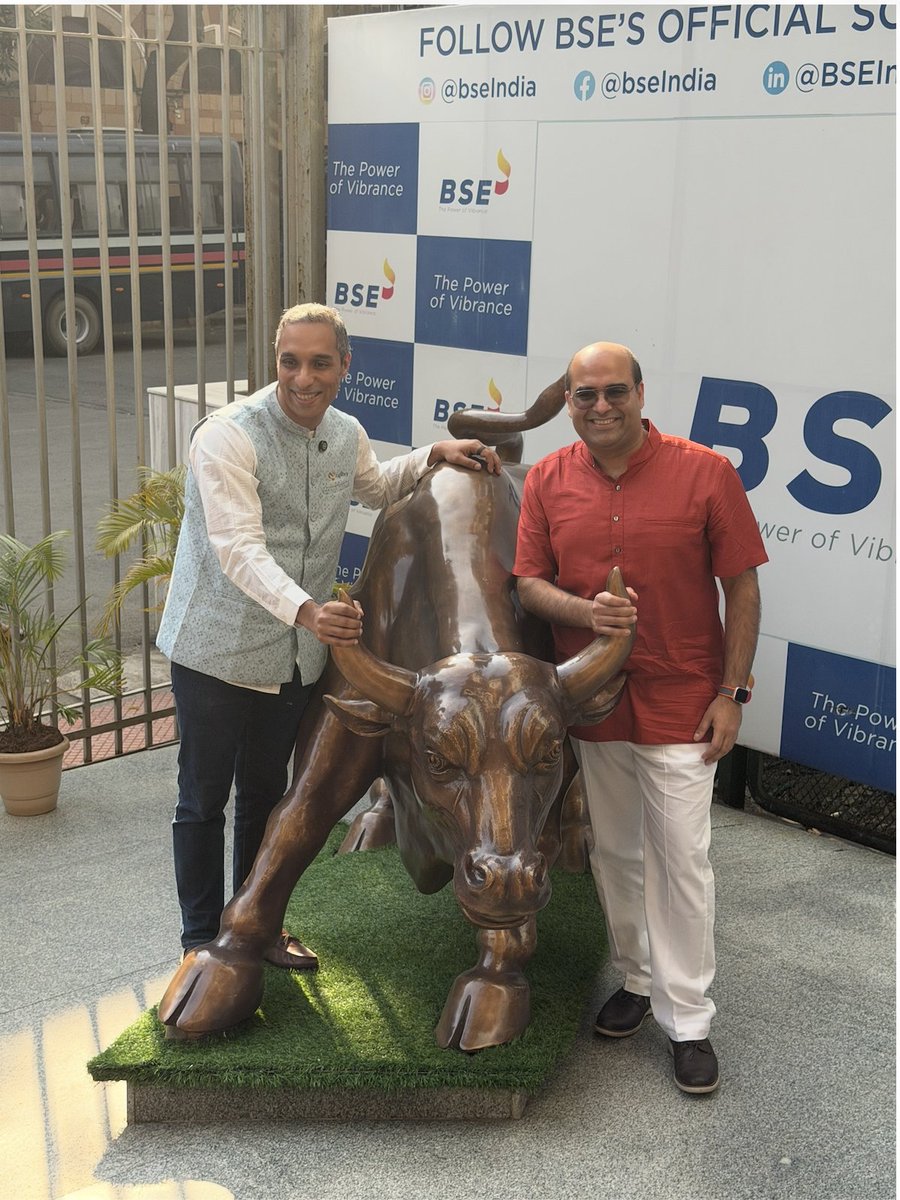
Today @capillarytech goes public. Seventeen years since three kids fresh out of college decided to start something in the wreckage of 2008.
I wasn't there for the second half.. the harder half. @AneeshBReddy steered this ship through storms I can only imagine. I'm grateful beyond words.
What I remember most isn't the milestones. It's the texture of those early days.
Merchants in Kolkata who humored us when we had nothing. Durga Puja 2008, camped outside police headquarters chasing traffic updates. Pan IIT at IIT Madras where our scrappy SMS service caught fire. That first angel check of ₹15 lakhs from IIT Kharagpur that we paid back in crores.
We had no idea what we were doing. Just energy, naivety, and this strange refusal to think small.
Then Aditya Birla and Future Group said yes. Right after Lehman fell. I still don't know why they trusted us.
The apartment in CV Raman Nagar with no water during the day. Chai walks in BTM Layout with @shubhmalhotraa, Abhilash, Prakhar, @pigol1.. trying to figure out if we were building something or just fooling ourselves.
Then loyalty took off.
That first campaign—₹11 lakhs in incremental sales, one weekend, fully attributed. That's when we saw it. A chance meeting with @KartheeMadasamy at CCD led to the @Qualcomm QPrize. We were shocked when we won.
The business grew, but we stayed scrappy. That tiny hotel in Dadar because it was cheapest. The Bangalore home-office. The Gurgaon apartment where Ajay held the fort. Holed up in Bur Dubai searching for product-market fit. The exhilaration when @sequoia (now @peakxvpartners) and @NorwestVP bet on us, alongside angels like @RajanAnandan, Venkat, KS, and Harminder.
But what I really remember are the crazy things.
Flooding someone in Gujarat with hundreds of thousands of texts. The new hire who nearly wiped our database on day one—later led all of engineering (take a bow, @pigol1). Anant building a POS system on an Excel sheet to close a deal. Sujatha, our first female hire, making sure our office was no longer a dorm room. Building loyalty systems where internet barely worked—the magic of "nightly sync."
We were pirates, not professionals. That's what made it magic.
Like humans, companies find their early years most thrilling. The teenage years? Brutal. But at seventeen, she's finally ready—scarred, wiser, infinitely stronger.
We remember our failures more than our wins. We carry the scar tissue.
But today, we celebrate.
What a journey, Capillary family. What a journey.
@seb_kennedy@EnergyFluxNews Ok fair as an attempt. But I'd bet Equinor has those 30% LT contracts linked to TTF/NBP or Brent, not to cost of production. Why would a low cost producer give up the margin upside? Cost linkage has problems for buyer as well e.g. gold plating