Nobel laureate Susumu Tonegawa, who pioneered cell-type-specific transgenic mice and the study of engrams, has passed away at the age of 86.
By @claulopezneuro
https://t.co/iQ6UR22ICk
We lost our beloved PhD mentor, Susumu Tonegawa, leaving an emptiness.
Whenever I think about courage, I think about Susumu. He switched fields twice and relearned everything. Whenever I think about greatness, I think about Susumu. He was on a mission to discover how Nature works for the benefit of humanity. Whenever I think about perseverence, I think about Susumu. There is a funny anecdote we knew that when he climbed the great wall of China at a scientific conference, he wanted to race everyone to the top and was perplexed when all the (younger) faculty members were much slower than he was.
He was a lion of a man.
A dear friend from the lab once told me that seeing science through his eyes has been one of the highlights of his life. It is mine as well.
I think this poem that by Ki no Tsurayuki expresses well what I feel , which I think others who have lost mentors can also feel 色も香も昔の濃さに匂へども 植ゑけむ人の影ぞ恋しき
Blossoms deep in color and fragrance as in the old days, yet I long for the one who first planted them.
Photos from happier days:
Happy to be a co-author on this beautiful study from Rosa Paolicelli’s group.
Congratulations to Anne-Claire, Rosa, and all collaborators!
Microglial TDP-43 mediates myelin refinement and represses Tyrobp cryptic exon inclusion in mice.
https://t.co/XnBqc1EzyB
DYK around half of the brain is not made of neurons? Among the other half is the octopus-like microglia.
In this visualization by our Electron Microscopy team, microglia (green) wraps around a pyramidal cell (blue), one of two types of excitatory neurons in the brain.
Our new paper is out in @ScienceMagazine! We developed mice with reversible control of autophagy, and showed that restoring this pathway after its suppression reverses neuronal abnormalities and brain dysfunction, demonstrating the resilience of neurons. https://t.co/kegmU08mcY
Excited to share our first red ACh sensor!
We developed GRAB_rACh1h, the first genetically encoded red fluorescent sensor for recording acetylcholine dynamics in vivo. (1/3)
Direct interactions between the cell’s powerhouses and nuclear pores might channel energy straight into the nucleus, fuelling cell division and differentiation.
https://t.co/EpkDHhwXYT
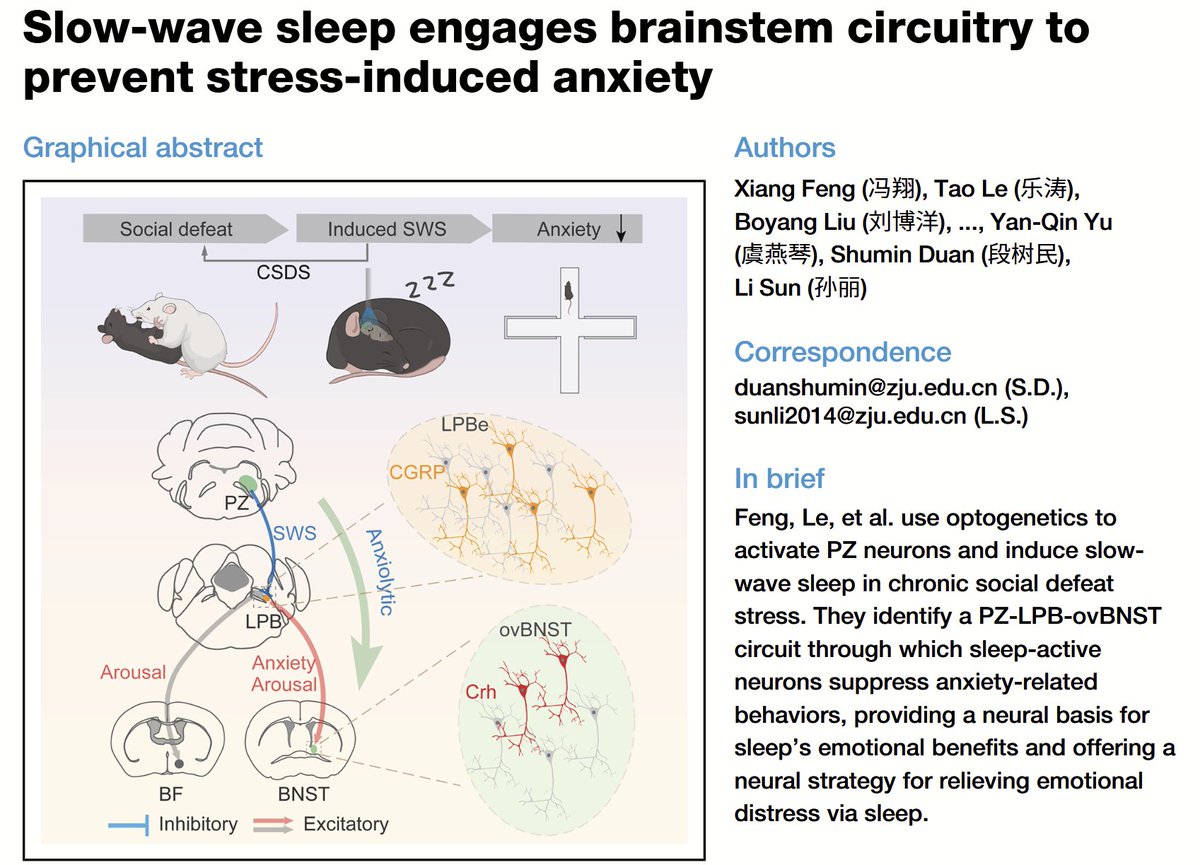
Deep sleep may be one of the brain’s most powerful anti-anxiety tools.
Researchers identified a sleep-active circuit linking the parafacial zone, parabrachial nucleus, and BNST that suppresses stress-related signaling during slow-wave sleep and prevents anxiety-like behavior. #SleepScience #Neuroscience #MentalHealth
https://t.co/0kEEWqKOGG
Sleep physiology and dementia, a new 5★ review @ScienceMagazine, gets into glymphatics, blood volume, heart rate variability, vasoactive amines, and neuromodulators. by @MaiNedergaard
https://t.co/zBMc1XQZcX
Important Nature Neuroscience paper shows how humans differ from LLMs.
Many people currently believe that humans are just next-word predictors, like LLMs.
But this new paper by Zou, Poeppel and Ding suggests something more interesting.
The human brain does predict words.
But it does not predict every word with the same precision.
Prediction is constrained by linguistic structure.
When a word continues the current phrase, brain activity tracks word surprisal in a way that resembles an LLM.
But when a word crosses a major phrase boundary, the match weakens.
In other words, the brain does not simply ask:
“What is the next word?”
It also asks:
“What structure am I currently building?”
This challenges one of the most common biases in today’s technological world: the belief that human language works like a large language model.
The answer is: no.
Human language is not just next-token prediction.
*
Paper in the first reply
🚀 DeepSeek-V4 Preview is officially live & open-sourced! Welcome to the era of cost-effective 1M context length.
🔹 DeepSeek-V4-Pro: 1.6T total / 49B active params. Performance rivaling the world's top closed-source models.
🔹 DeepSeek-V4-Flash: 284B total / 13B active params. Your fast, efficient, and economical choice.
Try it now at https://t.co/GCdiMzk1Dl via Expert Mode / Instant Mode. API is updated & available today!
📄 Tech Report: https://t.co/drlDrxkYtp
🤗 Open Weights: https://t.co/T13Y8i7SDM
1/n
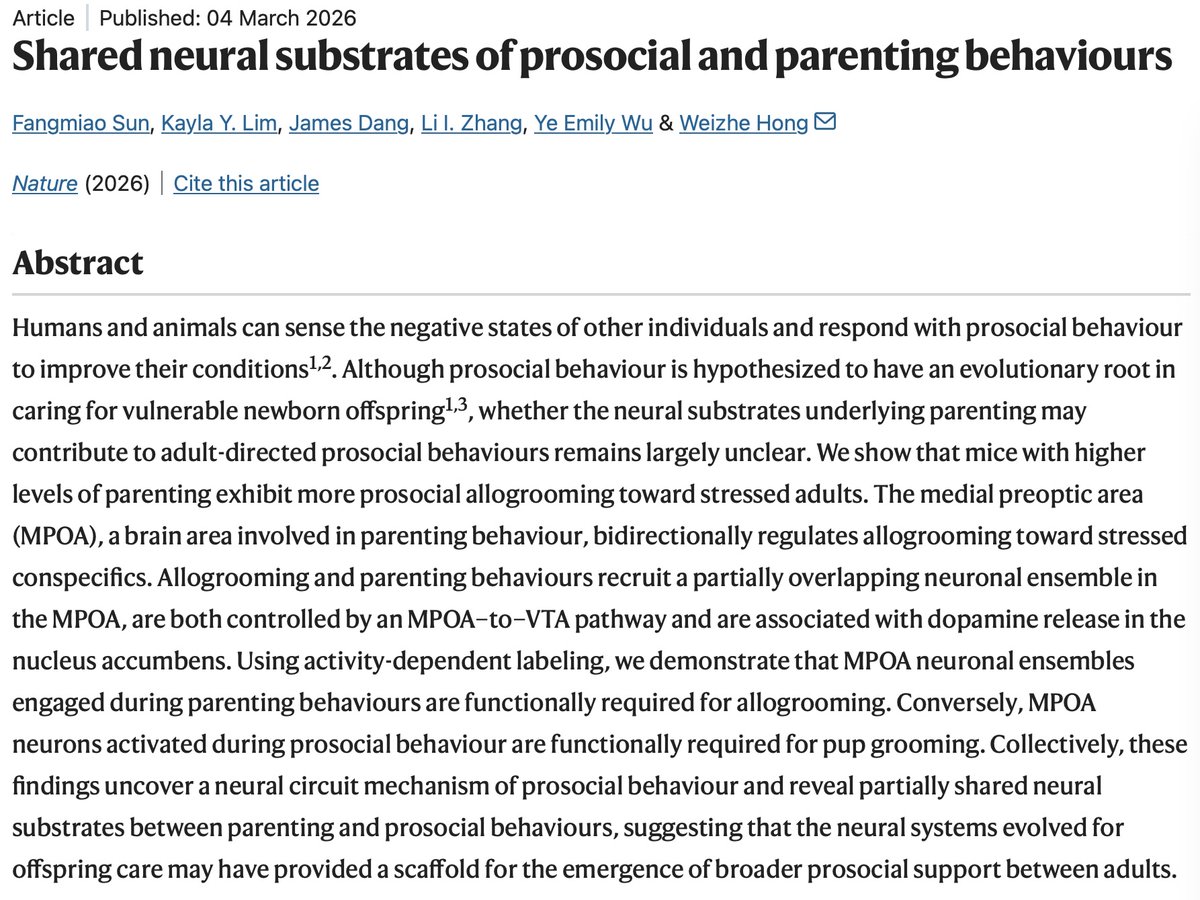
Excited to share our latest work in @Nature showing shared neural substrates for parenting and prosocial helping behavior - fantastic work by @Fangmiao4, @KaylaYingYan, and Emily Wu. Full text available here: https://t.co/1MdwgGaLIz
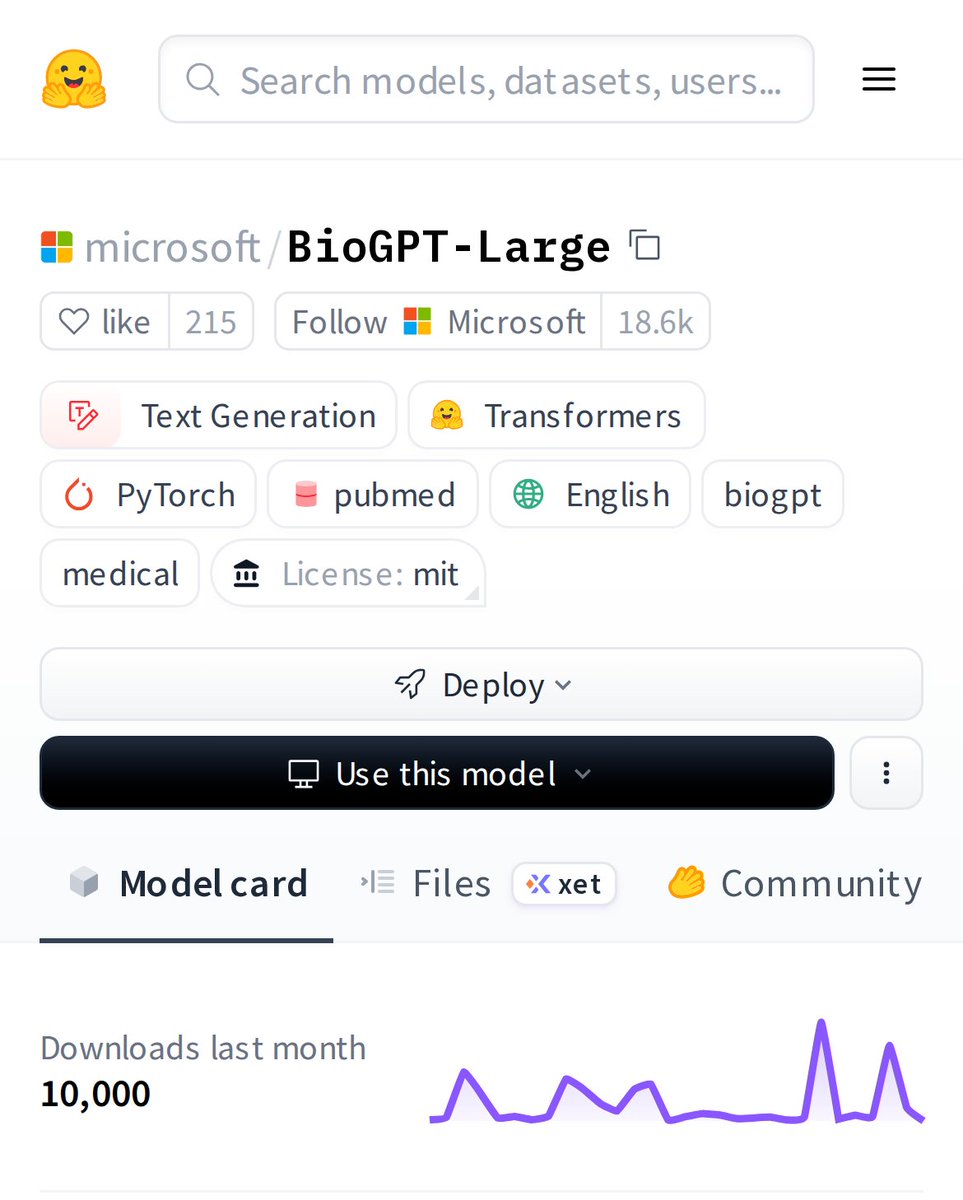
Meet BioGPT-Large: a specialized AI trained on millions of PubMed articles. It's not just another language model. It's a biomedical expert that can generate and understand complex medical text. This is huge for researchers and developers.
Online now: More than microglial depletion: PLX5622 activates the hepatic constitutive androstane receptor to alter anesthesia and addiction https://t.co/vRqsk0Rma9
Do you remember your first #JNeurosci paper?
Nancy Ip, who currently serves as the President and the Morningside Professor of Life Sciences at @hkust, recalls her first paper published in the journal as a graduate student.