It's paper day!!✨ Very happy to announce that my first paper is (finally) on the arXiv today! Check it out if you want to find out how we can use stellar streams living in the outskirts of galaxies to learn about their dark matter halos! 🔭 https://t.co/l9AkZJNI2G
Support the Very Large Array (VLA) by joining our Membership Program today!
Inspire the next generation of scientists by supporting K-12 #astronomy and #STEM education initiatives - for as low as $25/year!
Join today: https://t.co/HGXCEy56CY
Dark matter is one of the biggest mysteries in the universe.
Roman will shed light on the cosmic enigma using hundreds of natural telescopes –– foreground galaxies that magnify light from farther galaxies.
https://t.co/p4kRi1qUNw
🟣 #ARRAKIHS x #InternationalDayofGirlsandWomeninScience
We're joining the #11F celebrations to highlight the contributions of #women in astronomy and astrophysics! ✨🔭
We've prepared a contest, and there's a prize! 🤩
🔗 Join here ➡ https://t.co/5XSE1JSLm8
Let’s play & learn!
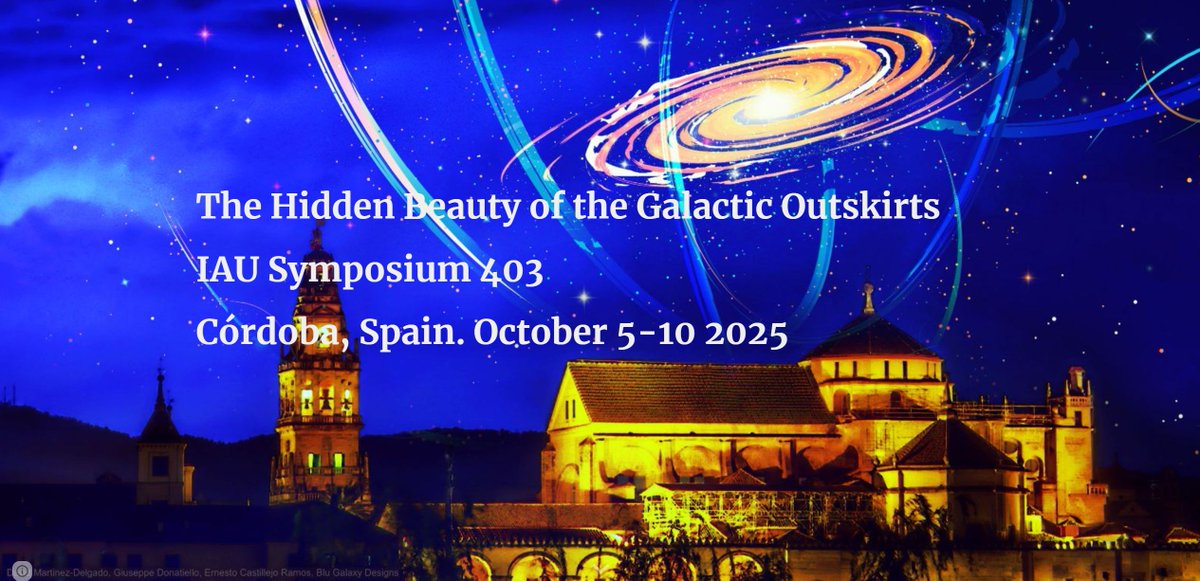
The IAU Symposium 403 "The Hidden Beauty of the Galactic Outskirts" will be celebrated in Córdoba (Spain) on October 5-10, 2025. The first announcement with a call for abstracts, invited speakers and information about IAU travel grants will be distributed in early February.
The IAU Symposium #IAUS403 on 'The Hidden Beauty of the Galactic Outskirts' will be held from October 5 to 10, 2025, in Córdoba, Spain.
https://t.co/pUHhzKpu76
#IAUS403
Happy Birthday to Edwin Hubble! The man who expanded our universe-literally! His work unveiled the vastness of galaxies and set the stage for modern cosmology. ✍️
"Equipped with his five senses, man explores the universe around him and calls the adventure Science."
@KAIxJU I absolutely love the way this is framed like it’s happening in a movie. Time slows down, everything else out of focus, the light giving him an angelic look 👏👏👏
Voilà la différence entre la surface du Soleil observé par le satellite SDO en 2019, lors du minimum d'activité solaire (gauche) et ces temps-ci, au maximum d'activité (droite)
Le Soleil n'est ni plus brillant ni plus chaud mais il y a plus de phénomènes actifs à sa surface
1/3
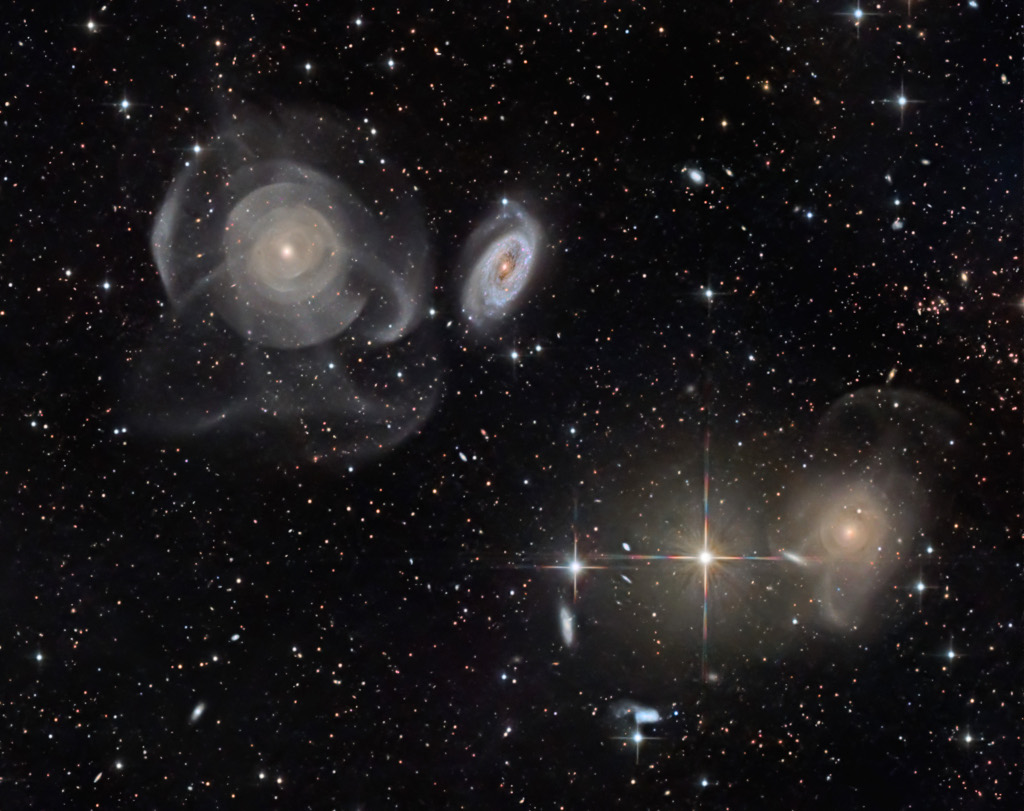
This spectacular intergalactic skyscape features Arp 227, a curious system of galaxies from the 1966 Atlas of Peculiar Galaxies. Some 100 million light-years distant within the boundaries of the constellation Pisces, Arp 227 consists of the two galaxies prominent above and left of center, the shell galaxy NGC 474 and its blue, spiral-armed neighbor NGC 470. The readily apparent shells and star streams of NGC 474 are likely tidal features originating from the accretion of another smaller galaxy during close gravitational encounters that began over a billion years ago. The large galaxy on the bottom righthand side of the deep image, NGC 467, appears to be surrounded by faint shells and streams too, evidence of another merging galaxy system. Intriguing background galaxies are scattered around the field that also includes spiky foreground stars. Of course, those stars lie well within our own Milky Way Galaxy. The telescopic field of view spans 25 arc minutes or just under 1/2 degree on the sky.
Image Credit & Copyright: George Williams
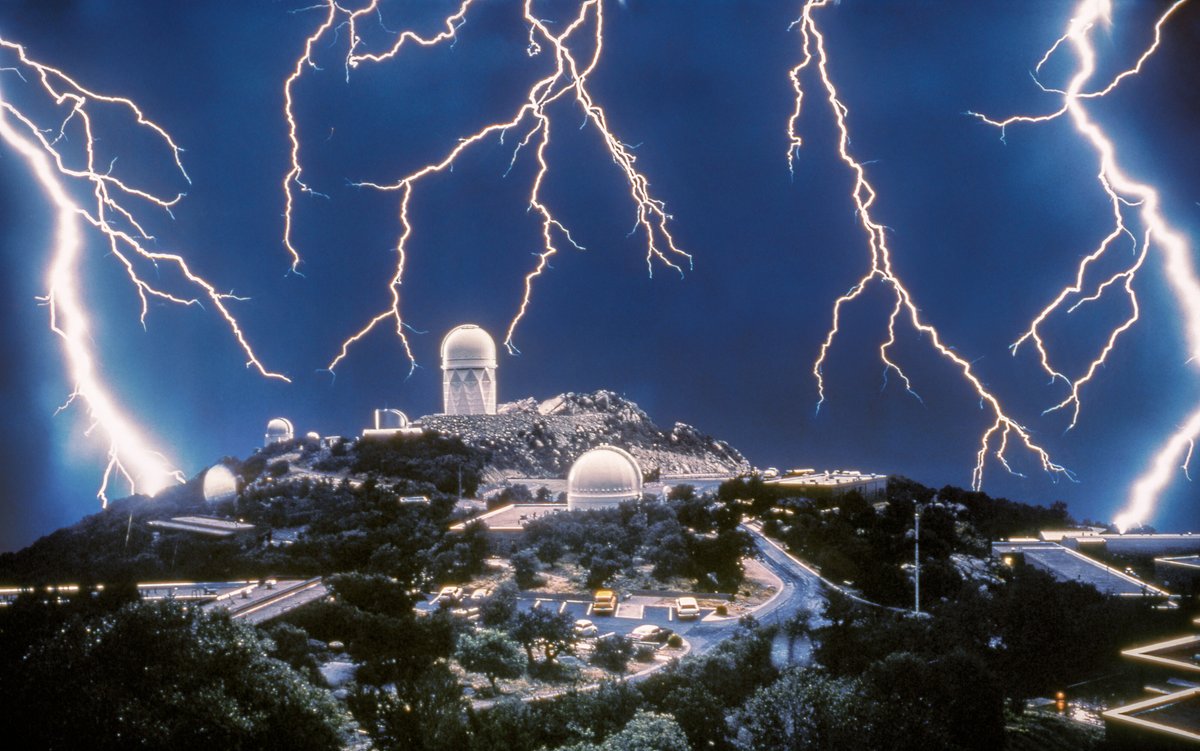
Happy Halloween! ⚡⚡
This eerie photo of @KittPeakNatObs, a Program of @NOIRLabastro was taken in 1972 during an Arizona summer storm. Among the telescopes lit by lightning strikes is the Nicholas U. Mayall 4-meter Telescope at the summit.
📷 Gary Ladd/KPNO/NOIRLab/NSF/AURA
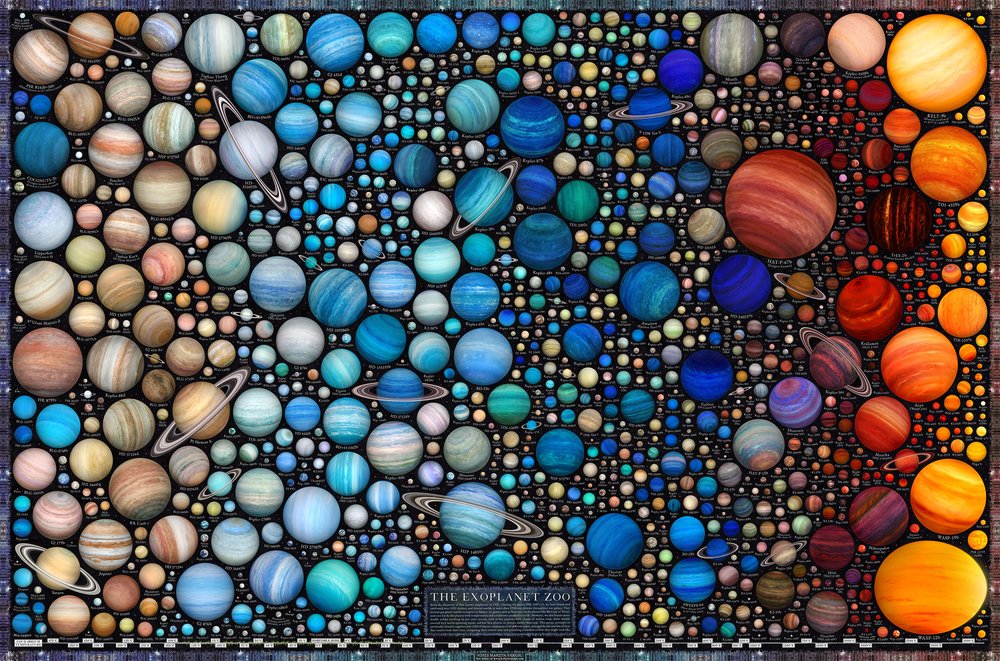
Artist @MartinVargic uses scientific data to create visualizations of hundreds of exoplanets, emphasizing the alien nature of these distant worlds.
His art explores the diversity of exoplanets, which range from Neptune-like ice worlds to scorching gas giants.
Vargic's work blends creativity with science, imagining planets based on data such as temperature and orbital characteristics, offering a visually rich take on worlds we can't directly observe.
His ongoing projects include expanding his exoplanet artwork and creating a "Scale of the Universe" poster. 💜 💙
See his work here: 👉 https://t.co/3911wRrgCj
Did you know #small galaxies orbit larger ones?🌌 As they lose energy, they can merge into a bigger #galaxy. Just before fading, they spread their #stars, creating beautiful ✨tidal streams✨
#tidalstreams#ARRAKIHS
Credit: David Martinez-Delgado (2024)
➡️https://t.co/VngbFmgLad
#ICYMI, we released 1% of the map our #DarkUniverse 🕵️ detective is working on.
Taken in just two weeks, the #ESAEuclid mosaic captures 100 million sources: stars & galaxies. Zoom in and be amazed every step of the way 👉 https://t.co/yyclhqi0ep
From @astrokat337: Stellar streams are exciting probes of galaxy evolution, and today’s authors are confident we’ll soon be able to find even more! 🔭✨️
https://t.co/0ZhUt0f1lJ
Fri, Sep 27, 2024
- Stellar Streams in the Local Universe
The twenty galaxies arrayed in these panels are part of an ambitious astronomical survey of tidal stellar streams. Each panel presents a composite view; a...
Read more at https://t.co/qd9fapZ2Ua