Introducing Genie 2, our latest protein design model! Genie 2 sets a new state of the art on key design metrics and supports motif scaffolding, including that of multiple motifs with undefined geometric relationships, a feature new to protein diffusion models. (1/5)
We love the excitement & results from the community on AlphaFold 3 and are doubling the AF Server daily job limit to 20. Happy to also share that we're working on releasing the AF3 model (incl weights) for academic use, which doesn’t depend on our research infra, within 6 months.
Glad to announce our new preprint with C. Hillar, D. Kragic, and @naturecomputes !
https://t.co/dFcfdwF503
We show via group theory how Fourier features emerge in invariant neural networks -- a step towards a mathematical understanding of representational universality. 🧵1/n
This new paper with Santosh Vempala gives a simple statistical justification for why and when Language Models *should* hallucinate using standard pretraining, even under ideal in-distribution training conditions. [1/7] https://t.co/jijRx3tbcN
In this work, we bring OrthoRep’s mutation rate up to 10^-4 substitutions per base, allowing us to durably hypermutate and evolve chosen genes in vivo at 1-million times the genomic mutation rate of the host yeast cell. What does this afford? https://t.co/5Cgn39jpax
1/n: We are excited to share that our paper on Chroma, a general purpose diffusion model for proteins, is out today in @Nature!
https://t.co/FwvQ15UaHc
A couple of my favorite highlights in the 🧵below 👇
Today we release Chroma, our generative model for protein design, open-source on Github with a Nature publication describing its biophysical and crystallographic validation. Chroma Conditioners enable one model to target multiple protein design objectives. https://t.co/u5P0c9b2wT
Are you looking to make your microscopy images pop? I've been working on an add-on to make loading tifs in @Blender more accessible!
With tif2blender, 3D animations of z-stacks are hopefully easier to make in open-source format.🌈
Try it at: https://t.co/yVO6paHyZe
Super excited to present #Blush and with it expand the applicability of cryo-EM. We reconstruct one of the smallest complexes ever with cryo-EM. A 40 kDa protein-RNA complex.
https://t.co/uaNn6RjVdX
But how do we make sure we’re not overfitting?
🧵1/4
Sharing an early preprint of my Microsoft AI4Science summer internship project. We developed SE(3) flow matching for protein backbone generation. Compared to SE(3) diffusion, we find our method achieves higher designability, faster sampling, with a way simpler implementation. 1/8
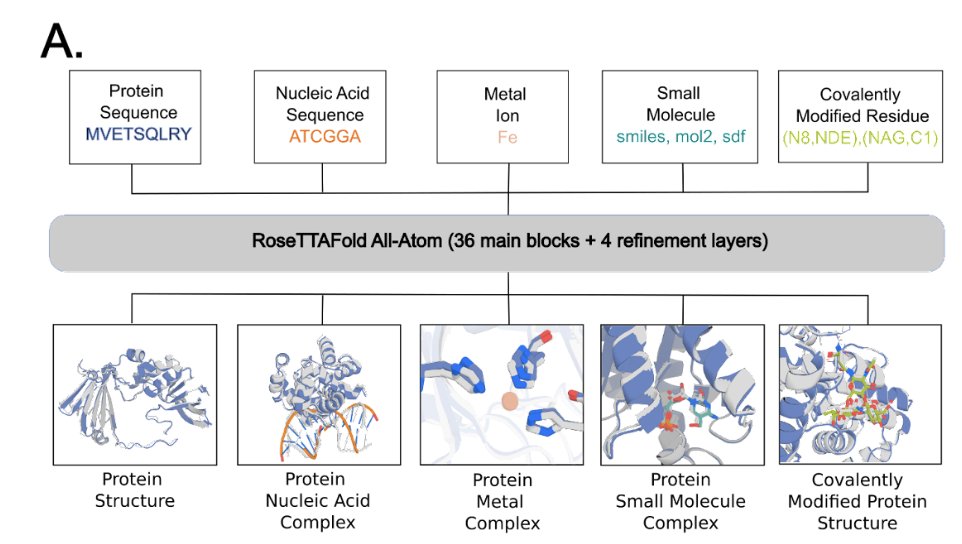
Very excited to share RoseTTAFold All-Atom and RFdiffusion All-Atom, methods for structure prediction and design of biomolecular assemblies! https://t.co/iG6rD0LHsi 1/n
RoseTTAFold updated to be All-Atom... biological assemblies containing proteins, nucleic acids, small molecules, metals, and covalent modifications ... and diffusion🤯https://t.co/36EtN0IzoL
We've added a lot more MSAs to OpenProteinSet since the original release last year and so we wrote up a standalone manuscript. To our knowledge, it's the largest and most accurate database of MSAs in the open. https://t.co/QtBkz1zq1c
Exciting news for the molecular dynamics community! 🧬 The Molecular Dynamics Data Bank aka MDDB is going to launch. 🚀 Here's what you need to know about this new European repository for molecular dynamics simulations data👇
#structuralbiology#moleculardynaimcs#drugdesign
We discovered a surprisingly easy way to control the brightness of fluorescent proteins via magnetic fields:
https://t.co/zxPPsd14zP
This raises fascinating scientific questions about the mechanism, and tantalizing technological opportunities for bioengineering.