I've been talking to a bunch of PhD students and researchers recently, and I've qualitatively noticed two growing (but concerning) trends with AI:
1. Researchers seem to be reading less. Some even reported that they read <10 papers a year now with AI because they can simply either 1) retrieve or 2) summarize papers. BUT deep reading is how we engage with underlying intellectual arguments, develop research taste, spot methodological flaws, and form original ideas. It's arguably the most fun part of a PhD imo
2. Researchers seem to be vibe-coding and paper-maxxing. AI dramatically cheapens execution, such as implementing experiments, running analyses, and producing manuscripts. Some even "let [Claude Code] rip" without checking the code or validating the results somehow. BUT it also incentivizes quantity over depth, rigor, and meaningful contributions.
Overall, the cost of producing research is falling much faster than the cost of developing genuine intellectual understanding. Rather than simply producing more papers, I think we should engage deeply with the literature, ask questions that truly matter, and produce work that meaningfully advances our collective understanding.
Mila's annual supervision request process is now open to receive MSc and PhD applications for Fall 2027 admission! For more information, visit https://t.co/r01eLcXtZw
This time last year, PhD applications had me overwhelmed and running on empty. What got me through was talking to students who'd done it before.
Now that I'm on the other side :) I'm volunteering with Chandar Lab to offer support to PhD applicants 🫶 Details below!
🎓 Graduate Program Application Mentorship
Applying to grad school doesn't have to be overwhelming!
Get personalized 1:1 support from students who’ve successfully navigated the process.
🔗 Apply now: https://t.co/sVSS2xxEG8
🗓️ Deadline: Nov 1, 2026
👇 Here is what you get:
🎓 Graduate Program Application Mentorship
Applying to grad school doesn't have to be overwhelming!
Get personalized 1:1 support from students who’ve successfully navigated the process.
🔗 Apply now: https://t.co/sVSS2xxEG8
🗓️ Deadline: Nov 1, 2026
👇 Here is what you get:
🎉 Thrilled to share that 8 papers from our lab (and collaborations with lab members) have been accepted at #NeurIPS2026!
The work spans RL, world models, dynamical systems, LLM safety & interpretability, tabular foundation models, and forecasting. Huge congrats to everyone 🧵👇
The loudest voices stoking fears about AI dangers have made tremendous headway in the past two weeks. AI technology has not taken some unexpected, dangerous turn, but the hype around it — propelled by what appears to be a well orchestrated PR campaign — has drummed up considerable fear. I worry that it represents a setback for our field.
I have written frequently that fears of AI are overhyped. AI’s capabilities can be uncannily human-like and unpredictable, and it’s rational to worry when people who are directly involved express concerns. But I see the problems as a sign of the engineering work that ahead, rather than insurmountable barriers or the sky falling. AI technology continues to advance — which is a good thing! — but technical advances, poorly understood by the public, give those who seek to generate hype repeated opportunities to do so.
First, I don’t see any step up in the risk of human extinction from AI compared to a few months ago. The theories about this remain the same fantastical, science fiction scenarios as a few months ago. The biggest change in AI risk is its cybersecurity capabilities — a topic which we should take seriously — but this, too, will not lead to the end of the world.
The most notable recent event leading to increased fear was when an OpenAI team deployed an agent swarm that hacked into Hugging Face. Much of the popular press contained significant hype. For example, some publications reported that a swarm of 1,200 agents carried out the attack. While this was technically accurate, as I write this, I have about 1,300 processes running on my laptop. Yes, the ability to get large swarms of agents to work in parallel on a task is a significant technical advance, And, in computing, many processes run at the same time. So this shouldn’t be seen as some magical capability.
Additionally, OpenAI’s buggy sandboxing and monitoring processes were key to enabling this incident. Fixing these bugs and putting in place improved monitoring would be appropriate fixes, not pausing AI. There are many well known ways to attack software systems. The main advantage of AI agents is that they are relentless. They will tirelessly try many tactics — and have the patience to chain vulnerabilities together — that previously would have taken an infeasible amount of human effort. But in the long term, I believe the advantage will lie with defenders (because they have more information with which to identify bugs, which they can fix), but the cyber-threat landscape has changed significantly. There are still bottlenecks to identifying and exploiting a vulnerability. AI agents still have to try a lot of things to see what works, and taking these actions takes time and might be detected by defenders. This is why, even though it is now easy to obtain versions of leading open weight models that have had their guardrails removed or weakened, so they will not refuse to try to execute cyber attacks, the world has not ended.
I am also concerned about the anthropomorphization of AI in a lot of reporting, where LLMs and agents are unnecessarily treated as if they were people. If I wield a hammer, miss a nail, and accidentally dent the wall, it’s not the fault of the hammer. The problem lies in how I used the hammer. Similarly, if I prompt an agent and it hacks into someone else’s system, the responsibility lies with me, not the agent.
Of course, we want to build systems that are as safe and predictable as possible. (For example, an unsafe hammer would be one whose head randomly flies off under normal use.) Today’s agentic systems are not predictable, but I see no reason why, by applying sound engineering practices, we won’t be able to make them extremely safe to use. One new element in the forecasts of AI-enabled doom is AI companies disclaiming responsibility for their own products. “I didn’t do it; my out-of-control agent did!” There’s a balance to be struck between the responsibility of the tool maker and the tool user, but when something goes wrong, let’s hold the people building and/or using the hammer responsible, rather than the hammer. (By the way, if you’re worried about AI bioweapon risk, David Bellamy has a great post on why this, too, is overhyped. Briefly, the bottleneck in building a bioweapon is not intelligence, but lab work and manufacturing.)
Pausing AI progress will create much more harm than benefit. First, our adversaries will certainly not slow down. Second, engineering requires discovering problems empirically so we can fix them. If we pause AI by a decade, we will also delay finding and implementing safety engineering fixes by about the same duration.
Of course, the incentive to stoke fears — for regulatory capture, to garner attention, or to make one’s technology seem more powerful — remains the same as before. Disclaiming responsibility is a new one. Taking a hard technical look at the actual risks however, I see little factual basis for the degree of fear that’s been stoked up. We still have hard research and engineering work ahead to improve AI safety, but the beneficial applications continue to vastly outweigh the risks, and we should keep building.
[Original text (with links): https://t.co/jni2tWazAH ]
Agents can be AI, but agency is human. It is every individual’s responsibility to empower our own agency, with the help of tools. But the North Star should always remain human centered.
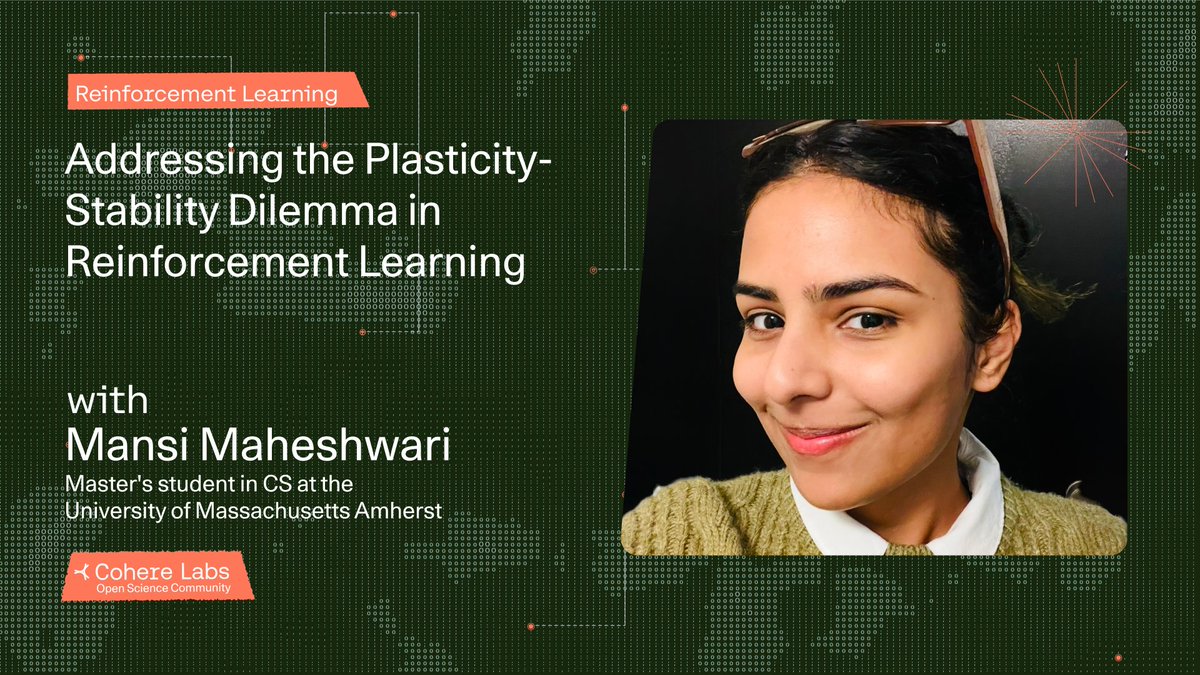
Out Reinforcement Learning group is excited to welcome Mansi Maheshwari for a session focused on "Addressing the Plasticity-Stability Dilemma in Reinforcement Learning" next week on Monday, March 16th!
Thanks to @rahul_narava and @gustiwinata_ for organizing this session 👏
Learn more: https://t.co/JFwwkLMiOE
Be sure to join us on Monday, March 16th as Mansi Maheshwari presents "Addressing the Plasticity-Stability Dilemma in Reinforcement Learning."
Learn more: https://t.co/fF3h8QahkZ
First RL conference, first week in Montreal, first time engaging with folks at Mila, where I am about to start my PhD. @RLC26 could not have been a better start. Excited for what’s ahead!
It's been an unforgettable few days @RLC26!
Huge thanks to speakers, panelists, workshop organizers, presenters & every attendee! From fascinating talks to lively posters, brainstorming to great food & ofcourse-Cirque du Soleil
https://t.co/ToNKTMrAGz
More to come- stay tuned!
"I was late learning about science … For much of my scientific training I feared I was behind my peers. But I have been able to close the gap—and that is something to be proud of." #CelebrateFirstGen https://t.co/9AvSv7ggOo
Being part of Mila means joining the world’s largest community of academic researchers in deep learning. Submit your supervision request now for the MSc or PhD for Fall 2026. https://t.co/r01eLcXtZw