I asked AI:
Who benefits financially if Europe brings in low/no income low educated non-culturally aligned welfare seekers from the third world?
"There are identifiable financial beneficiaries, and this is well-documented in immigration economics literature. Here's who actually profits:
1. Employers in low-wage sectors
- Construction, agriculture, food processing, cleaning, logistics
- Labor supply increase suppresses wages, boosting margins
- Reduces pressure to automate or improve conditions
2. Landlords & property owners
- Housing demand spikes in urban areas → rent increases
- Existing homeowners see property value appreciation
- Slum landlords and housing associations benefit most directly
3. Migration industry
- Lawyers, NGOs, translators, integration consultants
- This is a multi-billion euro industry in Germany, Sweden, Netherlands alone
- NGOs often receive per-head government funding — direct financial incentive to maximize intake
4. Retail & consumer goods
- Raw volume of consumers increases
- Governments often provide vouchers/cash that flows directly into consumption
5. Governments (short-term optics)
- GDP headline number goes up with population growth
- Politicians can claim “growth” while GDP per capita may stagnate or fall
Who Bears the Costs
- Native low-skilled workers — direct wage competition, most economically vulnerable
- Taxpayers — welfare, housing, education, healthcare, judicial costs
- Public service users — longer queues, diluted services
- Lower-middle class neighborhoods — concentrated social externalities
It’s essentially a privatization of gains, socialization of costs structure
Employers and landlords capture upside; diffuse taxpayer population absorbs downside. This is why mainstream economists who focus on aggregate GDP often support high immigration while working-class populations in receiving areas oppose it: they’re experiencing completely different economic realities.
George Borjas (Harvard) vs. Card/Peri debate covers this empirically in depth if you want the academic trail."
Finding myself going back to RSS/Atom feeds a lot more recently. There's a lot more higher quality longform and a lot less slop intended to provoke. Any product that happens to look a bit different today but that has fundamentally the same incentive structures will eventually converge to the same black hole at the center of gravity well.
We should bring back RSS - it's open, pervasive, hackable.
Download a client, e.g. NetNewsWire (or vibe code one)
Cold start: example of getting off the ground, here is a list of 92 RSS feeds of blogs that were most popular on HN in 2025:
https://t.co/dwAiIjlXet
Works great and you will lose a lot fewer brain cells.
I don't know, something has to change.
A few random notes from claude coding quite a bit last few weeks.
Coding workflow. Given the latest lift in LLM coding capability, like many others I rapidly went from about 80% manual+autocomplete coding and 20% agents in November to 80% agent coding and 20% edits+touchups in December. i.e. I really am mostly programming in English now, a bit sheepishly telling the LLM what code to write... in words. It hurts the ego a bit but the power to operate over software in large "code actions" is just too net useful, especially once you adapt to it, configure it, learn to use it, and wrap your head around what it can and cannot do. This is easily the biggest change to my basic coding workflow in ~2 decades of programming and it happened over the course of a few weeks. I'd expect something similar to be happening to well into double digit percent of engineers out there, while the awareness of it in the general population feels well into low single digit percent.
IDEs/agent swarms/fallability. Both the "no need for IDE anymore" hype and the "agent swarm" hype is imo too much for right now. The models definitely still make mistakes and if you have any code you actually care about I would watch them like a hawk, in a nice large IDE on the side. The mistakes have changed a lot - they are not simple syntax errors anymore, they are subtle conceptual errors that a slightly sloppy, hasty junior dev might do. The most common category is that the models make wrong assumptions on your behalf and just run along with them without checking. They also don't manage their confusion, they don't seek clarifications, they don't surface inconsistencies, they don't present tradeoffs, they don't push back when they should, and they are still a little too sycophantic. Things get better in plan mode, but there is some need for a lightweight inline plan mode. They also really like to overcomplicate code and APIs, they bloat abstractions, they don't clean up dead code after themselves, etc. They will implement an inefficient, bloated, brittle construction over 1000 lines of code and it's up to you to be like "umm couldn't you just do this instead?" and they will be like "of course!" and immediately cut it down to 100 lines. They still sometimes change/remove comments and code they don't like or don't sufficiently understand as side effects, even if it is orthogonal to the task at hand. All of this happens despite a few simple attempts to fix it via instructions in CLAUDE . md. Despite all these issues, it is still a net huge improvement and it's very difficult to imagine going back to manual coding. TLDR everyone has their developing flow, my current is a small few CC sessions on the left in ghostty windows/tabs and an IDE on the right for viewing the code + manual edits.
Tenacity. It's so interesting to watch an agent relentlessly work at something. They never get tired, they never get demoralized, they just keep going and trying things where a person would have given up long ago to fight another day. It's a "feel the AGI" moment to watch it struggle with something for a long time just to come out victorious 30 minutes later. You realize that stamina is a core bottleneck to work and that with LLMs in hand it has been dramatically increased.
Speedups. It's not clear how to measure the "speedup" of LLM assistance. Certainly I feel net way faster at what I was going to do, but the main effect is that I do a lot more than I was going to do because 1) I can code up all kinds of things that just wouldn't have been worth coding before and 2) I can approach code that I couldn't work on before because of knowledge/skill issue. So certainly it's speedup, but it's possibly a lot more an expansion.
Leverage. LLMs are exceptionally good at looping until they meet specific goals and this is where most of the "feel the AGI" magic is to be found. Don't tell it what to do, give it success criteria and watch it go. Get it to write tests first and then pass them. Put it in the loop with a browser MCP. Write the naive algorithm that is very likely correct first, then ask it to optimize it while preserving correctness. Change your approach from imperative to declarative to get the agents looping longer and gain leverage.
Fun. I didn't anticipate that with agents programming feels *more* fun because a lot of the fill in the blanks drudgery is removed and what remains is the creative part. I also feel less blocked/stuck (which is not fun) and I experience a lot more courage because there's almost always a way to work hand in hand with it to make some positive progress. I have seen the opposite sentiment from other people too; LLM coding will split up engineers based on those who primarily liked coding and those who primarily liked building.
Atrophy. I've already noticed that I am slowly starting to atrophy my ability to write code manually. Generation (writing code) and discrimination (reading code) are different capabilities in the brain. Largely due to all the little mostly syntactic details involved in programming, you can review code just fine even if you struggle to write it.
Slopacolypse. I am bracing for 2026 as the year of the slopacolypse across all of github, substack, arxiv, X/instagram, and generally all digital media. We're also going to see a lot more AI hype productivity theater (is that even possible?), on the side of actual, real improvements.
Questions. A few of the questions on my mind:
- What happens to the "10X engineer" - the ratio of productivity between the mean and the max engineer? It's quite possible that this grows *a lot*.
- Armed with LLMs, do generalists increasingly outperform specialists? LLMs are a lot better at fill in the blanks (the micro) than grand strategy (the macro).
- What does LLM coding feel like in the future? Is it like playing StarCraft? Playing Factorio? Playing music?
- How much of society is bottlenecked by digital knowledge work?
TLDR Where does this leave us? LLM agent capabilities (Claude & Codex especially) have crossed some kind of threshold of coherence around December 2025 and caused a phase shift in software engineering and closely related. The intelligence part suddenly feels quite a bit ahead of all the rest of it - integrations (tools, knowledge), the necessity for new organizational workflows, processes, diffusion more generally. 2026 is going to be a high energy year as the industry metabolizes the new capability.
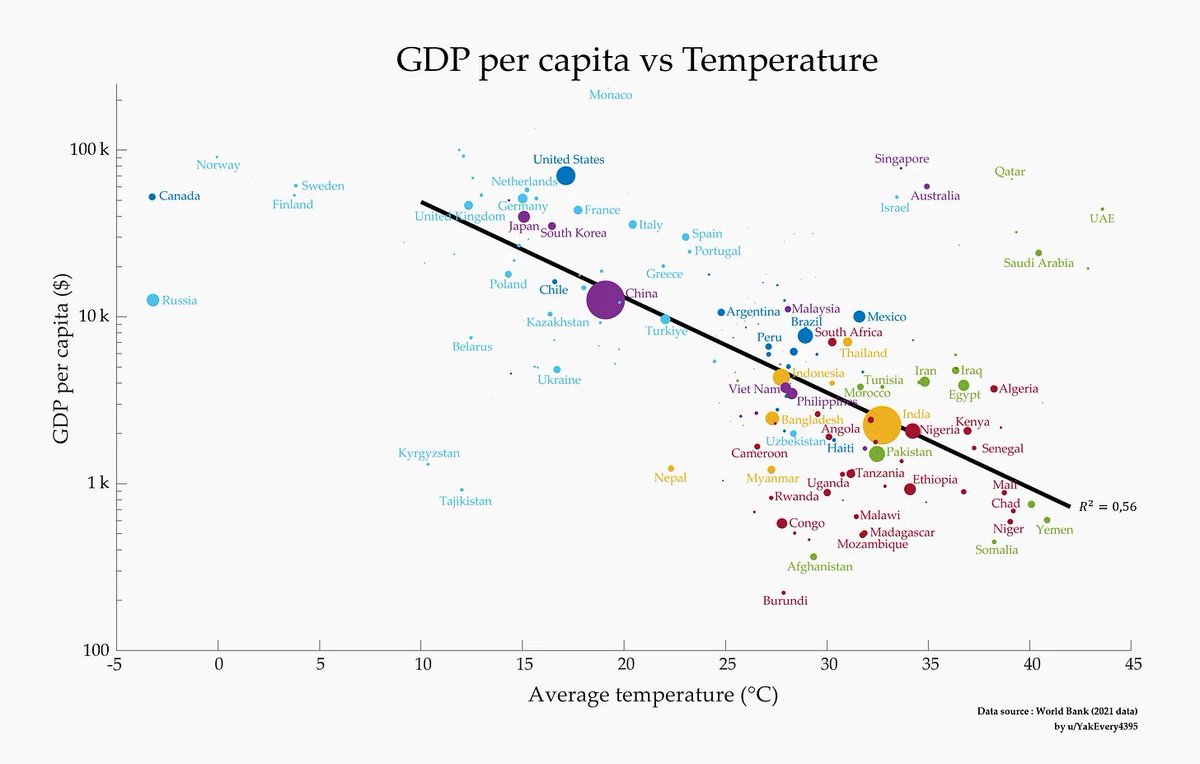
Think of all the most innovative cultures. What do they all have in common? Cold seasons.
You cannot afford to be lazy in a cold, seasonal climate:
- You can’t live impulsively. If you don’t stock food or plan winter shelter, you’re dead
- You must cooperate, or you’re dead
- You must delay gratification, or you’re dead
- You must create tools, preserve food and build storage systems, or you’re dead
Lazy, shortsighted behavior is punishable by death. Cognitive load increases and forward thinking becomes a selective breeding trait.
The closer to the equator you are, the less change there is. Resource abundance and constant climate mean no pressure to innovate, no long-term planning requirements. Warmth means comfort and comfort means complacency (biologically speaking).
Seasonal cognition is what led to the invention of calendars, agriculture and scheduling. The environmental force that paved the way for:
- Industrial revolutions
- Scientific method
- Modern infrastructure
Innovation thrives where the future is uncertain and immediate gratification is punished. Future orientation is an environmental phenomenon.
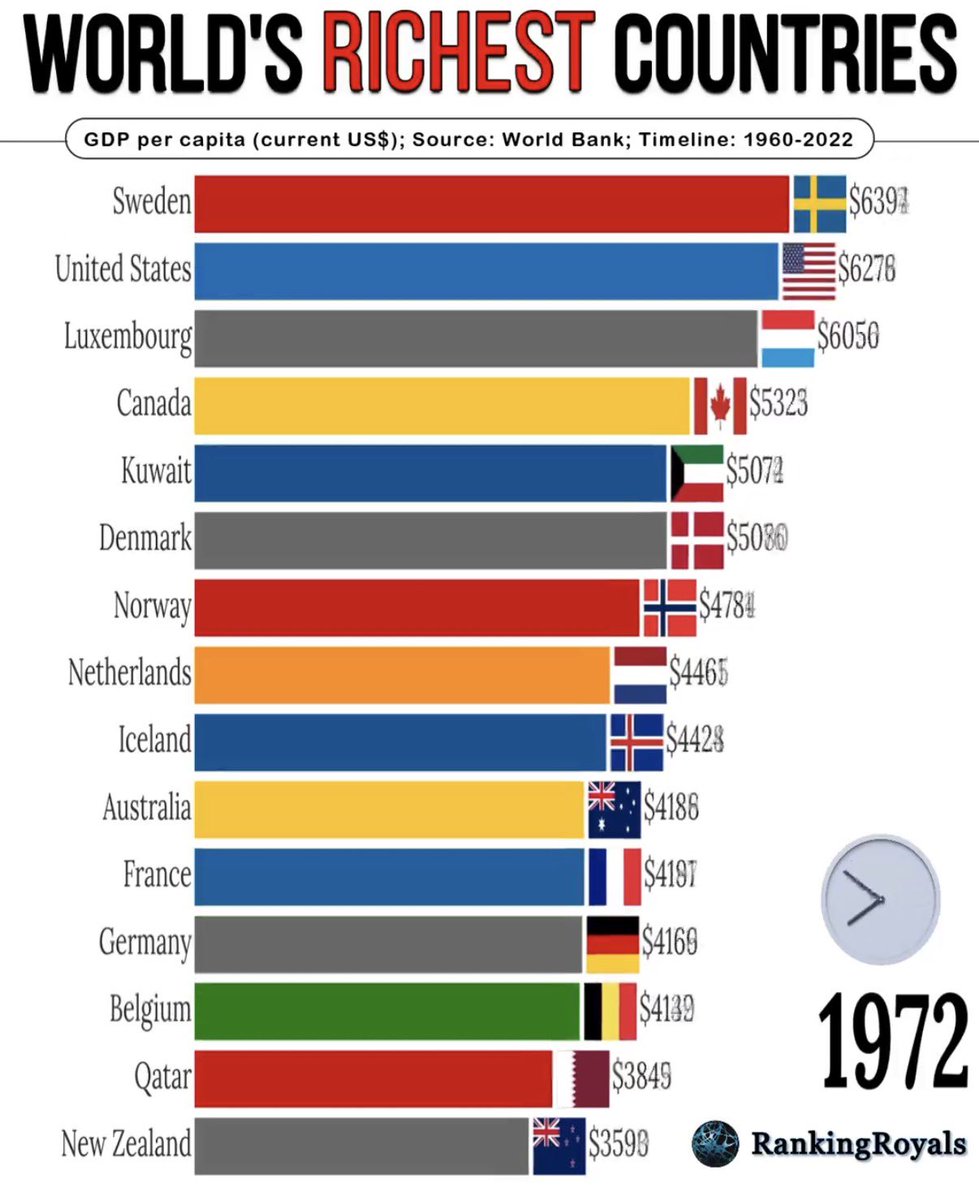
When I was born, Sweden was the richest country in the world.
Today I can’t live there.
Back then, Sweden was also the safest country in the world.
And we had the lowest child mortality.
It was a trust and honor based society.
Little enforcement was needed. I’ve never been tricked or scammed by a native Swede.
High tax yes, but with free healthcare, free school and free universities, all world class. Whether your dad was rich or poor, you had the same opportunity, same access to the best universities. Only real merit mattered for admission.
We had the most global companies in the world per person.
We dominated many global industries.
We even produced some of the best music and dominated several sports.
Quite a feat for a nation of then 8 million people.
Today I can’t realistically even live in Sweden - unless I want my house raided and my family assaulted by criminal gangs operating out of no-go zones in the suburbs of Stockholm.
Everyone’s home address is public, a remnant from the trust based era.
In one generation, the country has been destroyed, largely by one bad policy decision.
I’m not against immigration. I’ve lived in 10 countries. I’m the foreigner now. Immigration is not the problem.
Just look at the epic success of Singapore or Dubai. They literally made their success through immigration - merit based.
Or look at the CEOs of companies in Silicon Valley - many immigrants.
Sweden’s mistake is not doing *merit based* immigration, which means to qualify each person individually. It’s the opposite of racism.
- Doctor? Yes.
- Engineer? Yes.
- Pirate? No.
- Lost your police clearance in a boating accident? Also no.
Instead in Sweden we did the other way around.
- Qualified with all papers? Super difficult to get in.
- No papers at all? Awww.. Poor you. Let’s bring 100,000 of those, based on ethnicity.
But what about the human aspect? The compassion. Still makes no sense because with the money it costs to bring one failed integration case to Sweden, you can help 100 people in their home country through development projects. Helping 100 people is better than helping 1.
So what to do now? It’s difficult.
The criminals need to be locked up or thrown out. Every last one. Singapore and Dubai tolerate no crime. In El Salvador, Bukele sent 2,000 soldiers to arrest 2 people. What happens then? Suddenly the next criminal discovers a sudden passion for a new line of work.
In Sweden the police is filling out a form and adding it to the pile marked “no resources”.
Unfortunately I think Sweden needs to hit rock bottom before politicians are ready to embark on an El Salvador style clean-up.
It needs to become safe and attractive to be an entrepreneur in Sweden. Today it is not.
We need incentives attracting entrepreneurs, not pushing them away.
Sweden was a poor and rather miserable country in the 1800s. Many emigrated to Minnesota and other places for their children to not starve to death.
Then Sweden became a wealthy global mega success in the 1900s, thanks to great leadership and brave entrepreneurs.
Sweden can do that journey again but it will take real leadership - a Bukele moment of real change.
Good luck.
Eskiden özel okullar yoktu,hepimiz siyah önlük beyaz yaka ile aynı okula giderdik,kimin zengin kimin fakir olduğu bilinmez,böyle bir ayrım hiç birimizin aklına gelmezdi. Kaynaşmış bir millettik.Şimdi zengin özele fakir devlet okuluna gidiyor,çocuklukta ayrışmaya başlıyor toplum.
Only one European (well German of course) car in the world's best selling cars now
Not a single European company left in the leading tech companies anymore
Not a single European company left in the top AI companies
This is why Europe has zero negotiation power at the world stage, it's become irrelevant
Due to consistent anti-business overregulation by the European Commission most of the capital and talent has left
This period will be studied in history books as an example how a central government of half a billion Europeans was able to nuke its own economy in record speed
"I promise to not raise your taxes" and "I promise to not cut your benefits" are the two popular political promises that are inconsistent with the much more needed promise "I promise to cut the budget deficit to about 3 percent of GDP" that is required to prevent a big debt/dollar crisis. There is no way that the deficit/debt bomb problem can be sustainably dealt with unless there is a mix of tax revenue increases and spending decreases that are determined in a bipartisan way. Our representatives in Washington, DC, both Republicans and Democrats, know this is true. They understand the need to reduce the deficit by having those from both sides chip in a bit (e.g., a 4 percent increase in tax revenue and a 4 percent spending cut) which would lead to a supply/demand balance improvement for US debt which in turn would lower interest rates. Lower interest rates would help reduce the budget deficit as well as help the markets and the economy. But because politics have become so absolutist, they feel they can't go down this obviously best path because both their constituents and their parties will throw them out of office if they explored this more balanced approach. To me, that’s a tragedy.
A horrible @airindia crash today being the first 787 Dreamliner ever to have a fatal incident
Both the 787 and the 737 Max are part of the new "problem generation" of Boeing aircraft starting around the mid-2000s
Like the 737 Max, the Dreamliner had lots of manufacturing/safety issues but at least until today it never crashed
We have to wait for the investigation to make any conclusions why though
This crash puts the 787 Dreamliner near the bottom of airplane models in fatality odds though, positioning it next to the ATR 42/72, the plane that fell from the sky in Brazil last year
I personally solely fly Airbus planes:
- Airbus A318/A319/A320/A321 Classic or Neo
- Airbus A350
- Airbus A340
- Airbus A380
Or Boeing models but ONLY from before the mid-2000s:
- Boeing 737NG
- Boeing 747-400
- Boeing 777
- Boeing 717
All of these have great safety records
The 737 Max and 787 Dreamliner do not
I track all of these on my sites ✈️ Airline List dot com
P.S. I am NOT suicidal
The abdication of sovereignty by European countries on the topic of asylum and immigration is a historic relic unfit for the reality of today. It won't last.
GERMANY: EU regulators think it is too dangerous to simply break a bottle across the bow of a new ship, instead they insist on the use of this contraption. This is why the EU is failing. This is Economy Minister Habeck flailing.
No, we need a federal union of Europe
We can't compete as tiny single nations with big geopolitical forces like US and China
The problem is that the pragmatic
people in Europe who want to build are now on the right, but they're the same people who are against the EU
Meanwhile the left in Europe is pro-EU but they're fully infilitrated by climate change obsessed degrowthers who literally want commit economical suicide
You don't have many pro-EU capitalists in Europe which is exactly what you need to compete globally
@euaccofficial