Remember: Gauss's Law states that the total net electric flux passing through any closed surface is equal to the net enclosed electric charge divided by the permittivity of free space.
“Every living being is an engine geared to the wheelwork of the universe. Though seemingly affected only by its immediate surrounding, the sphere of external influence extends to infinite distance.”
— Nikola Tesla
A robot that starts flat and builds itself.
I find this fascinating, but probably not for the obvious reason.
The interesting part isn't simply that researchers can make a machine fold itself into a functional form. It's that we're beginning to design machines where transformation is part of the product, rather than something that has to happen in a factory before the product reaches us.
That changes the economics of physical technology.
For most of industrial history, manufacturing and deployment have been separate stages. We build something in one place, transport its finished form somewhere else, and then put it to work.
Self-assembling machines challenge that assumption because the thing you transport no longer has to look anything like the thing you eventually use.
I think that's the bigger idea hiding inside this tiny robot.
Imagine emergency equipment that travels flat and assembles where it is needed, machines that enter spaces their final shape could never fit through, or eventually devices whose assembly happens at the point of use rather than the point of manufacture.
We've spent decades asking how to make robots smaller.
Perhaps the more interesting question is whether they need to arrive as robots at all.
Where do you think self-assembling machines could have the biggest impact?
#Robotics #FutureOfManufacturing #AutonomousSystems #AITransformation
The Law of Large Numbers
Source for infographic: https://t.co/ngyYakLw82
NOTE: Reversion To The Mean and the Law of Large Numbers are closely related and often confused, but they describe different statistical concepts. The law of large numbers states that a sample mean converges to the true population mean as sample size increases, while reversion to the mean states that sequential measurements of some quantity can provide a better estimate of the typical value of that measured quantity as compared to a single measurement.
#Statistics #Mathematics
"Introduction to Machine Learning" is another freely available textbook (600 pages) that presents machine learning with a strong mathematical foundation.
The book begins with the mathematical background needed throughout the text, including linear algebra, calculus, probability, matrix analysis, and optimization. It then covers the main methods of supervised learning, such as linear and logistic regression, nearest-neighbor methods, decision trees, random forests, boosting, and neural networks.
A large part is also devoted to probabilistic and generative methods, with Monte Carlo sampling, graphical models, Bayesian networks, variational methods, normalizing flows, VAEs, and GANs. The final chapters include clustering, PCA, manifold learning, and generalization bounds.
I think it is an excellent reference if you want a broad view of machine learning along with the mathematics behind the main methods, without treating them as black boxes.
https://t.co/0VrDtRKUMx
No matter how the curve snakes from (p, r) to (q, s), the blue region plus the green region is locked at qs − pr.
That single geometric fact forces
∫r^s u dv + ∫_p^q v du = uv |{(p,r)}^{(q,s)}
Parametrize by x with u = f(x), v = g(x).
The identity becomes the product rule run backwards:
∫_a^b f g' dx = [f g]_a^b − ∫_a^b g f' dx
Finite-element codes for elastic solids rely on exactly this shift: derivatives move onto the known shape functions so the stiffness matrix is assembled from boundary integrals alone.
Which other classical identity gains the most from being drawn as pure area?
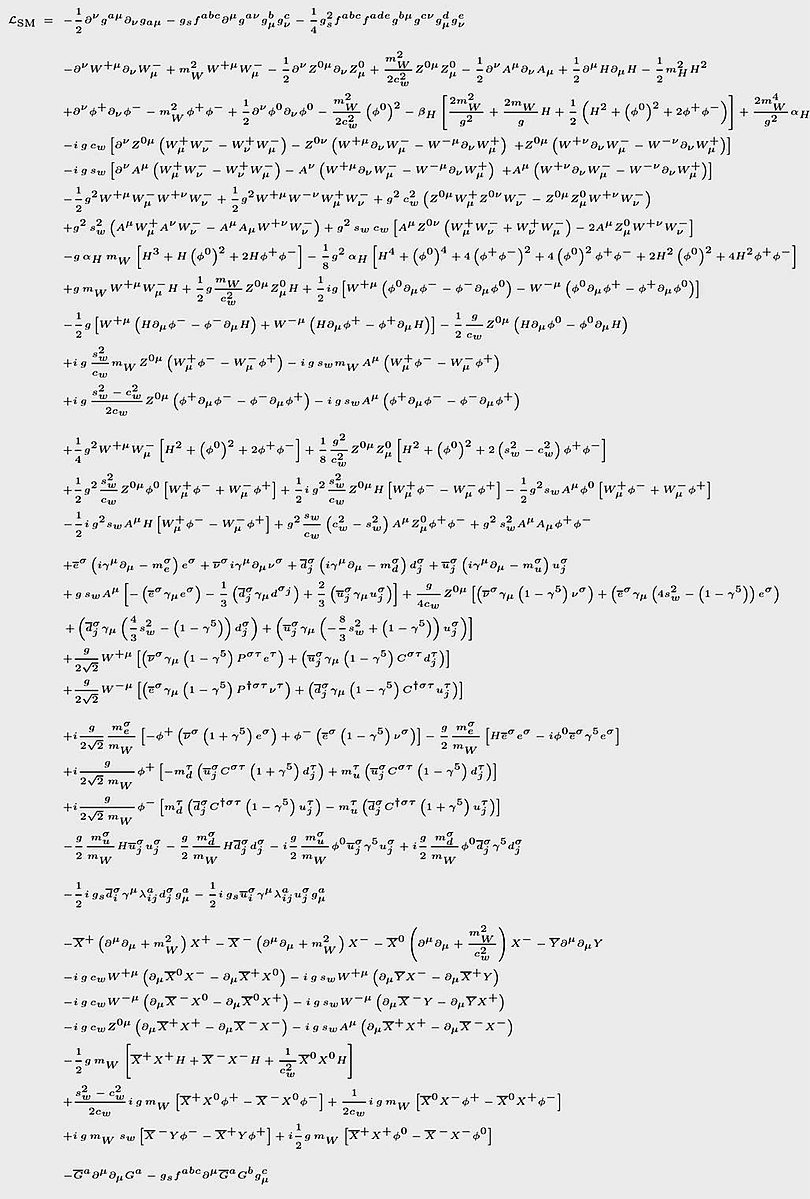
The Longest Equation in Physics
The model Lagrangian is a mathematical expression that summarizes the Standard Model of particle physics, which is the most successful theory of the fundamental interactions between elementary particles. It is composed of four different parts, each describing a different aspect of the Standard Model.
The model Lagrangian is written in a compact notation that uses symbols and operators from quantum field theory, such as covariant derivatives, field strength tensors, Dirac matrices, and gauge group generators. It also uses various constants and parameters that are determined by experiments, such as coupling constants, masses, and mixing angles.
It is one of the longest equations in physics because it contains many terms and factors that account for all the possible interactions and symmetries of the Standard Model.
It was transcribed by Thomas Gutierrez who derived it from Martinus Veltman's
Diagrammatica: The Path to Feynman Diagrams.
Black holes aren't completely black.
Stephen Hawking predicted that black holes emit a tiny amount of thermal radiation due to quantum effects near the event horizon. This phenomenon is known as Hawking radiation.
Tₕ = (ħc³) / (8πGMkᵦ)
Where:
• Tₕ = Hawking temperature
• ħ = Reduced Planck constant
• c = Speed of light
• G = Gravitational constant
• M = Black hole mass
• kᵦ = Boltzmann constant
The equation shows that a black hole's temperature is inversely proportional to its mass. More massive black holes are colder, while smaller black holes are hotter and emit more radiation.
As energy escapes through Hawking radiation, the black hole gradually loses mass. Over incredibly long timescales, it can eventually evaporate completely, linking quantum mechanics, gravity, and thermodynamics in one of physics' most profound predictions.
🎉 We’ve officially reached 30K followers on X!
Thank you Survivors for every follow, like and comment. Your support keeps our wasteland community growing stronger every day! ⚔️🔥
Next stop: 40K!
===========================
Join us on Discord: https://t.co/fDwolKxyk0
Follow us on Facebook: https://t.co/E2GAuTULo2
#darkwar
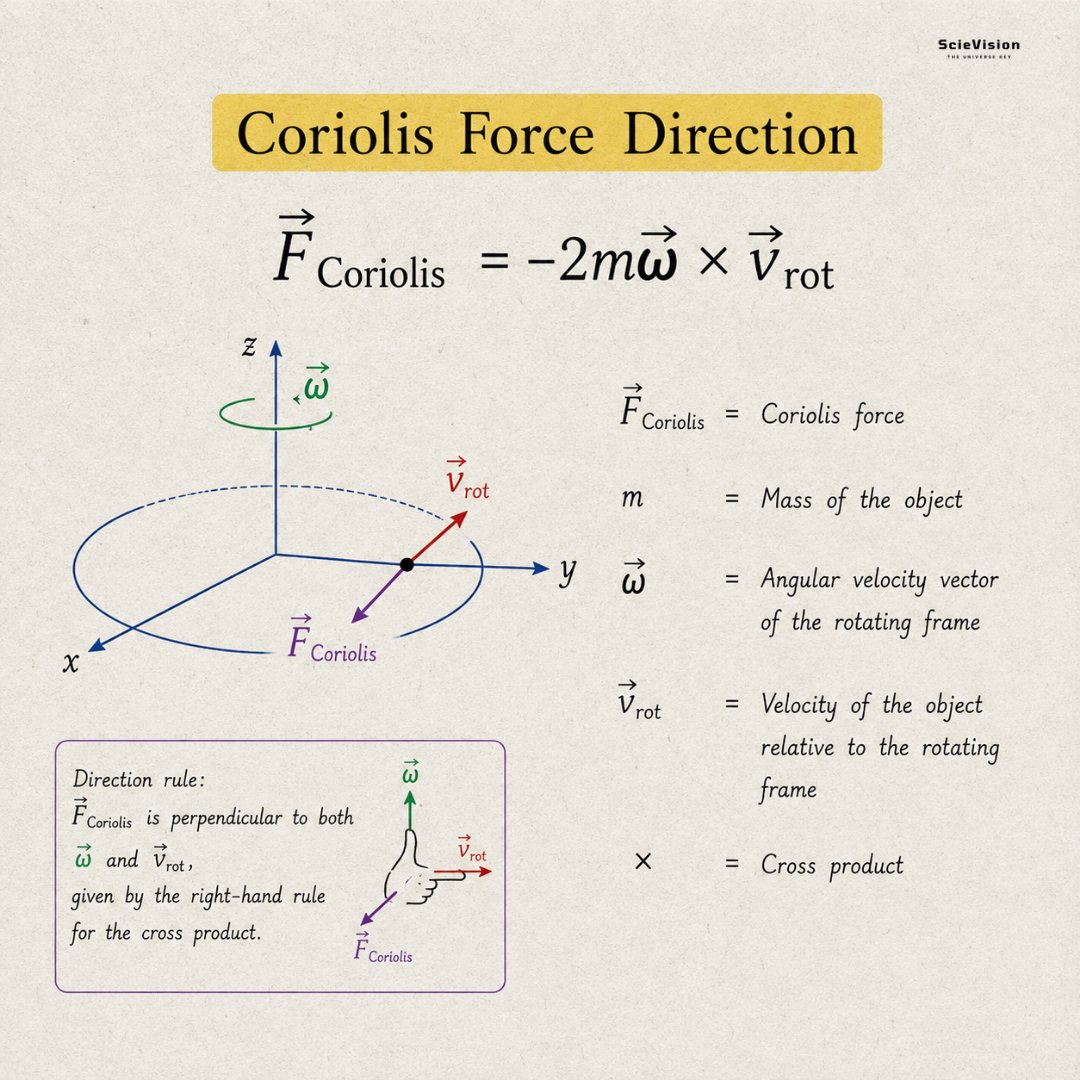
The Coriolis Force ✍️
Imagine standing on a giant spinning merry-go-round and throwing a ball straight at your friend sitting across from you. The ball curves away and misses completely, even though you threw it perfectly straight. Someone standing on the ground, watching from outside, sees the ball travel in a perfectly straight line. Nobody pushed it sideways. The platform simply rotated beneath the ball while it was moving, making the path look curved to everyone on the spinning surface. That curving effect is exactly the Coriolis force. It is not a real push between physical objects. It is an apparent force that occurs because the observer is inside a rotating system. Earth is that spinning platform for all of us.
The direction the Coriolis force pushes is what makes it fascinating. It never pushes an object forward or backward along its path. It never speeds anything up or slows anything down. It always pushes purely sideways at a perfect right angle to the direction the object is moving. Since the push is always sideways, the object sweeps out a curved path while roughly maintaining the same speed. Think of a car turning a corner, where the road pushes the tires sideways, curving the car without changing how fast the engine runs. The Coriolis force does exactly that to moving objects on Earth, continuously nudging them sideways so their path bends into a curve.
The effect works differently depending on which half of Earth you are on. In the Northern Hemisphere, everything moving horizontally gets pushed to its right. Winds curling into a storm system get deflected right, causing the entire storm to spin counterclockwise when viewed from above. This is why every hurricane in the Northern Hemisphere spins counterclockwise without exception. In the Southern Hemisphere, the geometry is completely reversed, and everything gets pushed to its left instead. This is why every cyclone there spins clockwise. At the equator, the effect almost disappears, which is why large spinning storms rarely form near the equatorial region.
The strength of the force depends on three things. A heavier object gets deflected more strongly. A faster spinning system produces a stronger effect. And a faster moving object gets deflected more than a slow one. For everyday objects moving at normal speeds, the Coriolis force is so tiny that it is completely overshadowed by everything else around it. You do not notice it while walking across a room or throwing a ball in your backyard. But for massive weather systems spanning thousands of kilometers, ocean currents crossing entire ocean basins, and missiles or artillery shells traveling at high speeds over long distances, it becomes the dominant force shaping the entire path and pattern of motion across our spinning planet.

















![mathemetica's tweet photo. No matter how the curve snakes from (p, r) to (q, s), the blue region plus the green region is locked at qs − pr.
That single geometric fact forces
∫r^s u dv + ∫_p^q v du = uv |{(p,r)}^{(q,s)}
Parametrize by x with u = f(x), v = g(x).
The identity becomes the product rule run backwards:
∫_a^b f g' dx = [f g]_a^b − ∫_a^b g f' dx
Finite-element codes for elastic solids rely on exactly this shift: derivatives move onto the known shape functions so the stiffness matrix is assembled from boundary integrals alone.
Which other classical identity gains the most from being drawn as pure area?](https://pbs.twimg.com/media/HPDlOhdaUAEcsty.jpg)