Jensen Huang built the world's most valuable chip company and is telling the next generation of programmers prompt engineering is the future:
"Why program in Python? So weird."
"The first time I talk to the computer, I'm just speaking in plain English."
"English, by the way, human, it's the best programming language of the future."
"How do you make a computer do what you want it to do? How do you fine tune the instructions with that computer? That's called prompt engineering. There's an artistry to that."
PS. If you found value in this post make sure to like and repost this tweet + follow @uncover_ai to stay updated with the latest AI news.
See you in the next one:
The distance between Makkah and Madinah is about 450 km. That means if you were driving at a continuous speed of 80 km per hour, you would arrive in approximately 5 hours.
Imagine, O believer, that the Messenger of Allah ﷺ traveled half of this distance riding on camels and half of it walking on his own feet, for eight days, accompanied by Abū Bakr aṣ-Ṣiddīq رضي الله عنه, in extremely hot days and very cold nights.
Our Prophet ﷺ carried his belongings and burdens that even mountains could not bear, after leaving his home in haste under the cover of darkness, fleeing with his religion from Quraysh, who had firmly resolved to eliminate him ﷺ.
Why all this hardship, exhaustion, and suffering?
All of this was so that this religion might prevail, that the universe might be illuminated with the light of truth, pushing away the darkness of ignorance and jāhiliyyah, and so that believers might live in the light of faith.
May my soul and my family be sacrificed for you, O Messenger of Allah.
O Allah, send prayers and peace upon our master Muhammad.🤲
🚨Anthropic just showed a 24-minute workshop on how to actually write prompts for Claude.
Taught by the people who built it.
Free. No registration. No paywall.
I've seen $300 courses that don't cover what they teach in the first 8 minutes.
Watch it and bookmark it now!
Scientists mapped a piece of brain the size of half a grain of rice.
One-millionth the size of the human brain.
It took them a year and over 1.4 million gigabytes to scan it.
They found over 57,000 cells, 150 million synapses, and even some new structures they didn't know existed.
Mapping the entire human brain in this level of detail would require all the data storage generated on Earth in a year + a 140-acre data center.
But the human brain itself can hold up to ~2.5 million gigabytes of information - enough for ~3 million hours of HD video or 342 years of continuous viewing.
It can process roughly 10 quadrillion calculations per second - enough processing power to run over 4,000 high-end gaming PCs all operating at peak ability.
And it only runs on the amount of power needed for a single dim light bulb.
No technology even comes close to doing what the brain can do.
The more we learn about biology, the more complex it becomes.
This is God's Glory on display.
200 yıllık biyoloji kitabı bir hafta sonunda öldü.
birisi oturmuş, hücreleri 3d gezdiğin bir app yapmış. video oyunu gibi. nöronu döndürüyorsun, aksonun içine giriyorsun, organeli tek tek ayıklıyorsun.
> arayüz: gpt image 2
> kod: gemini 3.5 flash
iki model. bir hafta sonu. matbaanın 1450'den beri yapamadığı şey.
birkaç yıla okullarda standart bu olacak. bizimkiler hala "tablet mi defter mi" tartışıyor.
oğlum çocuk hücreyi elinde çeviriyor artık. sen neredesin?
Mr. Bezos: Let's have that debate.
Under my 5% billionaires wealth tax, we'd:
-Give $12K to a working family of 4
-Expand Medicare for dental, vision, hearing
-Guarantee universal childcare
-Raise starting teacher pay to $60K
And you'd still be worth $269 billion after taxes.
@sholard_mancity Your post is admirable for promoting 'inclusivity'. But don't forget that Kenya is a country full of anti-intellectual nerds who have no time to build unicorns. So Ruto cannot move with scientists and tech giants because we have few of the former and none of the latter.
Build LLMs from Scratch 🚀
Found this gem from Vizuara, a 43-lecture series that actually delivers on its promise: building Large Language Models from the ground up.
What's inside:
→ Transformer architecture
→ GPT internals
→ Tokenization (BPE)
→ Attention mechanisms
→ Complete Python implementations
Perfect for ML engineers and developers who want to understand what's really happening under the hood of ChatGPT, Claude, and similar models.
🔗 [Playlist link in comments]
Watch. Practice. Learn
In 1948, a 32-year-old at Bell Labs published a paper nobody fully understood.
Engineers found it too mathematical. Mathematicians found it too engineering-focused. One prominent mathematician reviewed it negatively.
That paper - "A Mathematical Theory of Communication", became the founding document of the digital age.
The man was Claude Shannon. Father of Information Theory.
At 21, he wrote the most important master's thesis of the 20th century.
Working at MIT on an early mechanical computer, Shannon noticed its relay switches had exactly two states - open or closed. He had just taken a philosophy course introducing Boolean algebra, which also operated on two values: true and false.
Nobody had ever connected these two things.
His 1937 thesis proved that Boolean algebra and electrical circuits are mathematically identical, and that any logical operation could be built from simple switches.
Howard Gardner called it "possibly the most important, and also the most famous, master's thesis of the century."
Every digital computer ever built traces back to this insight.
At 29, he proved that perfect encryption exists.
During WWII, Shannon worked on classified cryptography at Bell Labs. His work contributed to SIGSALY, the secure voice system used for confidential communications between Roosevelt and Churchill.
In a classified 1945 memorandum, he mathematically proved the one-time pad provides perfect secrecy, unbreakable not just computationally, but provably, permanently, against an adversary with infinite power.
When declassified in 1949, it transformed cryptography from an art into a science. It laid the foundations for DES, AES, and every modern encryption standard.
At 32, he defined what information is.
His 1948 paper introduced one equation:
H = −Σ p(x) log p(x)
Shannon entropy. The average uncertainty in a probability distribution. The minimum bits required to encode a message.
Three things followed:
> He defined the bit - the fundamental unit of all information. His colleague John Tukey coined the name.
> He proved the channel capacity theorem, every communication channel has a maximum rate of reliable transmission. You can approach it. You can never exceed it.
> He unified telegraph, telephone, and radio into a single mathematical framework for the first time.
Robert Lucky of Bell Labs called it the greatest work "in the annals of technological thought."
Where his equation lives in AI today:
Cross-entropy loss - the function training every classifier and language model, is derived directly from H. Decision tree splits use information gain, which is H applied to data. Perplexity, the standard LLM evaluation metric, is an exponentiation of cross-entropy.
Every time a neural network trains, Shannon's formula runs inside it.
He also built the first AI learning device.
In 1950, Shannon built Theseus, a mechanical mouse that navigated a maze through trial and error, learned the correct path, and repeated it perfectly. Mazin Gilbert of Bell Labs said: "Theseus inspired the whole field of AI."
That same year he published the first paper on programming a computer to play chess. He co-organized the 1956 Dartmouth Workshop, the founding event of AI as a field.
The man:
He rode a unicycle through Bell Labs hallways while juggling. He built a flame-throwing trumpet, a rocket-powered Frisbee, and Styrofoam shoes to walk on the lake behind his house.
He called his home Entropy House.
When asked what motivated him: "I was motivated by curiosity. Never by the desire for financial gain. I just wondered how things were put together."
In 1985, he appeared unexpectedly at a conference in Brighton. The crowd mobbed him for autographs. Persuaded to speak at the banquet, he talked briefly, then pulled three balls from his pockets and juggled instead.
One engineer said: "It was as if Newton had showed up at a physics conference."
He died in 2001 after a decade with Alzheimer's, the cruel irony of information slowly leaving the mind of the man who defined what information was.
Claude, the AI model, is named after Claude Shannon, the mathematician who laid the foundation for the digital world we rely on today.
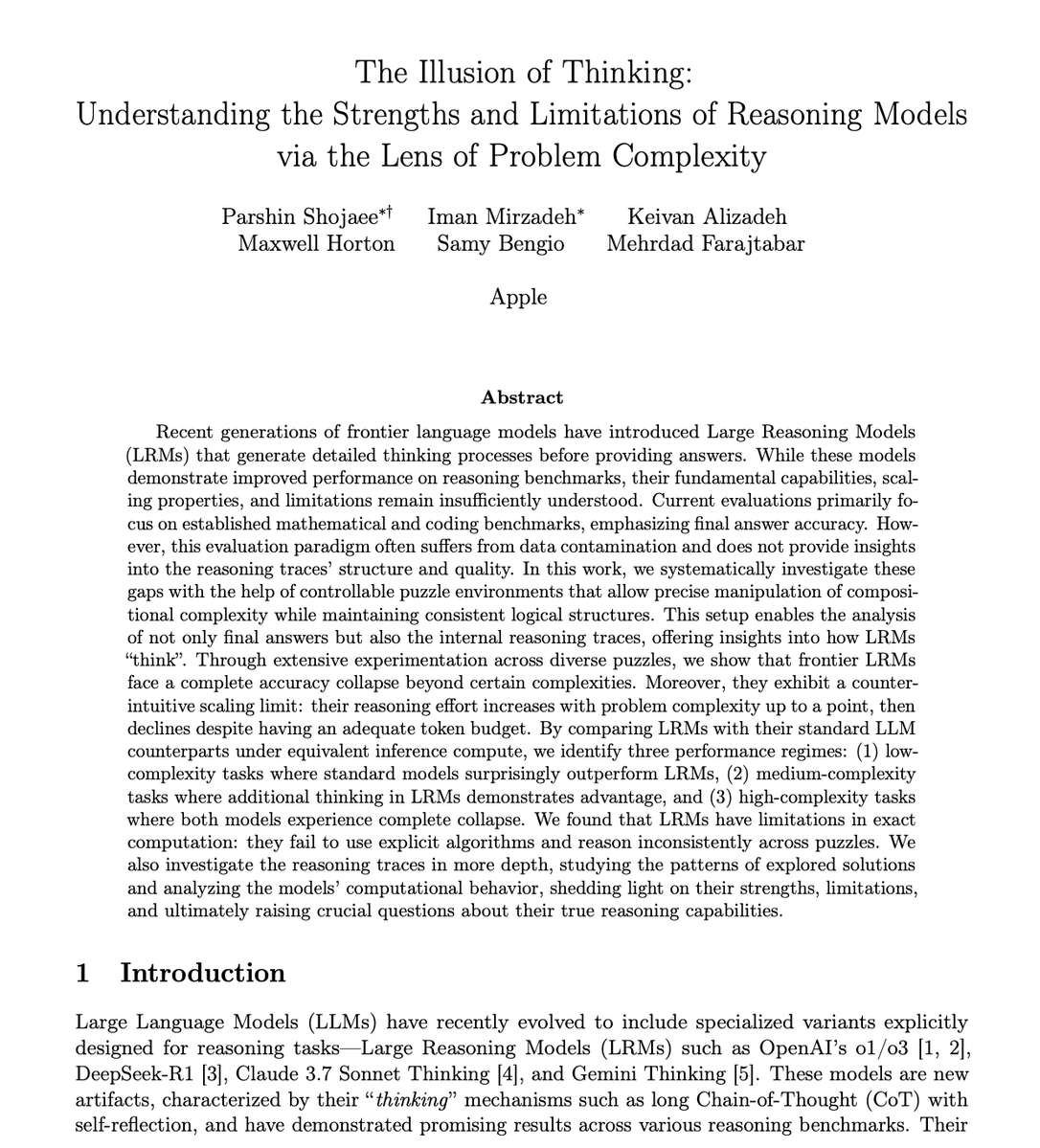
I can't help but realize that a majority of humans also have an illusion of thinking. Add that to the other cognitive bias of the illusion of control. It's our unconscious that does all the heavy lifting, and it's forged through habits. The argument that habits are the same as thinking should strike one as strange. But that is what it is!
One day, we will be able to simulate a complete human brain inside a computer.
When that day comes, the question of 'life' and 'consciousness' will have to be redefined from scratch.
— Henry Markram
We were taught the derivative as a formula to memorise.
A definition to recite.
A rule to apply.
Something that "gives you the slope."
But nobody told us what the formula was actually saying.
Every symbol is a sentence.
Every fraction is a question.
Every limit is a story about getting closer and closer to something you can never quite touch.
The top of the fraction?
That's a change. A difference. A before and after.
The bottom?
That's how long you waited to see it.
The limit?
That's you, zooming in, refusing to settle for an approximation - chasing the truth all the way down to an interval so small it almost disappears.
Put it all together, and you get the most honest question in calculus:
How fast is something changing - right now, in this exact instant?
Not on average.
Not over a minute.
Not eventually.
Right now.
That's it.
That's the derivative.
It's not a trick. It's not a rule. It's a beautifully precise way of asking a very human question: what's happening, in this moment?
We spent years solving these. Maybe it's time we actually understood them.





![techNmak's tweet photo. Build LLMs from Scratch 🚀
Found this gem from Vizuara, a 43-lecture series that actually delivers on its promise: building Large Language Models from the ground up.
What's inside:
→ Transformer architecture
→ GPT internals
→ Tokenization (BPE)
→ Attention mechanisms
→ Complete Python implementations
Perfect for ML engineers and developers who want to understand what's really happening under the hood of ChatGPT, Claude, and similar models.
🔗 [Playlist link in comments]
Watch. Practice. Learn](https://pbs.twimg.com/media/HI6NV38boAA0At-.jpg)