Terence Tao opens this interview describing how Kepler brute-forced planetary laws from Brahe's dataset. Tried random relationships for 20 years until one fit.
Now imagine millions of AI mathematicians doing the same with observations of human behavior. Formalizing what's easy to observe but tedious to capture.
That's where I think mathematical superintelligence actually leads: https://t.co/sqms1RbdH7
The Terence Tao episode.
We begin with the absolutely ingenious and surprising way in which Kepler discovered the laws of planetary motion.
People sometimes say that AI will make especially fast progress at scientific discovery because of tight verification loops.
But the story of how we discovered the shape of our solar system shows how the verification loop for correct ideas can be decades (or even millennia) long.
During this time, what we know today as the better theory can often actually make worse predictions (Copernicus's model of circular orbits around the sun was actually less accurate than Ptolemy's geocentric model).
And the reasons it survives this epistemic hell is some mixture of judgment and heuristics that we don’t even understand well enough to actually articulate, much less codify into an RL loop.
Hope you enjoy!
0:00:00 – Kepler was a high temperature LLM
0:11:44 – How would we know if there’s a new unifying concept within heaps of AI slop?
0:26:10 – The deductive overhang
0:30:31 – Selection bias in reported AI discoveries
0:46:43 – AI makes papers richer and broader, but not deeper
0:53:00 – If AI solves a problem, can humans get understanding out of it?
0:59:20 – We need a semi-formal language for the way that scientists actually talk to each other
1:09:48 – How Terry uses his time
1:17:05 – Human-AI hybrids will dominate math for a lot longer
Look up Dwarkesh Podcast on YouTube, Apple Podcasts, or Spotify.
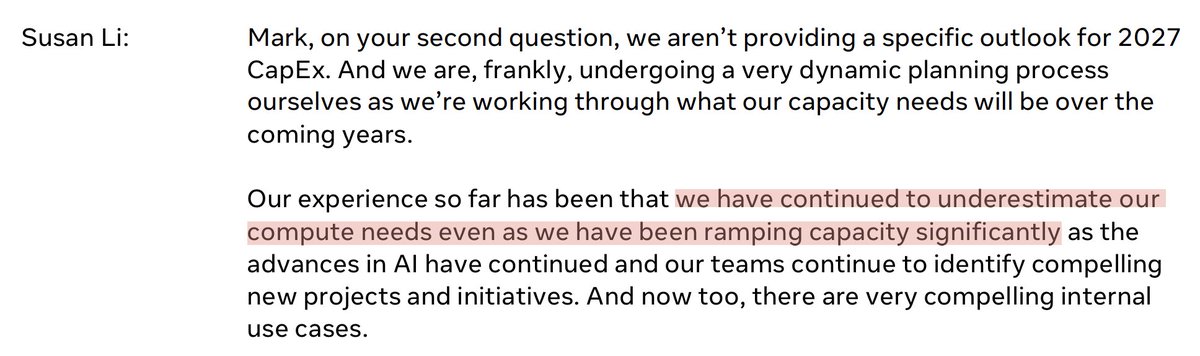
@ShanuMathew93 I arrived at a similar conclusion. Susan Li is pretty smart when it comes to planning. They're likely rotating their internal compute usage to external model providers that are subsidizing their models while benefiting from selling their own bare metal compute at a higher price
@edgefills Not to mention the risk of angering the Knicks mob - god forbid the people at the bar peek at the trade you put on. You may have come out with a Game 5 ticket but at what cost!
https://t.co/MV8xJr219G
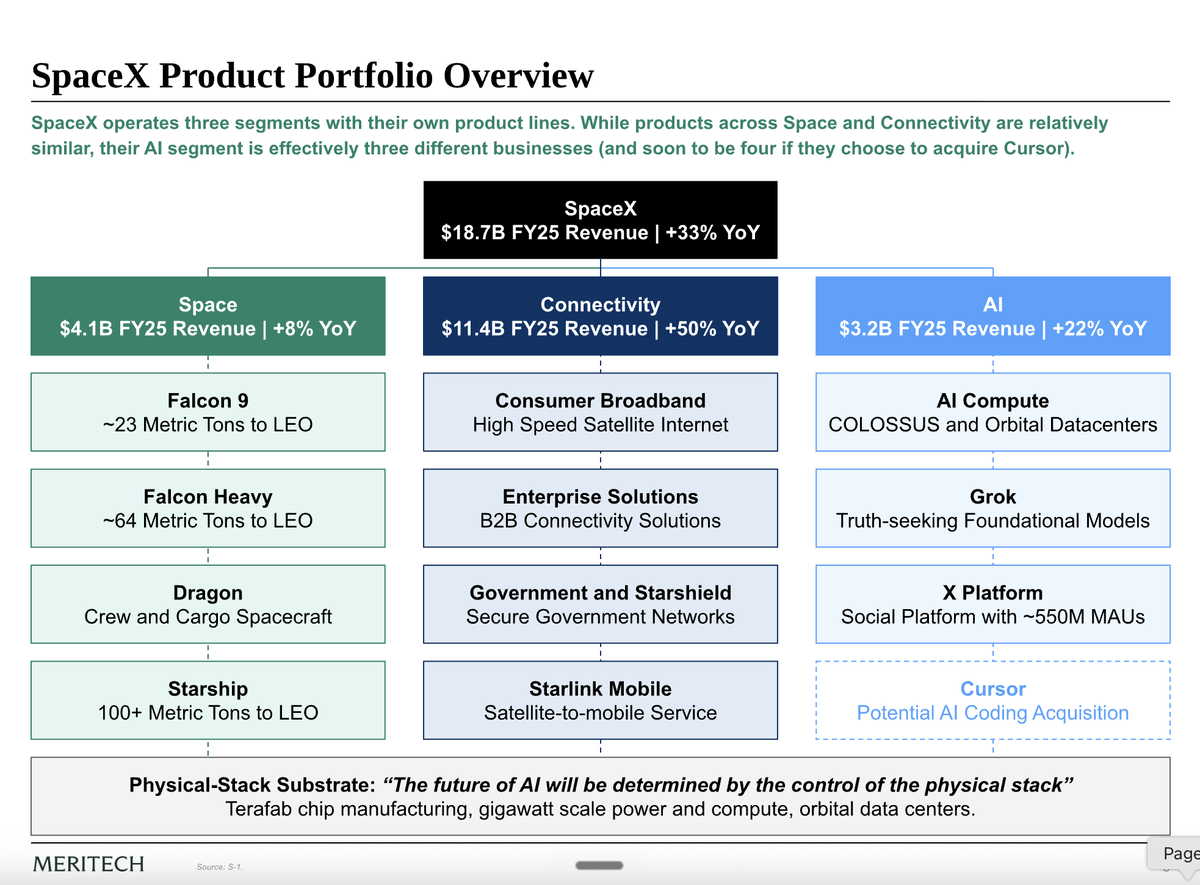
SpaceX filed its S-1 last week, and my partner @ausw2000 read all 318 pages (and made all the charts) so you don’t have to. The result: three businesses in one — Space, Connectivity (Starlink), and AI. AI is set to become the largest revenue segment within a year.
The company did $18.7B in FY25 revenue, up 33% YoY, and is reportedly expecting a $1.75T valuation that would make it a top-10 company globally.
The synergy is pretty impressive imo. SpaceX paid down xAI debt from Colossus I and II, reducing interest rates by 800bps.
AI revenue will pretty much be even with
Connectivity revenue this year, boosting valuation further.
What I'm curious about is how the rev is split between xAI and the SPV for the compute that Anthropic is renting. It'd give a good view into margins as well.
@trengriffin The section about cereal vs. airlines makes me think of the intense competition among AI companies today. It'll be interesting to see where pricing power concentrates on the stack.
Really happy to hear that Starcloud is using SpaceX for launch. Such a good name. And for all the orbital compute skeptics, they have an H100 in space today that has been used for both training and inference.
Another datapoint: Napoleon was tutored by Laplace.
Napoleon considered himself to be a “scientist in uniform” and would study physics, engineering, metallurgy, and celestial mechanics.
He would often summon Laplace to discuss physics.
Aristotle tutored Alexander the Great.
And he took over the world.
For 2,000 years, that was the deal. 1-on-1 tutoring was the cheat code, and only the royals afforded it.
Bloom proved it in 1984. 1-on-1 tutoring routinely lifts learners from the 50th percentile to the 99th.
Now with AI, you have a tutor for anything you want to learn. Quantum mechanics at 2AM. French conjugation. How the postgres query planner works. How to negotiate a term sheet. Literally everything.
The upside is that it's infinitely patient & infinitely knowledgeable. It also cost less than most of the subscriptions you will get.
Learning has never been this easy in human history. It's in fact now your fault if you are not learning something new everyday.
Marc Andreessen on what just changed:
DeepInfra has raised its $107M in Series B funding 🚀
AI is moving from training to production-scale deployment, and inference is becoming the system constraint.
DeepInfra was built for this shift — scaling high-throughput inference for open-source and agent-driven workloads. Grateful to our investors and partners, co-led by @500GlobalVC and @gharik
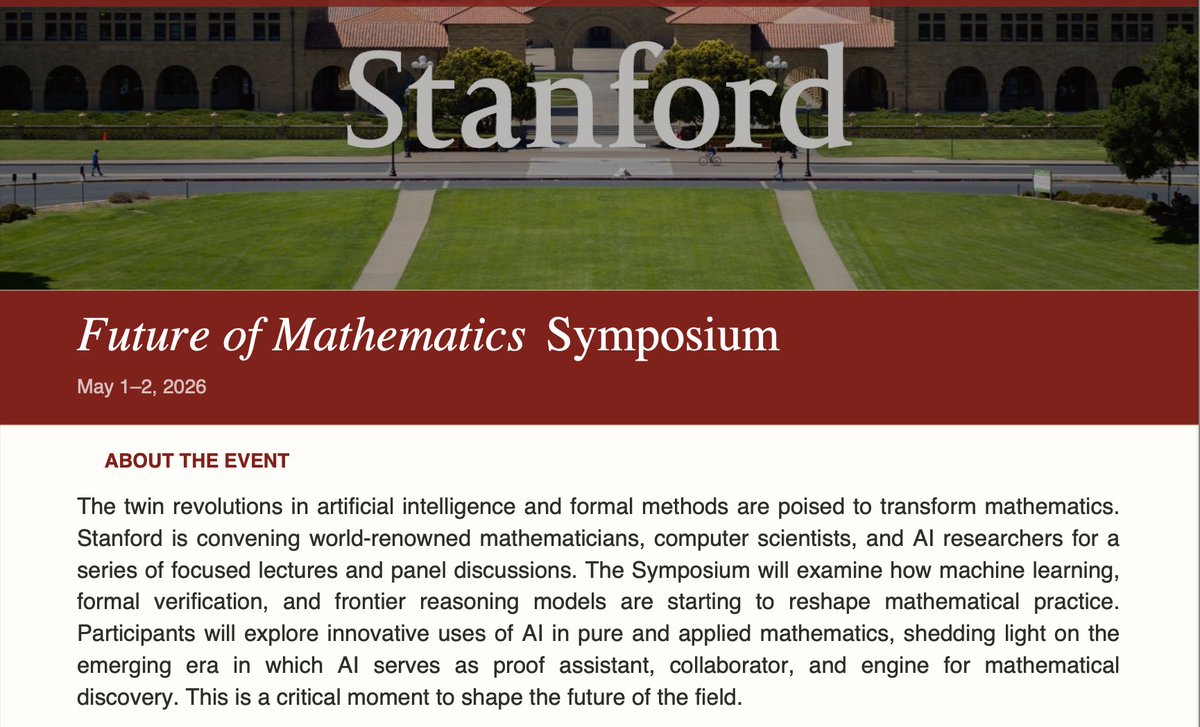
The Future of Mathematics Symposium is being held on May 1st-2nd!
We have a truly exceptional group of speakers, with multiple Fields Medalists including Terence Tao.
Tune in for livestream 9am-5pm PST (link below)