RESEARCH
5y follow up from the phase 3 KEYNOTE426 trial show that pembrolizumab + axitinib vs sunitinib as 1st line #therapy shows overall & progression free survival benefits in patients with advanced clear cell renal cell carcinoma.
#cancerresearch #clinicaltrials
https://t.co/wJMjDUXKW3
🎙️ImmunoBuddies Podcast – Manifest - the final part! Endless Potential, The Future of Predictive Biomarkers for Treatment Response and Toxicity with Dr.@ZaydTippu from @TheCrick.
Join us as Dr. Zayd Tippu explores the limitless potential of predictive biomarkers—what's next, what's needed, and what could change everything in immunotherapy.
📍Available now on Spotify, Apple Podcasts & everywhere you listen.
🔗https://t.co/nhfVzWtC2R
@AOlssonBrown@RickyFrazer1@IOClinicalNet@UKONSmember @UKAOSociety @OncologyNT@OncEd@myESMO@OncoAlert@BOPACommittee@royalmarsdenNHS@VelindreCS@MANIFEST_CIRRP
#ImmunoBuddies #PodcastEpisode #Immunotherapy #PrecisionMedicine #Biomarkers #CrickInstitute #ZaydTippu #OncologyResearch #MedicalInnovation #ManifestTheFuture
This Month, I'm doing 100 Push-ups a day to raise money for @CR_UK. Now more than ever, we need to fund the research that saves lives. Every rep and every donation counts!
https://t.co/ICLsIkmkzE
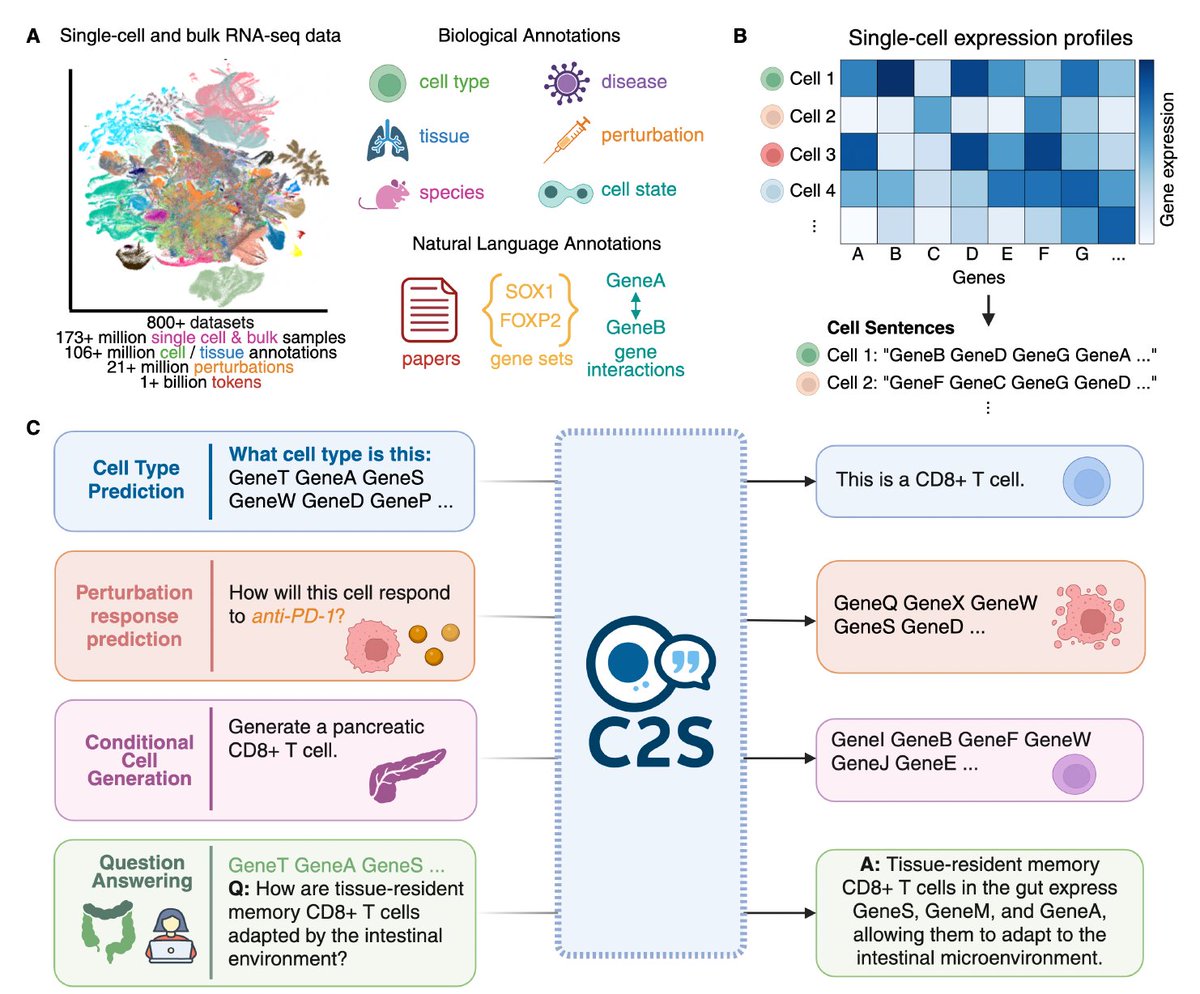
Yale and Google trained a 27B parameter model, C2S-Scale, to unify single-cell transcriptomics and biological language for deep reasoning across genes and cells. It outperforms prior models in interpretation, QA, and perturbation prediction using reinforcement learning
How does tumour heterogeneity arise? How can we predict cancer cell plasticity? In 2 studies, we trace #glioblastoma heterogeneity to a spatial cancer cell trajectory w. atlassing https://t.co/OY9T4rHYrj & predict plasticity w. snRNA/ATAC+deep learning https://t.co/AwlOHu3cq6 🧵
🚀 Thrilled to share our new paper on forecasting #IPF progression via follow-up CT generation! 🫁🖼️
We propose a lung structure & function–guided residual #diffusionmodels 🤖✨—with 2.5D #synthesis, structural attention, and #CLIP-based guidance! 📊🧬
📄https://t.co/1lceO4nTiv
📢 🧬 New preprint!
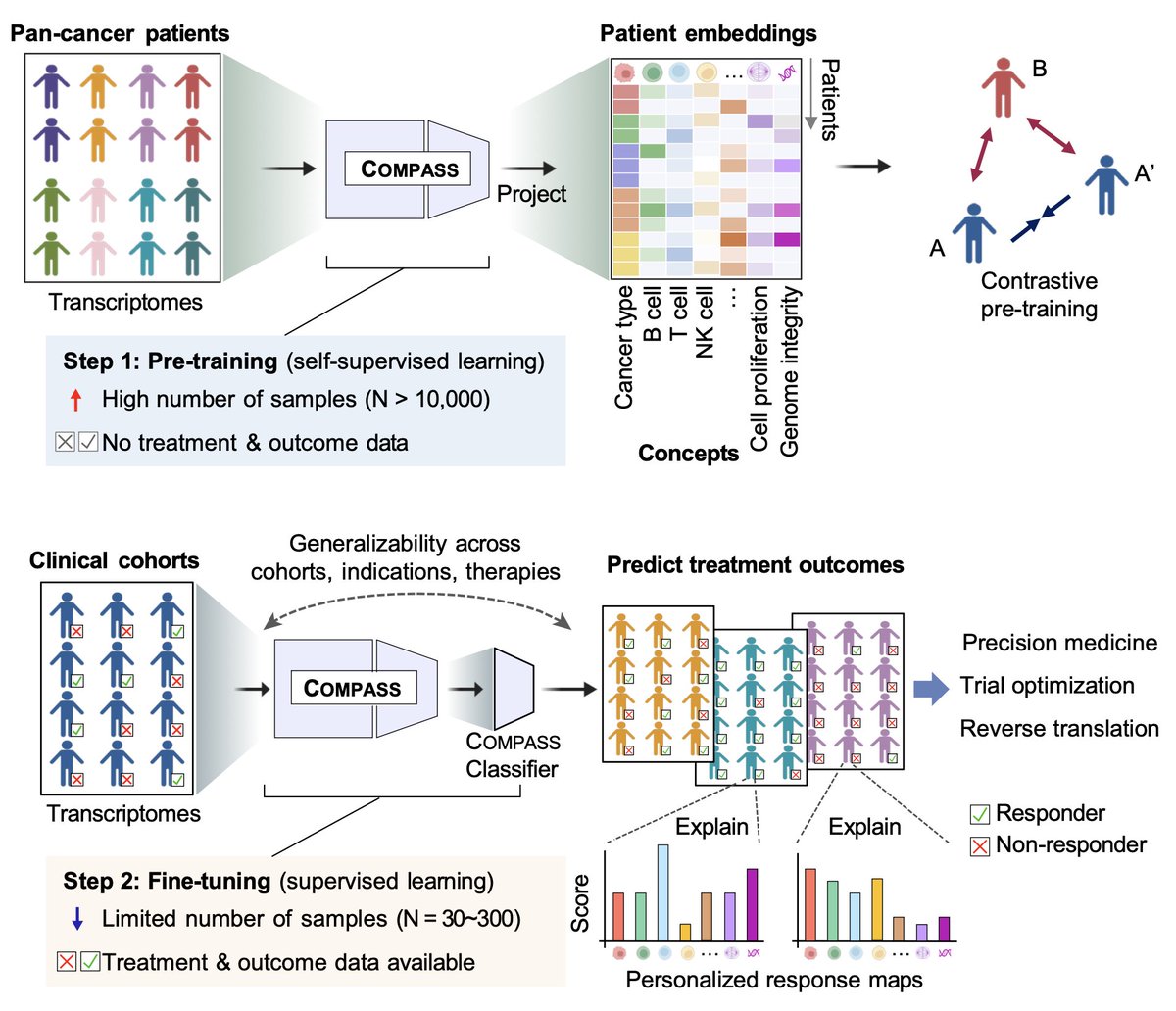
Can we predict which cancer patients will benefit, before treatment begins? @WanXiang_Shen
Immunotherapy saves lives but many patients don’t respond to treatment, and we still lack reliable tools to predict who will benefit
We introduce COMPASS, foundation AI model for immunotherapy response prediction across cancers and treatments
https://t.co/CniHfrrtCW
https://t.co/Ftty4ZfBYi
https://t.co/vFHtRYUJuh
@HarvardDBMI@harvardmed@KempnerInst@harvard_data@broadinstitute@Harvard
Thanks to incredible team @WanXiang_Shen Thinh H. Nguyen @_michellemli @YepHuang @IntaeMoon Nitya Nair Daniel Marbach
🧵👇
TranscriptFormer is a new AI model trained on millions of cells from 12 different species, spanning 1.5 billion years of evolution. It is a concise, interactive representation of this massive amount of data.
Preprint: https://t.co/X9dLDejVLL
Model: https://t.co/tCJmPUbBY8
🎉CrAIC Digital Pathology Journal Club - Thur
📜Talk: "Examining Confirmation Bias and the Role of Time Pressure During Human-AI Collaboration in Computational Pathology"
🎙️Speaker: Emely Roschbach
📆Date: 15:00 GMT 17/04
📄Paper: https://t.co/twaD9xowqV
#DigitalPathology#AI
VP-CLEM-Kit: An accessible pipeline for visual proteomics using super resolution volume correlative light and electron microscopy ... https://t.co/OxbydQPeZk #biorxiv_cellbio
🚀Exciting new review exploring the intersection of #mechanobiology & #AI!
From predicting cell forces to analyzing complex genomic data, AI is unlocking new insights into how cells respond to mechanical cues.
https://t.co/MlgGCRe7AZ